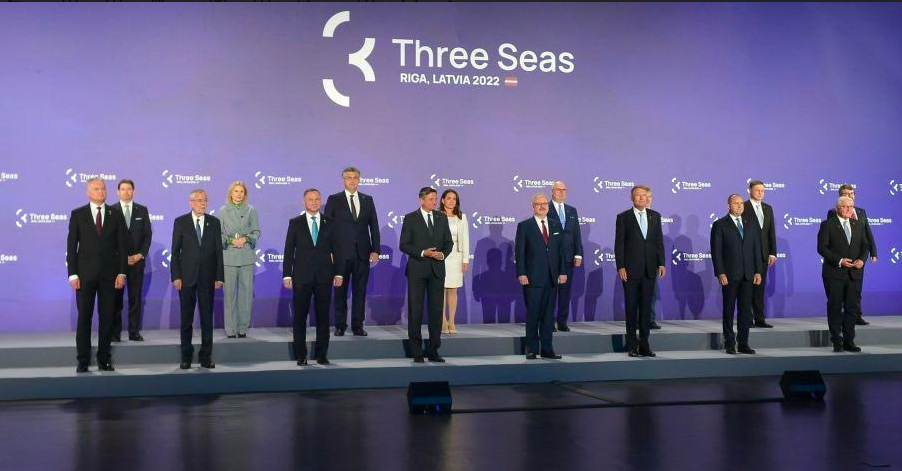
On Monday, the 20th of June, Riga was hosting the 7th summit of the Three Seas Initiative (3SI), an informal cooperation platform of twelve Central and Eastern European states (CEECs), all members of the EU.
The Riga Summit can be considered one of the most important ones since the launching of the initiative in 2015. Several important elements deserve to be evoked.
Ukraine has been granted a special partnership status with the initiative. “We awarded [the partnership status] to Ukraine today […] but we assume that the same kind of partnership can be shared by those countries that are located in Central Europe and […] are not yet members of the EU” – Polish President Andrzej Duda emphasised.
This decision followed a remote speech from Ukrainian President Volodymyr Zelenskyy, stressing the need to include Ukraine in the Initiative to “enable [the countries of the region] to realise their full economic, social potential”.
https://twitter.com/visegrad24/status/1538840189828734976?s=20&t=nCJtAqFT-vODdqPP0mo7vA
The US Development Finance Agency (DFC) also announced its willingness to support the Three Seas Fund with USD 300 million for various energy infrastructure projects. Likewise, another investment under the Fund has been announced in the Bulgarian port of Burgas.
On its official Facebook page, Instytut Nowej Europy mentions the “interesting presence of the Japanese Bank of International Cooperation” which “shows the growing interest in the initiative not only in Europe”.
The President of the BGK bank and the President of the 3SI Fund, Beata Daszyńska-Muzyczka, said that the summit was an opportunity to talk about the development of the region’s infrastructure.
“We need to increase investment in the logistics, energy, and digital infrastructure of the Three Seas region. The current needs in these three sectors amount to as much as EUR 650 billion – this is what is needed to match the infrastructure of Western Europe„, she explained, referring to the prospect of economic convergence between the East and the West of the continent.
The 3SI was lauched on the initiative of Poland and Croatia in 2015. It includes members of the Visegrad Group (Poland, the Czech Republic, Slovakia, Hungary), Romania, Bulgaria, Austria, Croatia, Slovenia, and the Baltic States (Estonia, Latvia, Lithuania). The name of the initiative refers to the geographical space located between the Adriatic Sea, the Black Sea, and the Baltic Sea.
The initiative focuses on the development of transport and communication infrastructure, energy, transfer of raw materials (gas and oil), and digitisation. The region is a large and rapidly growing market, and one of its goals is to stimulate economic cooperation between these twelve countries.
It also aims to include this group of states in the process of European integration as active creators, and not only as passive recipients of ideas and projects conceived within the founding core of the western EU.
Another key objective of the initiative is to smooth out the differences in the number and quality of infrastructure between the western and eastern parts of the EU. These include the construction of road and rail infrastructure, pipelines, ports, and various energy supplies.
This group of countries represents nearly a quarter of the total population of the EU (114 million inhabitants) and nearly 30% of its territory.
Image: TVP World
Author: Sébastien Meuwissen