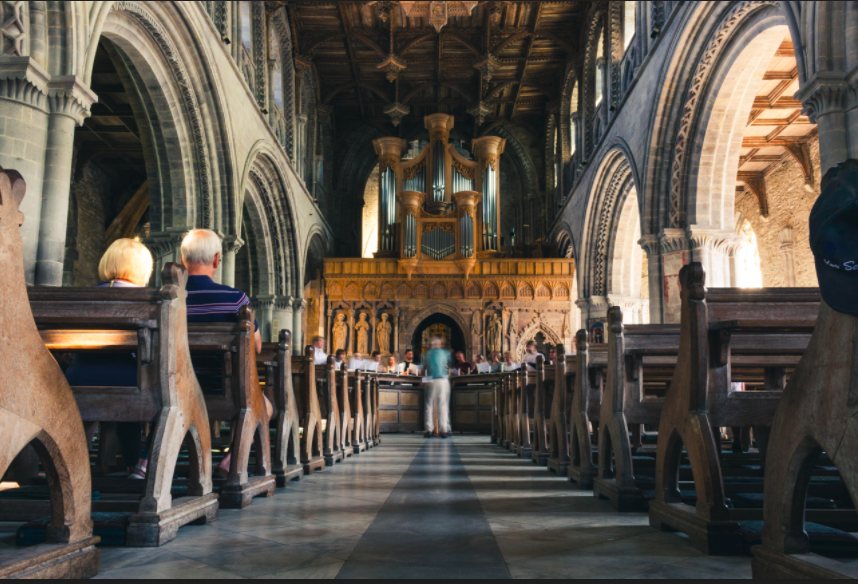
The 2021 census revealed that less than half of the population of England and Wales describes itself as Christian. It shows that the number of Christians has dropped by 17% (5.5 million) in the last ten years.
“We have left behind the era when many people almost automatically identified as Christian” – the archbishop of York, Stephen Cottrell, told the Guardian, when asked to comment on the results of the survey. The results actually paint a picture of populations that have moved away not only from Christianity but from religion as a whole. People were not asked to specify whether they belonged to any specific church.
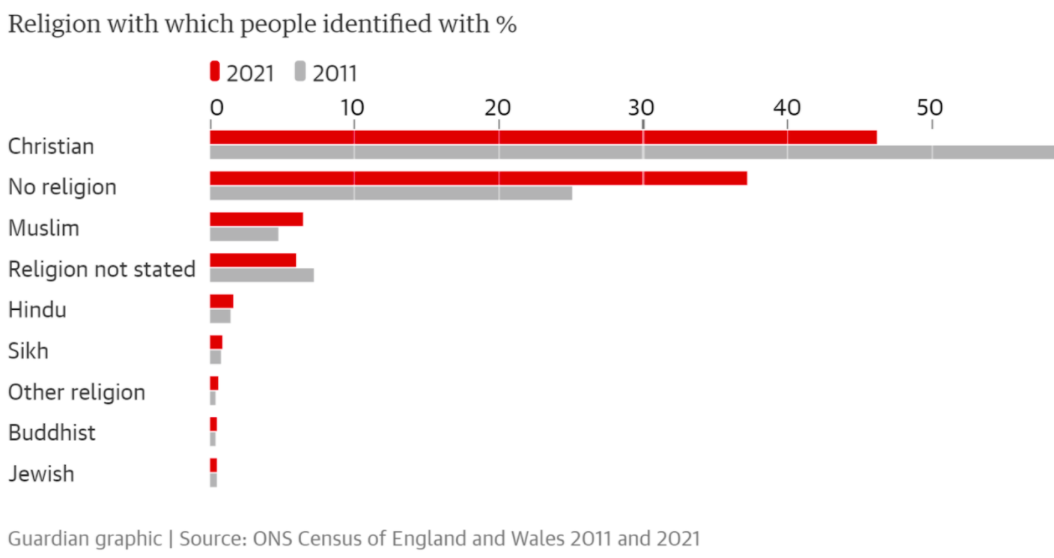
In the meantime, the Muslim population in England and Wales has risen by nearly 2%, bringing it to near 4 million. This represents a quite striking increase by 43% (1.2 million) in a decade. It’s worth mentioning that the proportion of people reporting “no religion” augmented by nearly 15% since the beginning of the 21st century.
The Guardian conducted research in order to find some correlation between a certain type of population in a given area and the expected answers when it comes to religious affiliation. Without generalising, it was concluded that the more White is a given population happens to be, the most likely it is to identify as “non-religious.”
In Wales, the highest numbers of people stating to have no religion were, Blaenau Gwent, Caerphilly and Rhondda Cynon Taf. In England, it was Brighton and Hove and Norwich. The aforementioned cities have the particularity of being predominantly White.
In turn, the places presenting the lowest figures when it comes to atheists were Slough, Harrow, Redbridge where almost two-thirds of the populations descend from ethnic minorities.
As of 2021, almost 82% of the population of England and Wales was White (against 86% in 2011), including non-Brits. The remaining minorities amount to less than 3% of the population.
It also turns out that Leicester and Birmingham have become the first British cities presenting so-called “minority majorities”. ONS data illustrates this transformation well. It reveals that almost 6 out of 10 Leicester residents are now from ethnic minority groups, compared with 1 in 4 in the early 1990s.
Image: Unsplash
Author: Sébastien Meuwissen