The wounds of World War II and the German occupation continue to fester as the call for reparations grows louder. However, Berlin’s steadfast denial only deepens the historical wounds, leaving these nations to grapple with the consequences of a painful past.
The German occupation of Greece and Poland during World War II left lasting scars on these nations, with devastating consequences that extend far beyond the war’s end. From financial ruin to the decimation of ancient Jewish communities, the atrocities committed by the Germans demand recognition and reparations. While some argue that Germany should pay for its wartime actions, Berlin has chosen to play hardball, ignoring the pleas for restitution. As the push for justice gains momentum, a comprehensive reckoning with history is essential.
„The Spectactor” highlights that, in distinction to many neighbouring nations, but like Greece, the Polish government did not engage in collaboration with either the Nazis or the Soviets, yet it suffered immensely from their occupations, resulting in the deaths of nearly six million Poles. From 2017 to 2022, the Polish government conducted extensive research on the impact of World War II on Poland’s development, producing the most comprehensive study of its kind. This research will serve as a blueprint for addressing Ukraine’s grievances in the future. The report revealed that the occupation’s material cost alone amounted to a trillion pounds, not to mention the immeasurable loss of human potential.
At the recent conference held near the Parthenon, lawyers convened to discuss the urgent need for Greece and Poland to receive the reparations they deserve. Former Greek President Prokopis Pavlopoulos passionately voiced his belief that Germany should be held accountable for its actions. He aptly stated, „A lesson unheard cannot be unlearned”, emphasising the importance of confronting the past to forge a better future.
Although Berlin has often taken an active role in international debates, including discussions on Brexit and beef, it has noticeably adopted a quieter stance on this uncomfortable issue. The question arises as to how much longer Germany can overlook the pleas for payment and continue to evade its responsibilities.
Even excluding the territories lost to the Soviet Union, the conservative estimate of damages inflicted on Poland’s „Core Lands” is significant. In April, Poland’s council of ministers passed a resolution affirming that the country never received reparations from Germany for their brutal occupation. While German ministers insist the matter is settled, their attempt to close the chapter on this issue stems from a misguided interpretation of history. Poland has not renounced its claims for reparations nor received compensation.
„The Spectactor” writes that critics who argue that Germany’s territorial concessions to Poland in 1945 were sufficient recompense for the war’s horrors overlook the larger context. The land transfers agreed upon during the Yalta, Tehran, and Potsdam conferences were meant to partially compensate for territories taken from Poland by the USSR in Lithuania, Belarus, and Ukraine. Poland was absent during these talks, and the land swap was a thinly veiled ploy by Stalin to further isolate the West from Moscow’s sphere of influence. Any honest historian would find it difficult to regard this as a fair resolution to Poland’s immense suffering.
Germany’s response to the reparations claims has been disappointing as it attempts to close the book on this chapter of history. However, such a stance disregards the country’s own previous actions regarding reparations. In the past, Germany has provided compensation to Nazi-era slave labourers, including thousands of Poles. It has also allocated billions of dollars in reparations to Holocaust victims, totalling around $86.8 billion (£68 billion), and similar isolated schemes had gone ahead in the 1970s and 1990s. In 2021, they also pledged €1.1 billion (£940 million) in development projects to its ex-colony Namibia, where it oversaw genocide and forced experimentation. Therefore, Germany’s assertion that Jewish victims deserve greater compensation than Polish victims is baseless and disregards the fact that many Holocaust victims and their families have not received adequate recompense due to Germany’s mishandling of relations with Warsaw. The denial of reparations to Poland and Greece, therefore, represents a troubling inconsistency and a failure to acknowledge historical truths.
Above all, this ongoing saga reveals that Berlin continues to deny its full responsibility for the atrocities of the twentieth century. It was only in 2020 that Germany finally approved plans to construct a memorial for Polish victims of German aggression. Poles have not forgotten that many of their historical artworks still hang in German galleries, looted by the Germans. This does not bode well for an already troubled continent.
Although there is no established plan to settle these claims, a Polish delegation intends to engage with Jewish groups in Washington, signalling progress towards ensuring fair compensation for Jewish victims and their families from future German reparations.
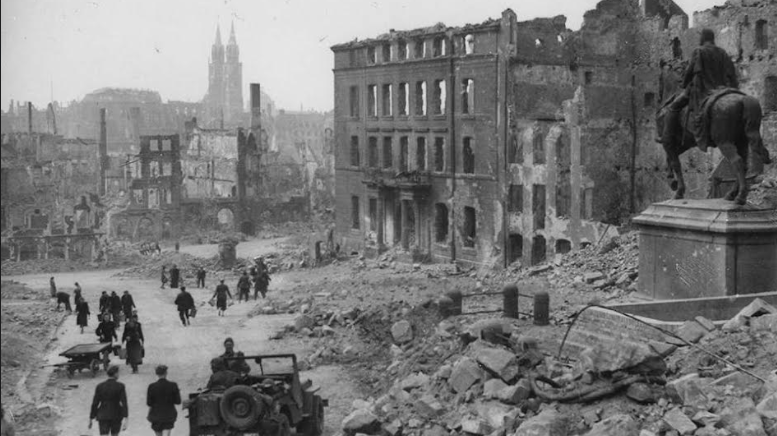
The conference concluded with a poignant moment, featuring a short CGI reconstruction of the devastated streets of Warsaw in the spring of 1945. The images highlighted the city’s broken bridges and the staggering loss of its population. These haunting memories are etched in the minds of many Poles and others worldwide who still wake from nightmares of these horrors. These deep wounds of memory affect most Polish families in some way, and they have every right to seek rectification. It is worth noting that Germany only ceased paying reparations to France for its 1914 invasion in 2010. So, „why is it too late for Poland? „ – „The Spectactor” asks.
In the words of Pavlopoulos, „The ball is now firmly in the court of Berlin and its international chums to take action.” The time to act is now.
Author: Patrycja Bodzek-Kurzyńska
Photo: Courtesy of the National Archives and Records Administration, 540139