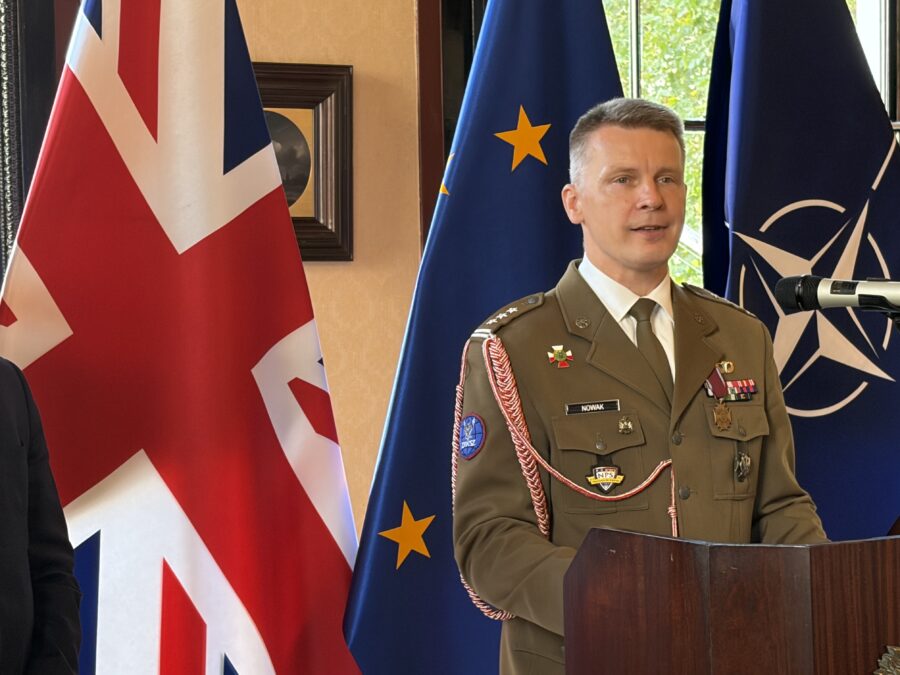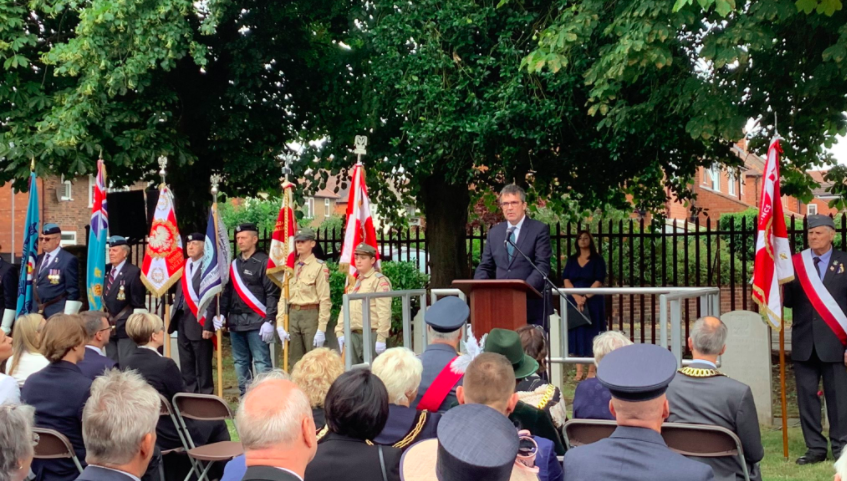
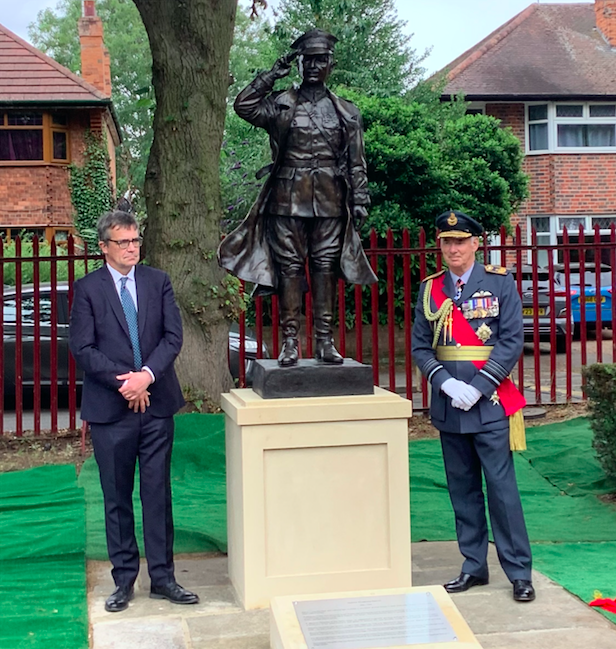
The Polish Ambassador to the UK, Professor Piotr Wilczek, spoke at the unveiling of the life-sized bronze statue of General Władysław Sikorski, the Commander-in-Chief of the Polish Army and Prime Minister of the Polish Government-in-Exile. The event took place at Newark Cemetery and was organised by the Polish Cultural Institute in London and Newark and Sherwood District Council.
Ambassador Piotr Wilczek and Air Chief Marshal Sir Andrew Pulford, have unveiled the statue of General Władysław Sikorski at Newark Cemetery on the 80th anniversary of his tragic death. He was buried there alongside 200 Polish airmen who lost their lives fighting „For Our Freedom and Yours” and contributing to the Allied victory.
Below is the entire text of the speech.
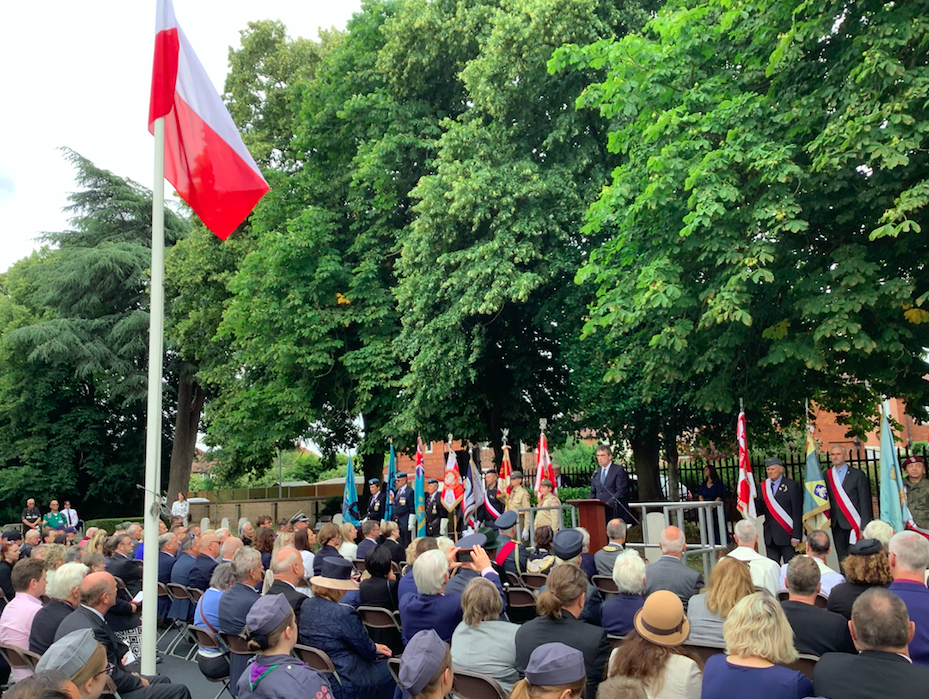
„Ladies and gentlemen,
We are gathered here today to remember and reflect upon the extraordinary life and tragic death of General Władysław Sikorski, a remarkable figure in Polish history. General Sikorski, one of the most outstanding Polish statesmen of the 20th century, dedicated his life to the pursuit of freedom and independence for his beloved homeland.
From his early days, serving in the Austrian army during Poland’s partition, to his involvement in underground independence activities and his leadership in the Polish Legions, General Sikorski demonstrated unwavering determination and political acumen. He played a pivotal role in creating a modern, unified armed force and preventing a civil war during a time of deep crisis.
When World War II engulfed Europe, General Sikorski emerged as a beacon of hope for millions of Poles. As Prime Minister and Commander-in-Chief of the Polish Armed Forces, he led his countrymen in battles fought in France, Norway, and Poland itself. Under his guidance, the Polish Victory Service transformed into the Union of Armed Struggle, laying the foundation for the future Home Army.
In London, General Sikorski tirelessly fought for the Polish cause, forging a strong Polish-British alliance. He was a steadfast advocate for the Polish army, and the Polish airmen’s significant contribution to the Battle of Britain stands as a testament to his visionary leadership.
General Sikorski’s achievements extended beyond the battlefield. Through agreements with the USSR, he facilitated the departure of thousands of Polish soldiers from Soviet Russia to join the fight against occupying forces. Additionally, he played a pivotal role in the creation of the Home Army, the largest and best-organized underground army in occupied Europe.
However, it was on that fateful day of 4 July 1943 in Gibraltar that General Sikorski’s life was tragically cut short. The plane crash that claimed his life, along with the lives of his daughter and colleagues, remains a haunting mystery to this day. The Gibraltar disaster marked a profound loss for Poland and robbed the world of a great statesman.
General Sikorski’s legacy endures, etched in the hearts and minds of his countrymen. His ashes now rest at Wawel Hill, alongside Poland’s greatest national heroes. His unwavering commitment to Allied unity, as expressed in one of his final speeches, continues to inspire contemporary Polish politics.
Let us remember General Sikorski’s indomitable spirit, his dedication to the cause of freedom, and his unwavering belief in a better future for Poland. May his memory serve as a constant reminder of the enduring power of courage and determination.
Thank you.”
Photos: British Poles