Those factors that were once Poland’s weakness, and which led to its collapse at the end of the 18th century – the Poles’ strong individualism, their attachment to individual freedoms, and their weak state structures – are contributing in modern Europe to the rapid and stable development of its economy.
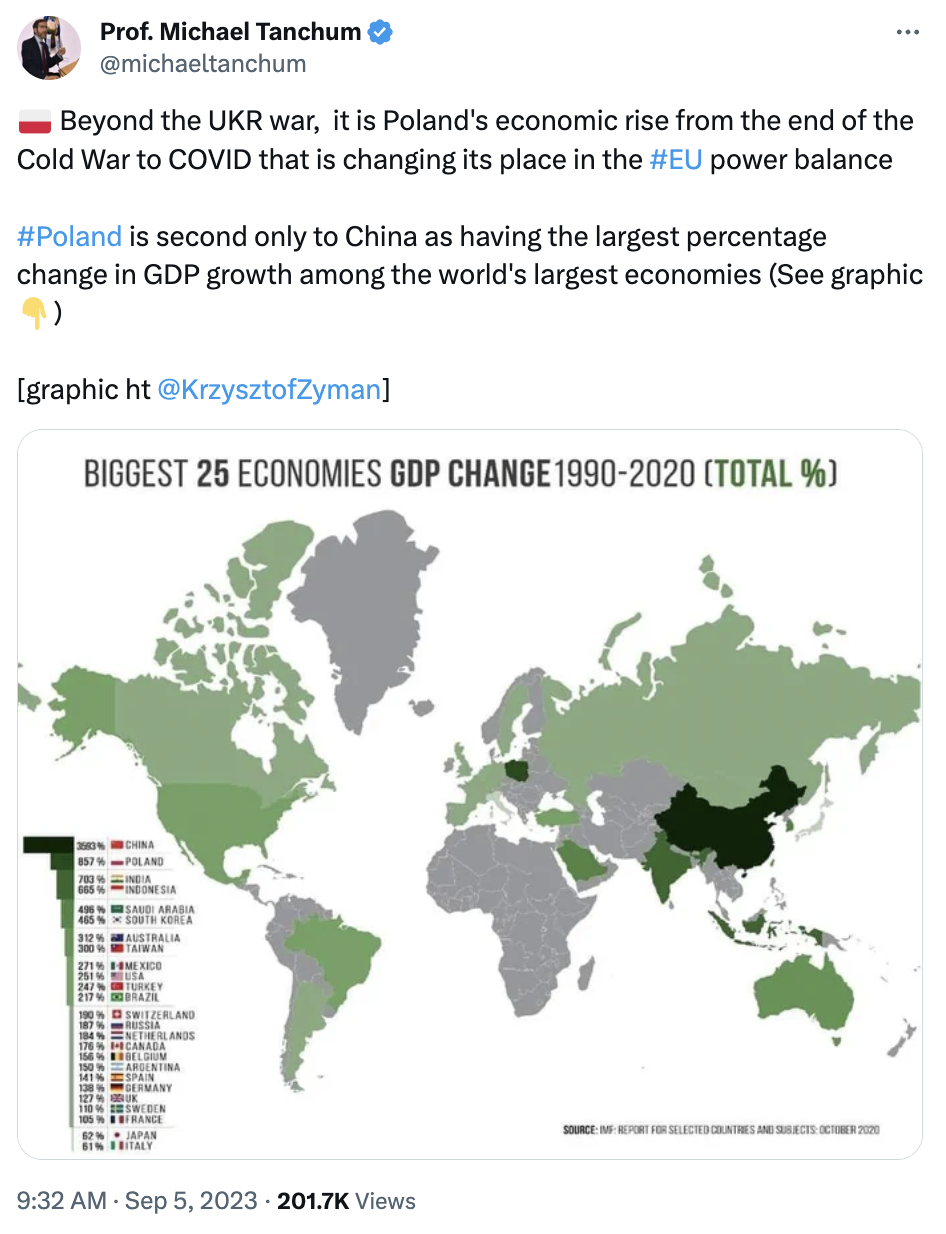
“Beyond the Ukrainian war, it is Poland’s economic rise from the end of the Cold War to COVID that is changing its place in the EU power balance. Poland is second only to China as having the largest percentage change in GDP growth among the world’s largest economies.”
This post was published on X (formerly Twitter) on September 5 by Professor Michael Tanchum, an American expert in international affairs, geopolitics, and economic policy affiliated with Harvard University. He illustrated his message with a world map showing data from the International Monetary Fund (IMF) about the economic growth of the world’s 25 largest economies between 1990 and 2020. China recorded the highest growth during that period (+3583%), followed by Poland, with +857%.
Next are four Asian countries: India (+703%), Indonesia (+665%), Saudi Arabia (+496%), and South Korea (+465%). The second European country in this ranking of the world’s 25 largest economies, in terms of economic growth between 1990 and 2020, is Switzerland, which comes far behind Poland with a growth of 190%. Russia ranks just behind Switzerland, its GDP having increased 187% over that period.
Poland now has the 21st largest economy in the world in terms of nominal GDP calculated in U.S. dollars, and is gradually catching up with Switzerland. But if IMF forecasts come true, it should first overtake the Turkish economy in the very near future.
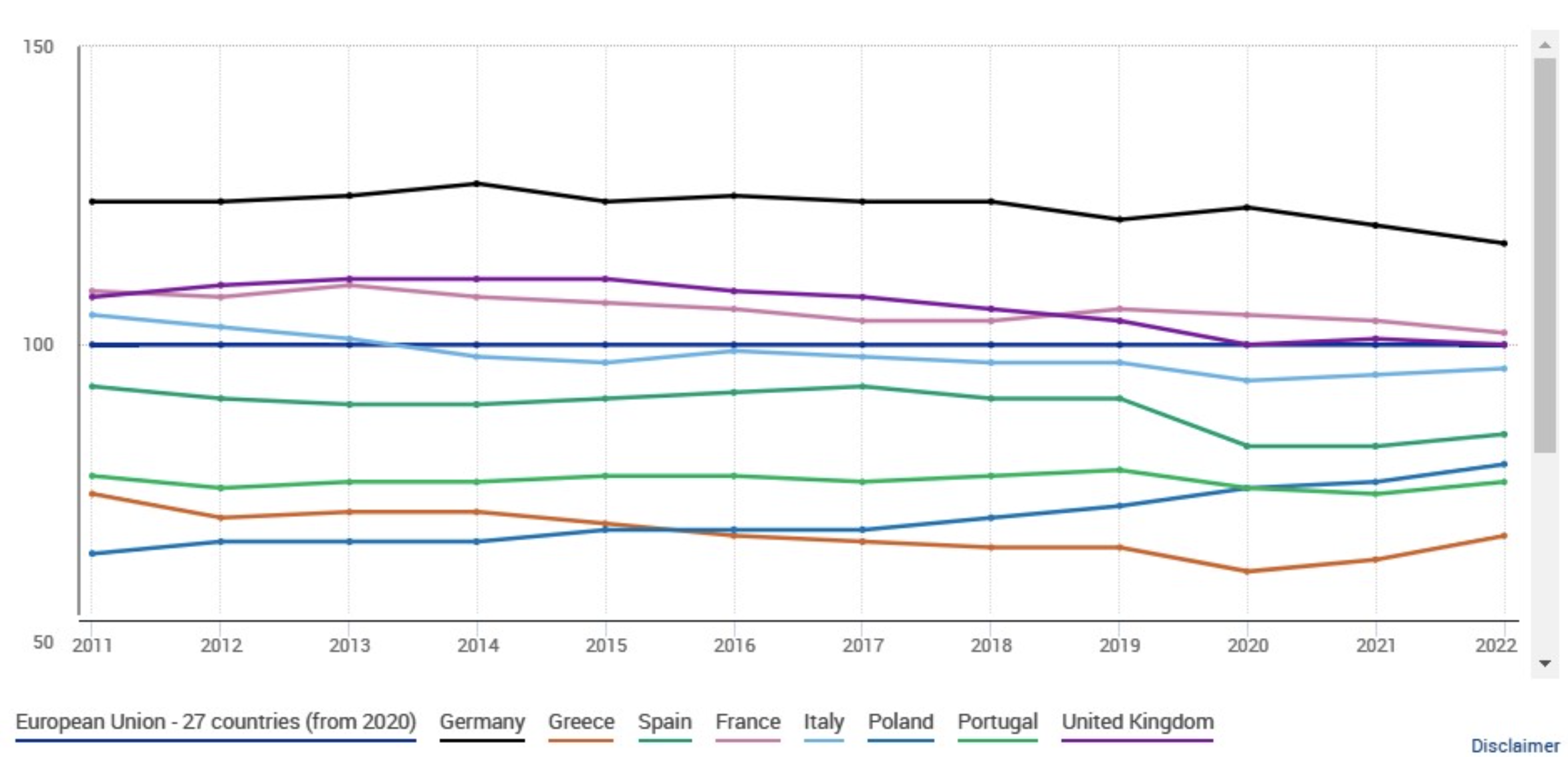
Poland’s economic development is also quite clear if we trace the change in the average purchasing power of a resident of this country against the European Union’s average, even if we only look at the last decade.
In 2011, Poland’s GDP per capita calculated in purchasing power parity – or purchasing power standards (PPS) – was 65% of the average of today’s EU-27 (i.e. without Britain, which left the EU in 2020). By 2022, Poland’s PPS per capita was 80% of the EU-27 average. During the past decade, Poland overtook Greece in 2015 and Portugal in 2020 in purchasing power standard (PPS) terms, i.e. in real wealth. In a few years it should also overtake Spain, whose GDP per capita calculated at purchasing power parity is now 86% of the EU-27 average (down from 93% in 2011).
According to IMF data, Poland’s GDP per capita when calculated in terms of purchasing power parity was still only 51.6% of the EU average in 2004, the year Poland joined the European Union, and will reach 86% in 2028.

Poland’s economic rise has not gone unnoticed
Poland’s economic strength has been drawing increased attention abroad of late, as evidenced by articles published in the European press: “Poland will be wealthier than Britain by 2030 – it’s time we took notice” (The Telegraph, May 7, 2023); “Poland’s formidable rise won’t be tempered by election hostility – Surging GDP per capita has made it Europe’s one real economic success” (The Telegraph, October 14, 2023); “How Poland is vying to steal Germany’s crown as the industrial heartland of Europe – As the G7 powerhouse loses steam, its eastern neighbour is going from strength to strength” (The Telegraph, October 9, 2023); “Poland has changed beyond recognition – and so has its place in Europe’s pecking order” (The Guardian, April 25, 2023); “Press: Poland among the fastest growing countries”(Deutsche Welle, May 19, 2023); “Europe’s true growth star – Over the last 30 years, Poland’s economy has caught up without anyone noticing. In terms of prosperity, our neighbor is getting ever closer to Germany” (Die Welt, October 19, 2023); “Economic boom in Poland: Will the German economy be overtaken by 2040?” (Telepolis, July 18, 2023); “Poland transformed by thirty years of economic miracle”(Les Échos, 13.10.2023); “Poland’s economic miracle: How it has become one of Europe’s export locomotives’” (elEconomista.es, June 30, 2023); “EU, Poland challenges German leadership” (Euractiv Italia, March 13, 2023, about Poland’s growing role as a regional energy hub) – and so on, and so on.
As noted by the author of the above-mentioned article from the British newspaper The Telegraph which was published last October with the title “How Poland is vying to steal Germany’s crown as the industrial heartland of Europe,” one of the features of Poland’s economic transformation is the growing share of industry in its GDP, in contrast to what is happening in most European countries, which are suffering from a process of deindustrialization.
“Germany’s manufacturing industry shrunk from 20.3pc of economic output to 18.5pc in the decade to 2022. Poland, meanwhile, saw its factory output grow from 16.7pc of GDP to 17.7pc over the same period,” Matt Oliver writes in The Telegraph.
In fact, during the period discussed Poland was the only country in the European Union where the share of industry in the economy, when calculated both in relation to GDP and in terms of total value added, increased. If we look at the share of industry in the total value added created by the Polish economy, it was 27.6% in 2022. In 2016, for example, it was 25.9%, which shows that the upward trend has continued in recent years. Poland’s share in the total value of industrial goods sold in the entire EU is currently 6%, which places Polish industry in fifth place, ahead of the Netherlands (4%) and after Germany (26%), Italy (19%), France (11%), and Spain (8%).

The geopolitical consequences of decades of sustained economic growth
To understand how 30 years of uninterrupted growth – with the exception of the first year of Covid, 2020, when Poland in fact had one of the smallest recessions in the entire EU regardless – can change the balance of power in Europe in the long run, it is worth comparing the evolution of GDP and per capita income expressed in U.S. dollars for Poland with that of its two big neighbors, against which it has had to defend itself for centuries: Russia and Germany.
In 1990, when Poland regained full independence from Moscow, getting rid of its communist dictatorship and opening its economy to the free market, Poland’s GDP was $65.98 billion. Last year, Poland’s GDP reached $688.18 billion. During the same period, Russia’s GDP increased from $516.81 billion to $2,240.42 billion, and Germany’s GDP increased from $1,171.67 to $4,072.19 billion. This means that, while a little over three decades ago Poland’s economy expressed in USD was equivalent to 12.77% of Russia’s and 5.63% of Germany’s, last year the proportions were 30.72% and 16.90%, respectively.
And in terms of per capita income in U.S. dollars, the average Pole, with an income of $1,731, was twice as poor as the average Russian and well over ten times poorer than the average German in 1990. Last year, by contrast, with an income of $18,321, the average Pole was one-fifth wealthier than the average Russian and less than three times poorer than the average German.

In recent years, under the Law and Justice (PiS) government, economic development has been accompanied by an increase in Poland’s military weight vis-à-vis its neighbors, an increase that underwent a sharp acceleration after Russia’s attack on Ukraine. It is worth noting that Poland is the only country on NATO’s eastern flank that borders both Ukraine and Russia. But regardless of current circumstances, isn’t the modernization of the Polish armed forces and the increase in their potential vis-à-vis Russia’s a natural consequence of this change in the balance of economic power?
Those rating agencies, international organizations, and economic journalists who, over the past decade, have highlighted Poland’s remarkable, long-lasting economic dynamism – even during the great financial crisis of the late 2000s, Poland was the only EU country to record economic growth – often explain this phenomenon in terms of certain strengths of Polish society.
(…)
Read the full article here.
Olivier Bault
Photo: iStock