
Recent data published by Eurostat reveal how well Poland has been doing lately, economically speaking.
In 2020, Poland’s GDP contracted by merely 3.5% despite the pandemic. That is significantly lower than the OECD average, which was 5.5%. It is worth noting that in the meantime, this figure stood at almost 10% in the UK!
In 2022, Poland’s GDP per capita reached 79% of the EU average. In other words, that is no big deal if we are talking about the 27 member states. However, once we look at the situation from a global point of view, it turns out that the Polish economy scores well and continues to thrive.
Poland’s GDP per capita at purchasing power parity amounted to about 210% of the world’s average as of 2022. Estimations by the World Bank reveal that Poland was then ranked 38th out of 189 in the list of the richest countries on the globe. The World Bank also points out that several countries that overtook Poland last year ago in terms of GDP per capita happen to be so-called tax havens (such as Ireland, Luxembourg, San Marino, …) or that their territory was located on oil or gas (Saudi Arabia, Bahrain, Kuwait, …).
The Polish economy has been catching up with wealthier countries at a remarkable pace in the last three decades. When the oldest Eurostat data concerning this period were published back in 1995, Poland was among the poorest countries in Europe. Its GDP per capita expressed in purchasing power parity did not exceed 45% based on the average calculated for the 27 countries that belonged to the EU in 2020. Only the Baltic States and Romania scored worse at the time. As it was noted by the Guardian in an article Anna Gromada, the 13:1 GDP per capita gap between Poland and soon-to-be united Germany was twice that between the US and Mexico in 1989.
We often use indicators such as GDP or GDP per capita to assess a given country’s wealth, as they are the most popular ones. Another somewhat less-known one is the AIC (actual individual consumption) per capita, which focuses on comparing price levels between countries. The AIC per capita calculates the amount of goods consumed by a household living in a given country. It takes into account not solely what consumers buy directly with their earnings, but also the consumption of goods and services allocated by the government. These include health care and education.
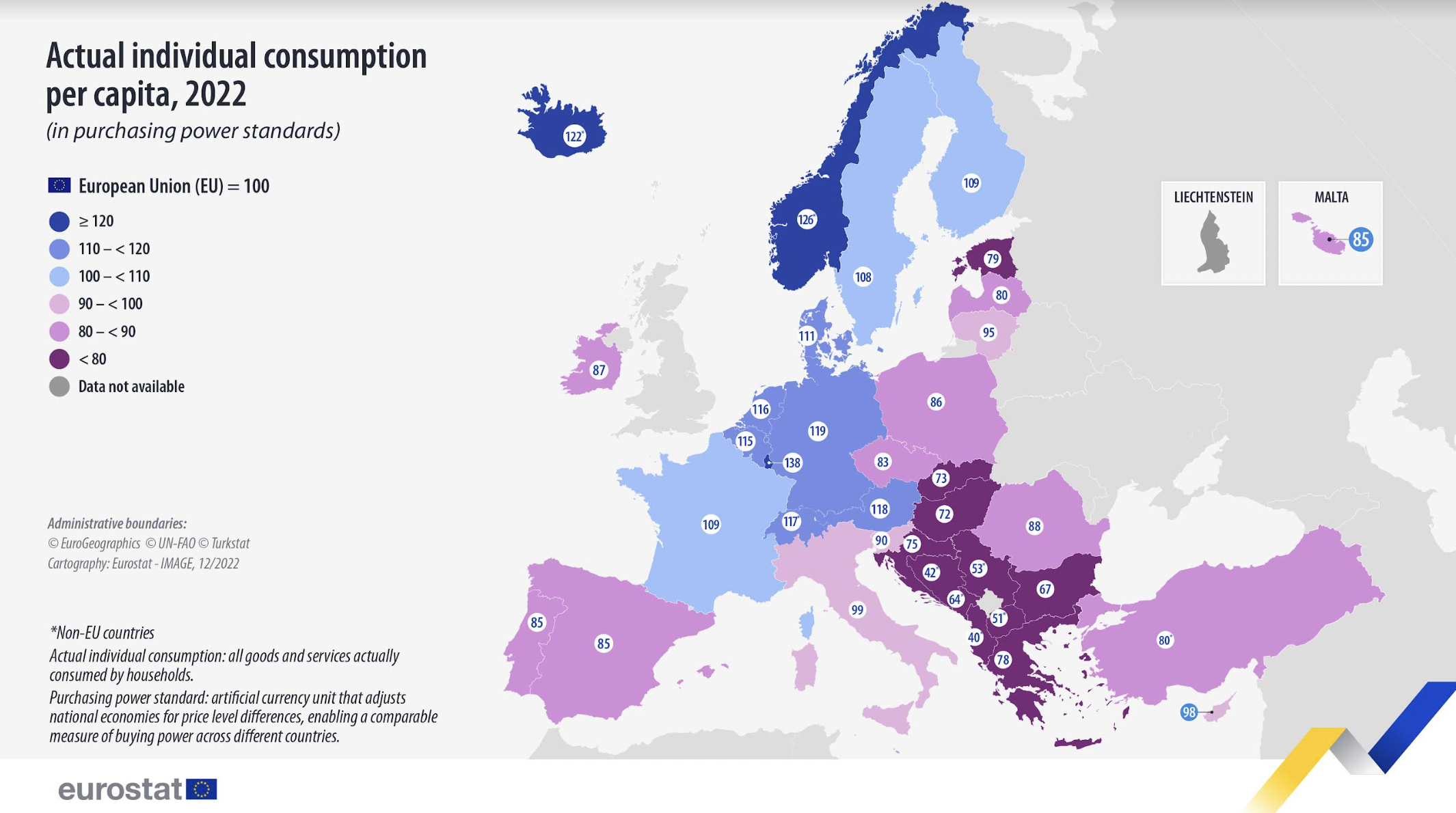
When such criteria are taken into account, Poland scores even better than in the other categories. In 2022, the level of Poland’s AIC per capita in amounted to 87% of the EU average. In 2023, Poland caught up with Portugal and Slovenia. It also overtook Spain and Czechia in this way of c calculating the well-being of households.
Image: Unsplash
Author: Sébastien Meuwissen