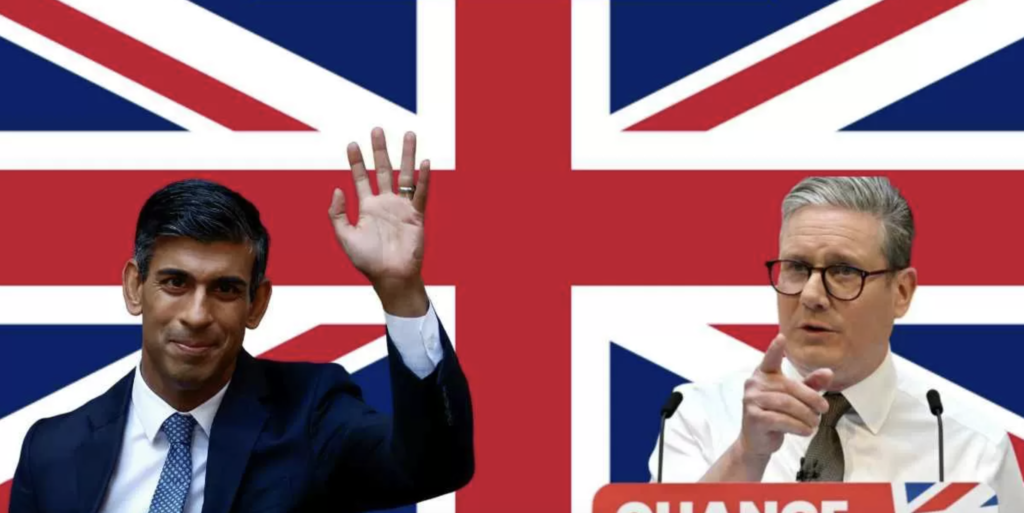
After 14 years of opposition the Labour Party will now form a government in the United Kingdom. The parliamentary election left the political stage in Britain with significant changes – reducing the list of Conservative Party MPs to more than half of its number. The clear winner is the Labour party with 412 seats in the house of commons, almost doubling its 2019 results. It is the worst election result for the Conservative Party since its establishment in 1832.
The commentators agree that Prime Minister Rishi Sunak’s decision to call elections as early as July, instead of – as widely expected – October or November, turned out to be disastrous for the Conservative Party. Sunak announced the election date just after a series of good economic results had been reported, hoping to make the rebounding economy a campaign theme, but this failed – partly also due to his personal mistakes. On 22 May, when Sunak called the election, forecasts suggested that the Conservatives could count on 155 seats. As a result PM Sunak decided to abandon the leadership in the party. He congratulated to Keir Starmer who will now replace him as the country’s Prime Minister.
Unfortunately a Polish-born Conservative MP Daniel Kawczyński was unable to keep his mandate.
The list of key right-wing politicians who will not return to the House of Commons is longer. Grant Shapps, the last Defence Minister, has also lost his seat. Alex Chalk, the former justice minister, will not become a MP. Douglas Ross, leader of the Scottish branch of the Tories, will also remain outside the House of Commons.
Among the winners is the right-wing Reform UK party, headed by pro-Brexit leader Nigel Farage. The party won 13 seats, which is even better than the pre-election forecasts. Support for the party is fairly evenly spread, but there are few constituencies where its candidates have realistically had a chance of winning. So far Reform UK has only had one MP, Lee Anderson, who was not elected as the party’s candidate but as a member of the Conservative Party, and changed his party affiliation in March this year.
The Liberal Democrats won 71 seats in the House of Commons.
The Scottish National Party (SNP) also noted unsatisfying score. The party which has governed in Scotland continuously since 2007, won only 10 of Scotland’s 57 seats. This is the SNP’s worst result in a House of Commons election since 2010.
Tomasz Modrzejewski