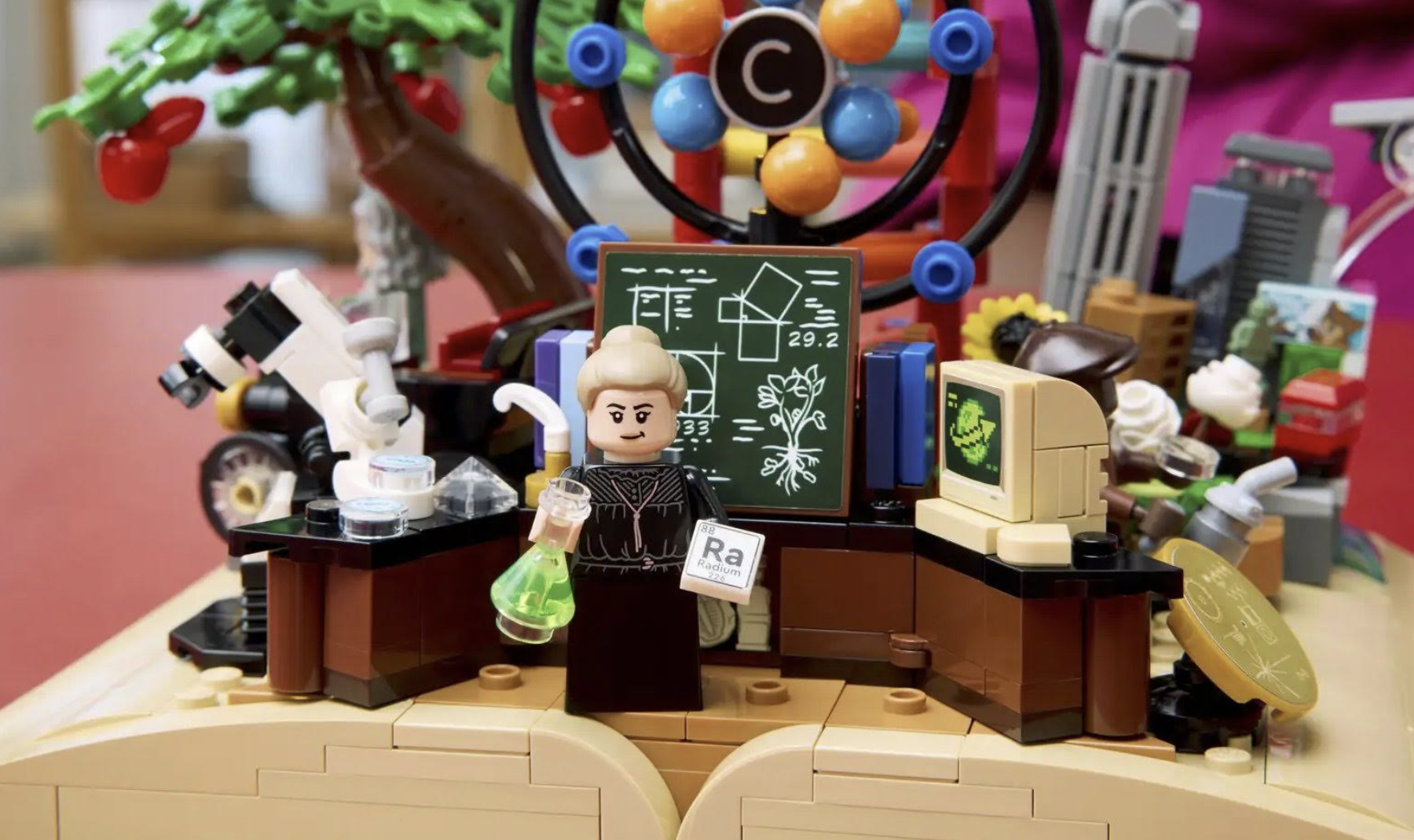
The Lego group decided to correct the description of their new set commemorating famous scientists including Maria Skłodowska-Curie. Before the change, they used only the French part of Maria’s surname and one she received from her French husband. The British Poles were one of the media that wrote about the mistake and called on Lego to correct their product’s description.
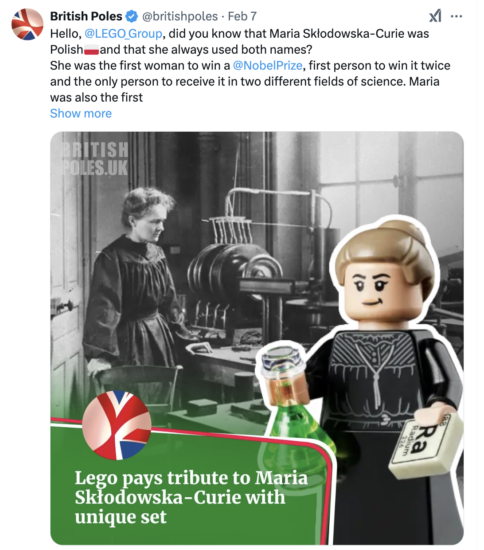
The new, correct description of the Lego set shows the Polish part of her surname.
It is important to remember that Maria Skłodowska-Curie always used both of her names and was deeply involved in the development of Polish science and the fate of her homeland.

Using only the surname of her husband would also not show the proper respect for the Polish Nobel prize laureate who was the first woman lecturer at the French University of Sorbonne.
Maria Skłodowska-Curie, a physicist, chemist and two-time Nobel Prize winner, was voted the most influential woman in history in the British BBC History poll.
She was born on 7 November 1867 in Warsaw. At 15, she graduated with a gold medal from the Female Government Gymnasium in Warsaw. She was interested in sociology, mathematics, physics, and literature.
In 1891, Maria went to Paris, where she enrolled in the Faculty of Mathematical and Natural Sciences at the Sorbonne.
Maria Skłodowska graduated from physics in 1893. A year later, she married a French physicist, Pierre Curie. After her wedding, she was known as Maria Skłodowska-Curie, but she always used both parts of her surname.
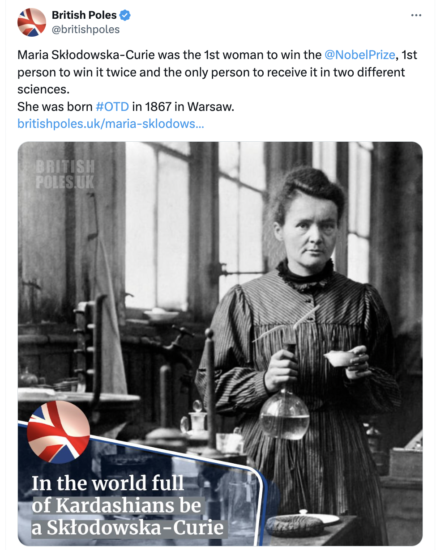
She became the first female professor at the Sorbonne on 6 November 1906. She was 38 years old when she delivered a lecture on physics in front of the full room. She was the 1st woman to win a Nobel Prize, 1st person to win it twice and the only person to receive it in two different sciences.
Maria Skłodowska-Curie’s dream was to support the reborn Polish state. She wanted it to become one of the world leaders in radiotherapy. As early as November 1921, she wrote a letter to Ignacy Paderewski proposing the opening of a Radium Institute in Warsaw, with a treatment and research facility modelled on the Institut du Radium in Paris, which she had already directed for 12 years.
Maria Skłodowska-Curie gifted the new Institute the first gram of radium, which she had to buy in the US for USD 51 600.
Maria Skłodowska-Curie died in 1934 from anaemia. The illness was linked to the prolonged exposure of her body to harmful radiation.
She was buried in the Sceaux cemetery, next to her husband.
Source: Dzieje.pl, British Poles
Photo: IPN and Lego Group
Tomasz Modrzejewski