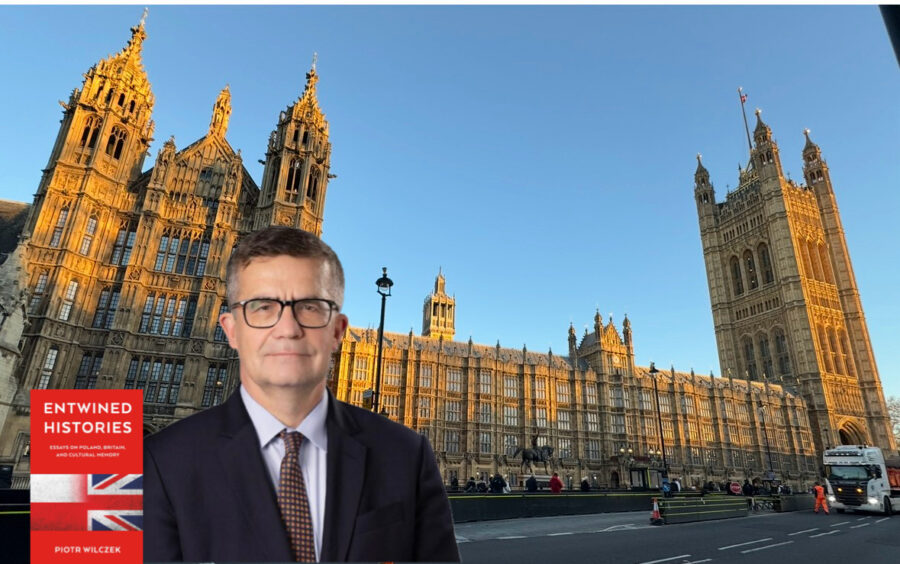
Writing from Warsaw, Poland’s former ambassador to the United Kingdom, Professor Piotr Wilczek, has offered an outsider’s diagnosis of Britain’s culture wars, one marked less by outrage than by puzzlement. In an opinion piece for The Spectator, Wilczek portrays a country locked in a cycle of intense, often apocalyptic argument over issues that, to external observers, appear strikingly narrow and self-contained.
From his vantage point beyond the British news cycle, Wilczek argues that the ferocity of these debates is disproportionate to their true substance. Britain, he suggests, increasingly resembles a nation engaged in a fierce conversation with itself, one in which the stakes are framed as existential. Still, the disputes themselves are frequently symbolic and parochial.
To illustrate the point, Wilczek points to a recent controversy in Brighton, where a museum proposal to “decolonise” Father Christmas, including a rethink of the “naughty list”, escalated into a national topic for debate. The episode, he argues, mattered less for its content than for the speed with which it became a proxy battle in the wider culture war. Such incidents, in his view, reveal a political culture primed to convert even whimsical gestures into moral showdowns.
Wilczek is careful to stress that his critique is not a rejection of dissent. On the contrary, he emphasises that disagreement is the lifeblood of democratic societies. What troubles many of Britain’s friends abroad, he writes, is the highly self-referential nature of these conflicts: they generate enormous heat, but shed little light on the country’s most pressing challenges.
One source of distortion, Wilczek suggests, lies in the wholesale importation of American culture-war dynamics into a British context. While the borrowing of ideas has long been a British strength, he argues that importing the emotional temperature of American debates shaped by a very different history of race, constitutional conflict and institutional fragility risks skewing priorities. Detached from their original context, these disputes retain their intensity while losing their sense of proportion.
The British Museum serves as a central example. Wilczek notes that arguments over imperial collections from the Parthenon sculptures to the Benin bronzes have dominated headlines for years, with renewed momentum in 2025 around repatriation and long-term loans. Yet these symbolic battles, he argues, often eclipse more urgent concerns: chronic underfunding, decaying infrastructure, and the unresolved fallout from the 2023 theft scandal, in which hundreds of artefacts were stolen or removed by an insider.
A similar pattern, Wilczek contends, is evident in higher education. British universities, he notes, face a genuine structural crisis. By 2025–26, nearly half of English institutions were projected to be running deficits, with redundancies exceeding 15,000 staff across the sector. Despite this, public attention remains fixated on familiar flashpoints, disinvited speakers, pronoun guidelines, curriculum “decolonisation”, and free-speech disputes while declining academic quality and financial instability attract comparatively little scrutiny.
Wilczek argues that symbolic politics flourishes precisely because it is cheap and fast. Changing language, issuing statements, or appointing committees is easier than tackling systemic problems. As a result, cultural disputes unfold in what he describes as a parallel universe of studios, social media and opinion pages, largely detached from policy decisions or resource allocation. The outcome is ritualistic: outrage peaks, statements are issued, and attention swiftly moves on.
Even the arrival of a Labour government promising to transcend culture wars has not fundamentally altered this dynamic, Wilczek observes. The familiar controversies persist, suggesting a deeper structural addiction to performative conflict.
From the outside, Wilczek concludes, Britain’s culture wars provoke more bewilderment than alarm. The country appears to be fighting battles that matter chiefly because they are being fought. Legitimate issues are undoubtedly involved, he acknowledges, but debate loses its value when it becomes theatre rather than substance.
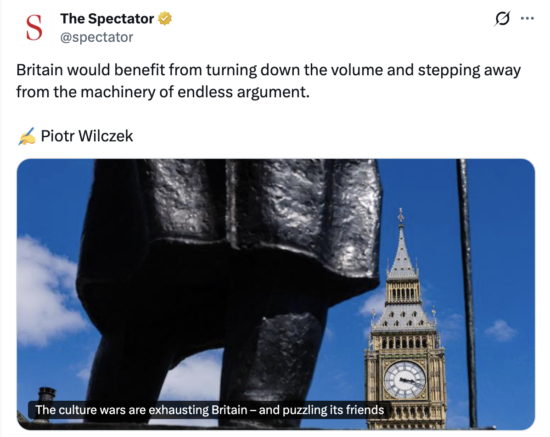
Britain, he argues, would benefit from lowering the volume and stepping away from the machinery of endless argument. It remains a resilient country, and it is precisely that resilience, Wilczek suggests, that makes its culture wars seem so strangely out of place.
You can access the original text here: https://spectator.com/article/the-culture-wars-are-exhausting-britain-and-puzzling-its-friends/
Source: The Spectator
Photo: X/
Tomasz Modrzejewski