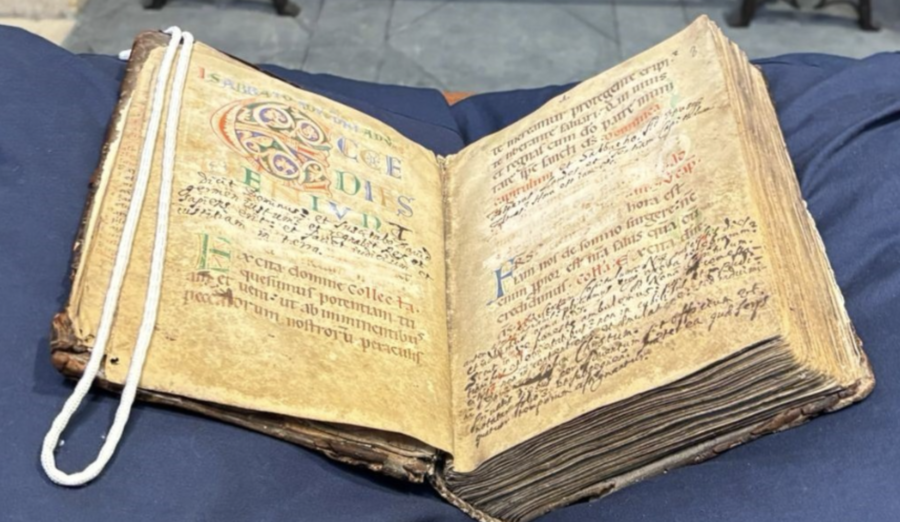
For centuries, the Ląd Collectarium lay quietly on monastic shelves, serving generations of Polish clergy and scholars. Created in the 12th century for the Cistercian abbey in Ląd, the manuscript belongs to the earliest strata of Poland’s written and liturgical culture. Its pages, shaped by medieval hands, once guided prayer and ritual in a world far removed from modern borders and political upheaval.
The manuscript’s fate changed abruptly in the 20th century. Following its transfer to the Archdiocesan Archive in Poznań, where it was recorded as part of the collection until the late 1930s, it vanished amid the devastation of the Second World War.
The German occupation of Poznań in 1939 brought systematic looting of church, library and museum holdings. Like countless other cultural objects, the Ląd Collectarium disappeared into the shadowy networks of wartime confiscation and post-war dispersal.
For decades, the manuscript was known only through absence. In 1966, it was formally listed as lost, a symbolic entry in the long catalogue of Polish cultural destruction.
Its unexpected reappearance on the London rare book market in the 1990s offered no clear answers as to how it had travelled from occupied Poland to the West. Eventually, it entered an American academic collection, catalogued without full knowledge of its wartime history.
The turning point came in the early 2020s, when scholarly research into medieval liturgical manuscripts brought renewed attention to the object.
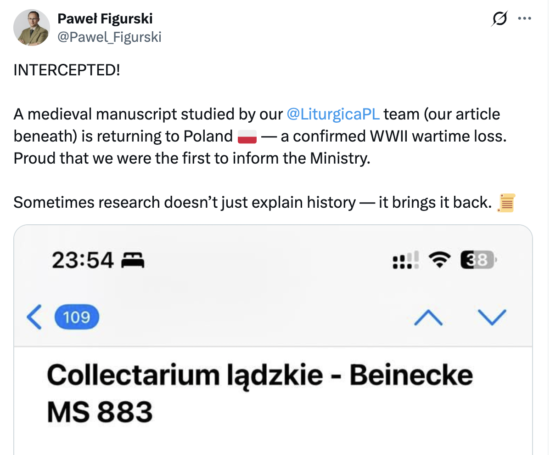
Careful examination of provenance, combined with archival evidence, revealed that the Collectarium could not have left Poland legally. A formal restitution claim submitted in 2024 set in motion a detailed investigation, one that acknowledged the broader historical context of Nazi cultural plunder.
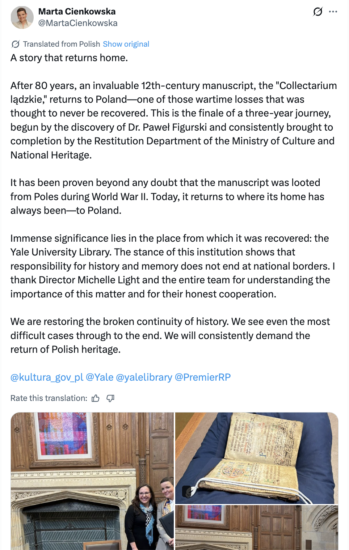
What followed was not merely a legal process, but an act of historical responsibility. The holding institution recognised that returning the manuscript was essential to restoring a broken continuity of memory. With international cooperation and specialist support, the centuries-old volume was prepared for its journey back across the Atlantic.
“Confirmation of the manuscript’s precise history was possible thanks to research carried out at the Beinecke Library following the submission of a formal restitution claim by the Ministry of Culture and National Heritage in May 2024. Taking into account the broader context of the systematic confiscation, dispersal, or destruction of Polish cultural heritage by Nazi Germany, the Beinecke Library of Yale University recognised that the documentation provided by the Ministry of Culture and National Heritage constitutes the most probable explanation for the manuscript’s disappearance from its original collections,” the Polish Ministry of Culture stated.
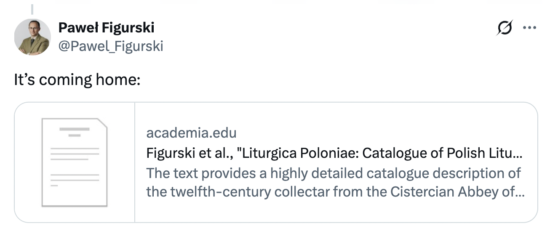
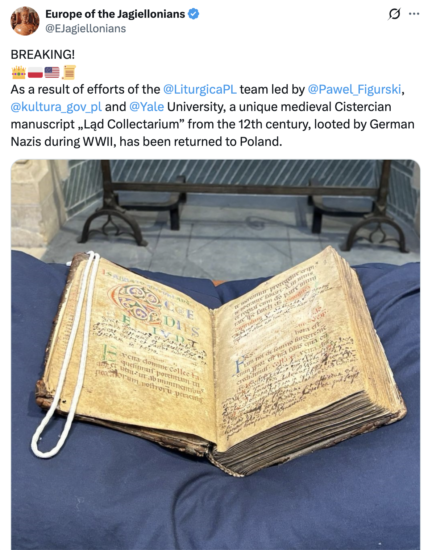
After reviewing the restitution claim submitted by the Ministry, the Beinecke Library of Yale University agreed to return the manuscript to Poland. As the Ministry noted, the transfer of the lost manuscript was also made possible thanks to expert knowledge and logistical support provided by representatives of the FBI Art Crime Team, the FBI Office at the US Embassy in Warsaw, and the FBI Office in New Haven.
The Ministry added that the first information regarding the presence of the Ląd Collectarium in American collections reached it thanks to Dr Paweł Figurski, who, together with his team, conducts research into early liturgical manuscripts.
After more than 80 years in exile, the Ląd Collectarium is returning to Poland not simply as a recovered artefact, but as a witness to the resilience of cultural heritage. Its story reflects the wider fate of many European treasures displaced by war, and demonstrates that even the most elusive losses can, with persistence and cooperation, find their way home.
Photo: X/@EJagiellonians
Tomasz Modrzejewski