Jarosław Iwaszkiewicz (1894–1980) was one of the most distinguished Polish writers and translators of the twentieth century, a central figure in the literary life of modern Poland. Yet when his long and eventful life came to an end on 2 March 1980, those closest to him felt that, despite his achievements, he had not found personal fulfilment. To many observers, he seemed to possess everything: talent, recognition, family, admirers, material security and influence, but he departed with a lingering sense of incompleteness.
He was born on 20 February 1894 in Kalnik, near Kyiv, then part of the Russian Empire, in a small sugar refinery where his father worked as an accountant. Baptised as Leon, he later adopted the name Jarosław, which became both his literary and public identity.
After spending his early childhood in Warsaw, he moved with his mother to Ukraine; in 1912, he passed his school-leaving examinations at a grammar school in Kyiv and began studying law at the University of Kyiv. His literary debut came in 1915 with the poem “Lilith”, published in the sole issue of the journal Pióro.
Between 1916 and 1918, he worked as an actor and literary director at S. Wysocka’s Studio Theatre in Kyiv, gaining experience that would later inform his dramatic writing. In the spring of 1918, he joined the 3rd Polish Corps; after its disarmament,t he travelled to Kraków and, in October 1918, settled in Warsaw.
There, he quickly became involved with the circle surrounding the journal Pro arte et studio and performed at the “Pikador” literary cabaret. In late 1918 and 1919, he emerged as one of the founders of the Skamander group, alongside Julian Tuwim, Jan Lechoń, Antoni Słonimski and Kazimierz Wierzyński, helping to shape the poetic voice of the newly independent Polish state.
From 1919 to 192,0 he served on the editorial board of Zdrój, and between 1920 and 1922 edited the “Art” section of Kurier Polski. He contributed poems, short prose and reviews to Kurier Lwowski (1921–1922) and Tygodnik Ilustrowany (from 1922).
In 1921, he co-founded the experimental theatre “Elsynor”, where Stanisław Ignacy Witkiewicz’s play The Pragmatists was staged. In 1922, he married Anna Lilpop; in 1928, the couple settled at Stawisko, near Warsaw, a house that would become an important centre of artistic and intellectual life.
During the German occupation (1939–1945), Stawisko functioned both as a cultural salon and a place of refuge. Literary evenings continued in private, while clandestine education took place and aid was provided to writers and to Jews in hiding, including the provision of false documents and temporary shelter. After the Warsaw Uprising in 1944, the house offered assistance to displaced Varsovians. In these years, Iwaszkiewicz combined discretion with quiet acts of solidarity, navigating the dangers of occupation while maintaining a semblance of cultural continuity.
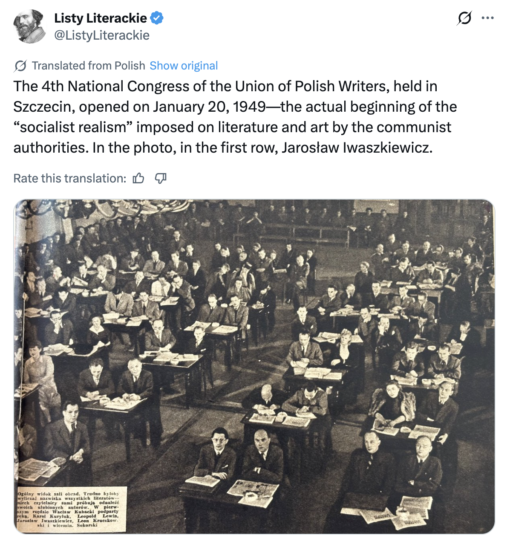
After 1945, he chose to cooperate with the new communist authorities. He became literary director of theatres, president of the Polish Writers’ Union (first in 1949, and again from 1959), editor-in-chief of the influential monthly Twórczość (from 1955), and from 1952 until his death served as a Member of Parliament.
He received numerous state honours, including the State Prize, and participated in official cultural diplomacy. His stance provoked controversy: some regarded him as an opportunist aligned too closely with power, while others saw in him a pragmatic guardian of literary institutions during politically constrained times.
Throughout these decades, he produced a vast and varied body of work: poetry collections such as Lato 1932 and Mapa pogody; novels including Księżyc wschodzi (1933) and the epic cycle Sława i chwała (1956–1962); short stories such as Panny z Wilka and Brzezina; plays including Lato w Nohant; essays, travel writing, and biographies of famous music composers, including Frederic Chopin.
He was a popular translator of Shakespeare, Tolstoy, Bunin, Kierkegaard and Gide, and left behind a monumental three-volume Diaries, published posthumously, which revealed the complexity of his inner life.
Iwaszkiewicz’s career spanned empires, two world wars, occupation, Stalinism and the political thaw of 1956. He was neither easily condemnable nor easily absolved: a writer of lyrical sensitivity and psychological depth, a cultural organiser and statesman, a man capable of both compromise and courage. His life resists simple judgment, and it is precisely this tension between art and power, conscience and survival that continues to animate debate about his legacy.
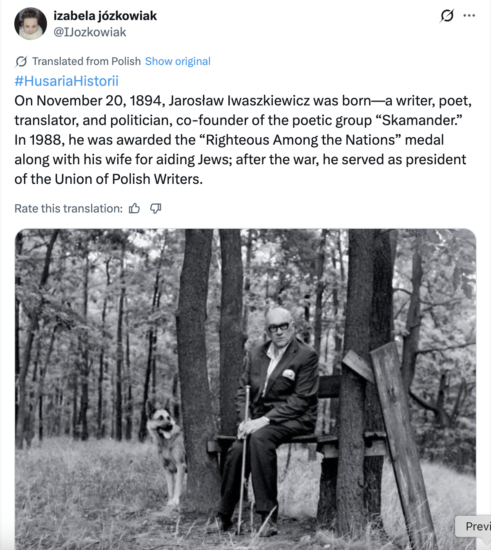
Photo: X/@PLenFrance
Tomasz Modrzejewski