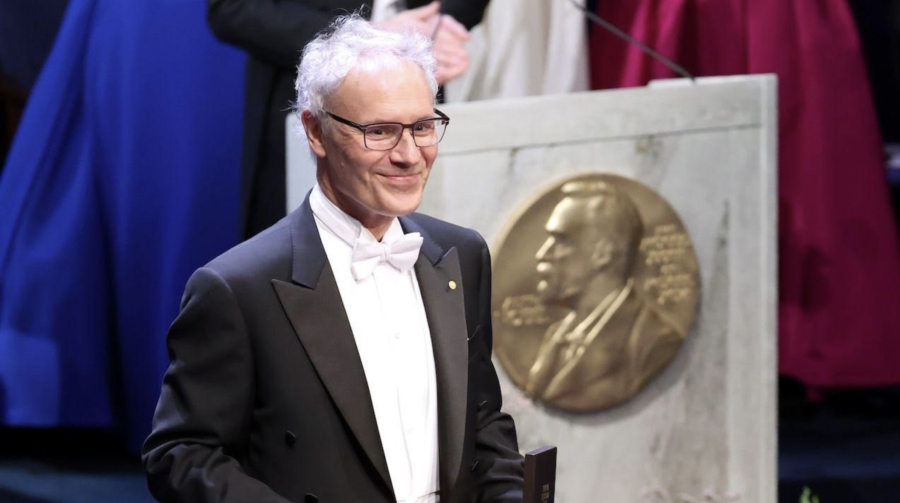
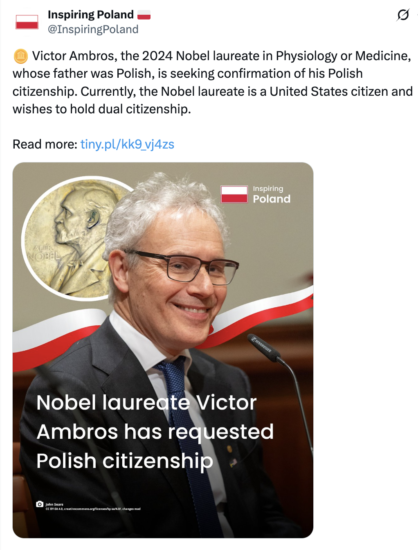
Victor Ambros, the American scientist awarded the 2024 Nobel Prize in Physiology or Medicine for pioneering research on microRNA, has expressed his intention to obtain Polish citizenship, a symbolic gesture he says would honour his family’s heritage and strengthen his ties with Poland.
During a visit to Warsaw, Ambros met Polish Prime Minister Donald Tusk and spoke publicly about his wish to reconnect with the country of his ancestors. The Nobel laureate emphasised that the decision carries a deeply personal dimension.
“For me, it would be a way of honouring my father, my aunt, their parents, and all those people who fought and endured so that I could exist today,” he said, describing the application for citizenship as a tribute to earlier generations of his family.
Ambros, a leading molecular biologist in the United States, grew up with only indirect connections to Poland. His father, a Pole who was deported to Germany as a forced labourer during the Second World War, later emigrated to the United States, where he built a new life. According to Ambros, the circumstances of immigrant life in mid-twentieth-century America often meant that cultural and linguistic ties faded quickly.
“My only connection with Poland was my father,” the scientist explained. Yet he noted that many immigrant families at the time chose not to pass on their native languages, particularly when living far from established communities. His own father settled in Vermont after marrying an American woman and raising a family in an area without a Polish diaspora.

Despite this distance, Ambros says he developed a strong emotional connection to Poland through stories told at home. He remembers his father describing a country whose borders repeatedly shifted throughout history, a narrative that shaped his early perception of Poland as something almost intangible.
“When I was growing up, I remember conversations in which my father spoke about Poland as a country whose borders were constantly shifting on the map. This created in my mind the sense that Poland was something almost unreal, like an illusion,” he recalled.
Over time, however, that perception changed as Ambros gained a deeper understanding of Poland’s history and resilience. Reflecting on the country’s survival through political upheavals and war, he now views Poland as a powerful example of national endurance.
“Only later… did I increasingly realise how remarkably resilient the Polish nation has been… Today it is stronger than ever,” he said.
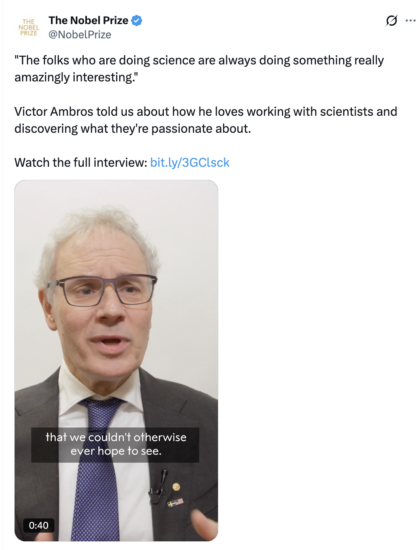
Ambros also believes that his Nobel Prize could help strengthen scientific cooperation with Poland. “I treat it as an opportunity to add even a small brick to the whole,” he remarked, suggesting that he hopes his recognition might contribute to the visibility and development of Polish research.
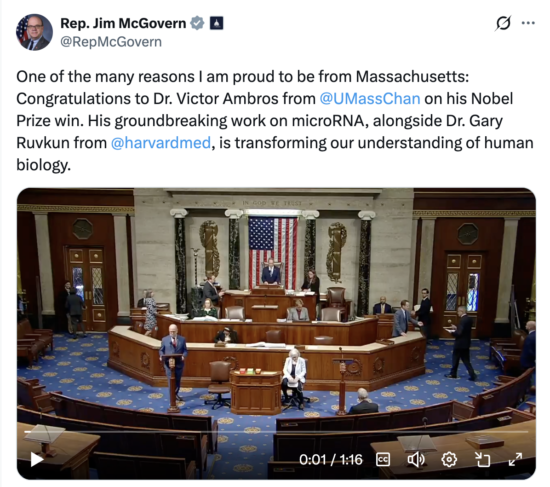
The Nobel Prize awarded to Ambros and fellow American scientist Gary Ruvkun recognised their discovery of microRNA, tiny molecules that regulate gene activity. The finding revolutionised molecular biology and has become crucial for understanding many diseases and developing new diagnostic and therapeutic approaches.
Born in 1953 in New Hampshire, Ambros built his scientific career at institutions including Harvard University and Dartmouth College. He currently works at the University of Massachusetts Medical School, where he leads research into RNA biology and therapeutics.
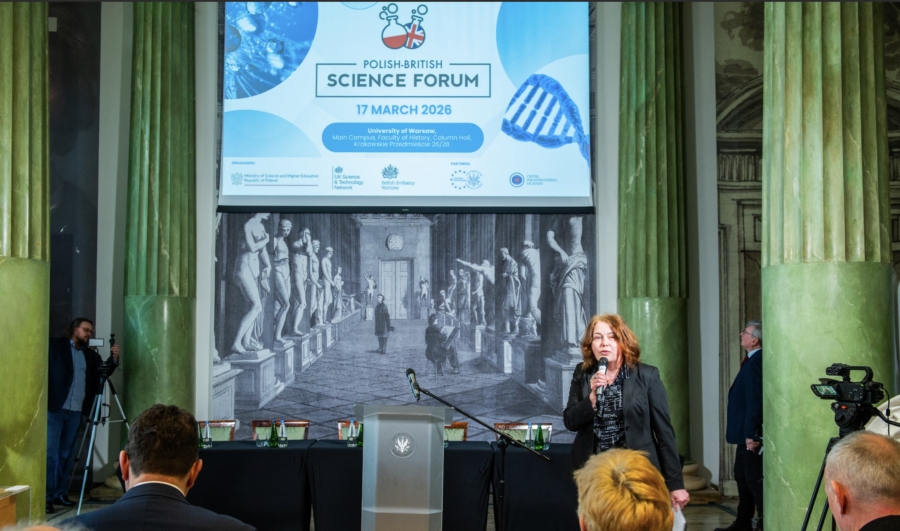
During his visit to Poland, he also delivered a lecture at the Staszic Palace in Warsaw on the role of microRNA in gene regulation and modern medicine.
For Ambros, the visit was a return to the country whose history shaped his family and whose scientific future he now hopes to support.
Photo: @AllyMcItalia/X
Tomasz Modrzejewski