
The UK government has launched an eight-week public consultation on plans to introduce a national Digital ID system, inviting citizens, businesses and organisations to help shape how it would work in practice. The initiative is part of a broader effort to modernise public services, with ministers arguing that digital identity could make interactions with the government quicker and easier. But the project draws strong opposition from the British public and some politicians, even within the ruling party.
The proposed system is intended to act as a form of core digital infrastructure, allowing people to access services such as tax, childcare support, or other government functions through a single, secure identity. The consultation document outlines ambitions to reduce bureaucracy, improve efficiency and create more “joined-up” services, similar to the convenience already seen in online banking and other digital platforms.

Alongside the consultation, ministers plan to establish a “People’s Panel” of around 100–120 citizens, selected to reflect the UK population, who will take part in more detailed discussions before final decisions are made. The government has said that feedback from both the public consultation and the panel will inform the next steps, with a formal response expected after the process concludes.
The United Kingdom’s debate over a national Digital ID system is increasingly characterised by a clear mismatch between political momentum and public opinion. While the government continues to explore implementation through consultations and pilot discussions, the available evidence suggests that public support remains limited, and concerns are both widespread and well-defined.

Multiple surveys indicate the absence of a clear mandate for a nationwide Digital ID scheme. An Ipsos poll found that 45% of Britons oppose the introduction of a national digital identity system, compared with 33% who support it, a gap of 12 percentage points. Similarly, research conducted by Survation reported 43% opposition versus 36% support, reinforcing a consistent pattern across different polling approaches.
Beyond headline approval figures, deeper concerns arise around security. Approximately 80% of respondents in recent surveys say they are worried about data breaches or cyber-attacks, highlighting a significant trust deficit when it comes to storing sensitive personal information within centralised systems.
These figures are notable. In public policy, reforms that fundamentally alter how citizens interact with the state typically require strong majority support. In this case, not only is such support lacking, but opposition is consistently higher than approval.
Despite this, the government has chosen to proceed with consultations and exploratory initiatives. Ministers argue that public engagement, through consultations and discussion panels, will help shape a system that is both secure and beneficial. Critics, however, take a different view. To them, the process appears less like genuine consultation and more like a step towards legitimising a policy direction that has effectively already been determined.

At the core of the opposition lies a set of fundamental concerns about how a Digital ID system could reshape the relationship between citizens and the state.
One major issue is the potential impact on freedom of expression. If identity becomes closely linked to both online and offline activity, individuals may begin to self-censor, concerned that their views or associations could be monitored or recorded. Even the perception of surveillance can influence behaviour, fostering a more cautious and less open society.
Closely related is the broader risk of increased state surveillance. A centralised identity system could enable authorities to link data across multiple domains, public services, digital platforms, and even physical movement through technologies such as facial recognition. While such integration may improve administrative efficiency, it also raises the prospect of unprecedented levels of monitoring.
There are also concerns about the concentration of power. When access to essential services such as healthcare, housing, or welfare depends on a single digital identity, the system itself becomes a powerful gatekeeper. Critics fear that what begins as a voluntary mechanism could gradually evolve into a de facto requirement, with serious implications for those who opt out or encounter administrative difficulties.
Security risks further complicate the picture. Centralising large volumes of sensitive personal data creates an attractive target for cybercriminals. Given previous incidents involving breaches of government systems, sceptics question whether any such system can be made sufficiently secure to justify the risks involved.
Cost is another point of contention. Estimates suggest that implementing a national Digital ID system could require substantial public expenditure, yet clear funding plans have not been fully articulated. At a time of fiscal constraint, many argue that resources would be better directed towards more immediate priorities, including pressures on the NHS, housing shortages, and support with the cost of living.
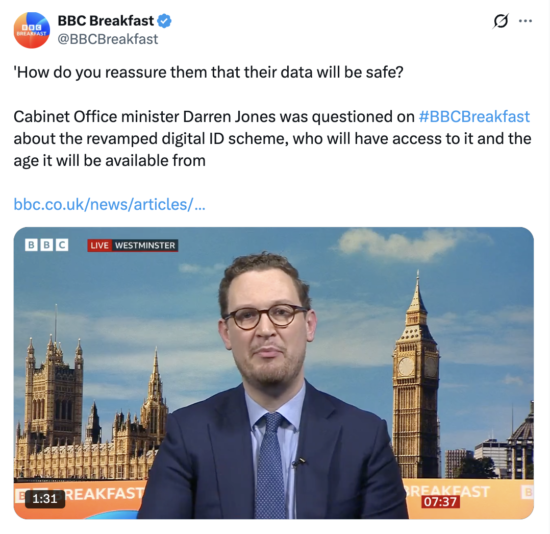
Notably, resistance is not confined to the public. Reports indicate growing unease within political circles, with some MPs expressing reservations about both the substance of the policy and its potential electoral consequences. In a climate where public trust remains fragile, advancing a controversial initiative may carry significant political risks.
Photo: X/@_MAGA_NEWS_
Tomasz Modrzejewski