In a decision that is already rippling far beyond Spain’s borders, the country’s Supreme Court has drawn a sharp legal line through what many might once have dismissed as a trivial social gesture. A man who kissed a woman’s hand without her consent has been convicted of sexual assault, an outcome that signals a profound shift in how the law interprets physical contact and personal autonomy.
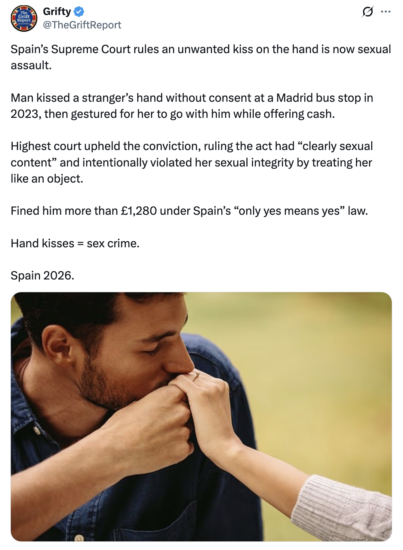
The case itself unfolded in seemingly ordinary circumstances. At a bus stop in Alcobendas, near Madrid, a man approached a woman, took her hand, kissed it, and allegedly propositioned her with money. What might once have been categorised as inappropriate or offensive behaviour instead became the subject of a criminal conviction.
Spain’s highest court rejected the defence’s argument that the act amounted merely to street harassment. Instead, judges ruled that the unsolicited physical contact constituted a violation of the woman’s “sexual integrity,” elevating the act to sexual assault under Spanish law.
The ruling is notable not for the severity of the act, but for the principle it establishes: any non-consensual physical contact of a sexual nature, even one as brief or seemingly minor as a kiss on the hand, can be criminal.
This decision is rooted in Spain’s sweeping overhaul of sexual consent laws in 2022, often summarised by the phrase “only yes means yes.” Under this framework, the absence of explicit consent is enough to classify an act as sexual assault, violence, or intimidation, and no longer needs to be proven.
Legal experts say the court’s reasoning reflects a broader redefinition of harm. Sexual assault is no longer judged primarily by the force used, but by the autonomy violated. As the judges emphasised, even minimal physical contact can infringe on a person’s freedom if it occurs without consent.
The ruling lands in a Spain already engaged in intense public debate over consent, gender, and power. The 2023 incident involving Luis Rubiales, who kissed footballer Jenni Hermoso without her consent during the Women’s World Cup celebrations, became a global flashpoint.
Rubiales was later convicted of sexual assault and fined, with courts affirming that the absence of consent alone was sufficient to establish wrongdoing.
Together, these cases form a legal and cultural continuum: from a high-profile stadium incident to a fleeting encounter at a bus stop, the same principle applies.
Critics of the ruling argue that criminalising minor gestures risks overreach, blurring the line between social awkwardness and criminal conduct. Supporters counter that the law is finally catching up with a basic truth: consent is not proportional to the scale of the act.
Two of the magistrates delivered dissenting opinions, taking the view that the incident did not constitute sexual assault.
“A kiss (or two) on another person’s hand is, in our culture, a form of greeting, now obsolete,” they stated, according to court documents.
They further added that, alongside kissing someone on the cheek or shaking hands, such gestures “are not acts of a sexual nature”.
In practical terms, the decision sends a clear message. Social conventions, whether a celebratory kiss, a greeting, or flirtation, do not override personal boundaries. What matters is not intention, but permission.
While rooted in Spanish law, the implications extend beyond it. Legal systems across Europe and beyond are grappling with similar questions: how to define consent, how to balance proportionality, and how to reflect evolving social norms in criminal law.
Spain’s answer, now reinforced by its highest court, is unambiguous. Even the smallest gesture can carry legal weight if it disregards consent.
In that sense, the case is less about a kiss and more about a principle that is rapidly reshaping the legal landscape: the body is not a social space, but a private one, governed first and foremost by consent.
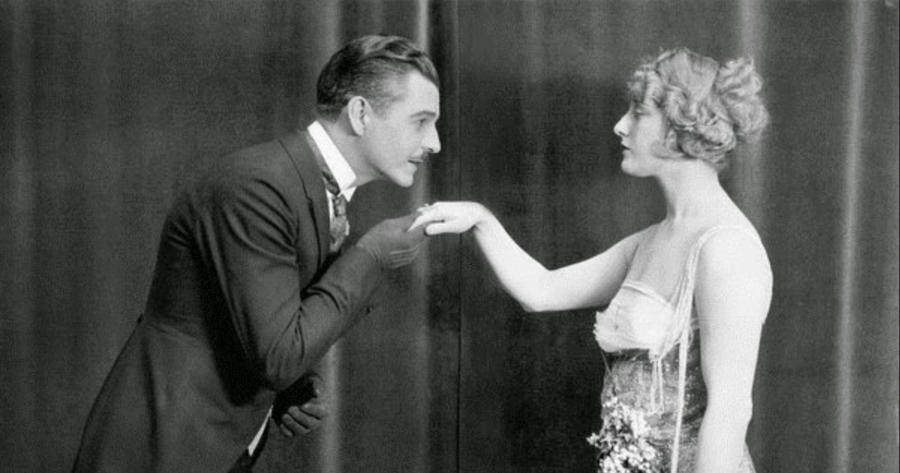
The court decision must be well communicated to all traditional Polish men residing or visiting Spain, as kissing a woman’s hand remains important for the national culture.
Photo: X/@zaza_priv
Tomasz Modrzejewski