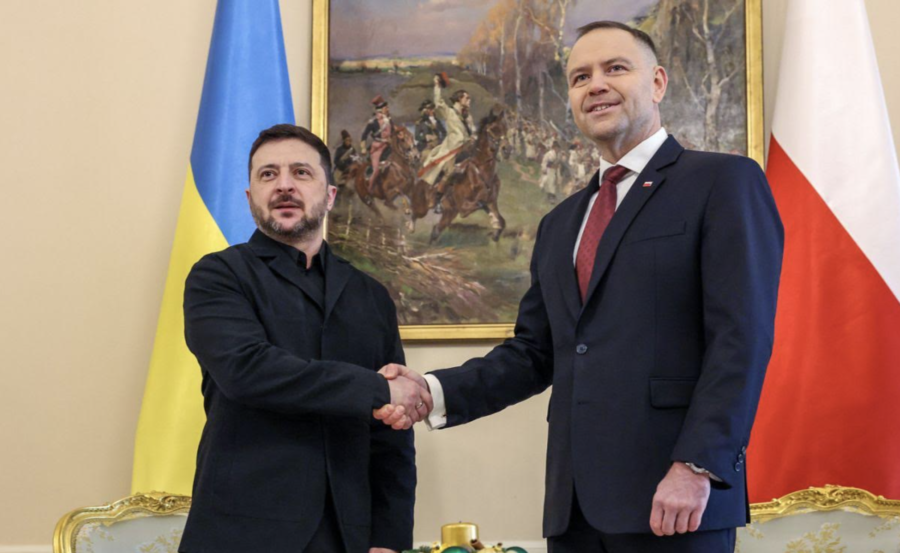
Polish President Karol Nawrocki has announced the withdrawal of the Order of the White Eagle from Ukrainian President Volodymyr Zelensky, citing Kyiv’s decision to name a military unit after the “Heroes of the UPA” as the reason for the unprecedented move.
The Order of the White Eagle is Poland’s highest state distinction and was awarded to Zelensky in April 2023 in recognition of his role in strengthening Polish-Ukrainian relations, promoting democracy and security in Europe, and defending fundamental human rights during Russia’s invasion of Ukraine.
In a video statement released on Friday, Nawrocki said that, following consultations with the Chapter of the Order of the White Eagle, he had decided to revoke the honour after Zelensky approved the naming of a Ukrainian Armed Forces unit after the Ukrainian Insurgent Army (UPA).
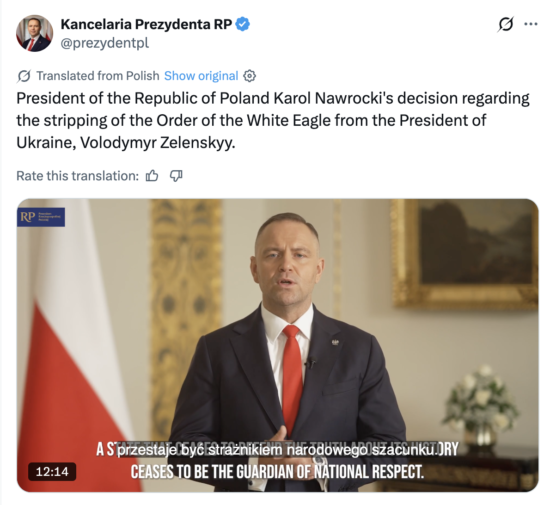
“The President of the Republic of Poland has a duty to safeguard the honour of our highest state decoration,” Nawrocki stated. “In light of President Zelensky’s approval of this decision, I concluded that the distinction should be withdrawn.”
Despite the diplomatic significance of the decision, the Polish leader stressed that it was not directed against the Ukrainian people and did not signal any change in Poland’s strategic support for Ukraine in its war against Russia. He emphasised that Warsaw remains committed to assisting Kyiv and maintaining close security cooperation.
However, Nawrocki argued that the glorification of organisations associated with crimes committed against Polish civilians during the Second World War undermines efforts to build trust between the two nations. He described the naming of the unit as “outrageous, incomprehensible and deeply disappointing”, particularly given Poland’s extensive military, humanitarian and political support for Ukraine over the past several years.
According to the president, the revocation carries both symbolic and practical significance. He characterised it as a warning that certain historical sensitivities cannot be ignored in Polish-Ukrainian relations.
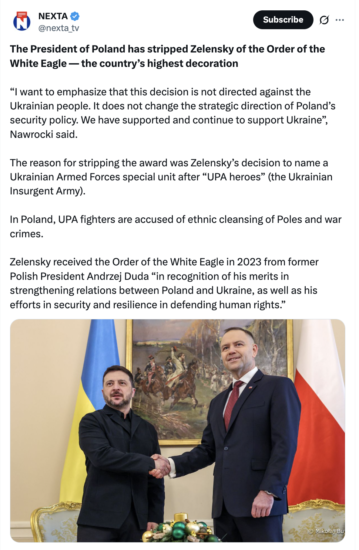
“There are boundaries that should not be crossed,” Nawrocki said, calling on Ukraine to pursue what he described as a path of historical truth and mutual respect.
The decision comes amid longstanding disagreements between Poland and Ukraine over the legacy of the Organisation of Ukrainian Nationalists (OUN) and the Ukrainian Insurgent Army (UPA). In Poland, the Volhynia massacres of 1943 are widely regarded as acts of genocide against the Polish population. Many Ukrainians, by contrast, view the UPA primarily through the lens of its resistance to Soviet rule and see the wartime conflict as more complex and reciprocal in nature.
Nawrocki also renewed calls for legal restrictions on the public display in Poland of red-and-black flags historically associated with the OUN and UPA. He argued that symbols linked to ideologies responsible for mass atrocities should not be promoted in public life.
At the same time, the president insisted that Poland remains open to cooperation with Ukraine. He stated that Warsaw would continue to support its neighbour while defending its own historical memory, national interests and state symbols.
The announcement triggered an immediate reaction from Kyiv. Ukrainian Foreign Minister Andrii Sybiha described the move as a “strategic mistake” that would ultimately benefit Russia. In response, he declared that he would return the Commander’s Cross with Star of the Order of Merit of the Republic of Poland, which he received in 2022.
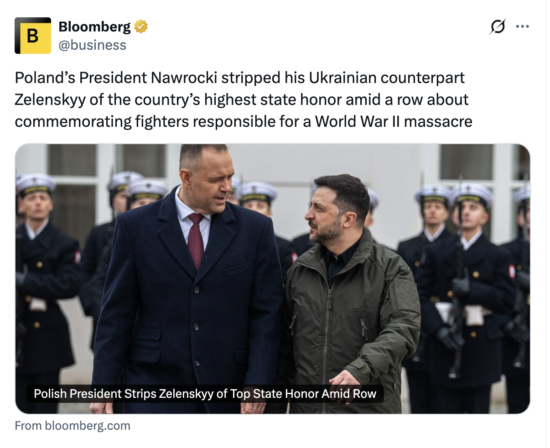
Prime Minister Donald Tusk revealed that he had discussed the issue with Zelensky before the announcement. According to Tusk, the Ukrainian president assured him that he had no intention of offending Poles or damaging relations between the two countries.
The dispute began in late May when Zelensky formally granted the title “Heroes of the UPA” to a Ukrainian military unit. The decision drew criticism across much of Poland’s political spectrum, including from government ministers and senior officials. Nawrocki subsequently referred the matter to the Chapter of the Order of the White Eagle for consideration before making his final decision.
Looking beyond the immediate controversy, Nawrocki argued that Ukraine’s aspirations to join the European Union require a willingness to confront difficult chapters of its past. He stated that modern Europe was built upon the rejection of totalitarian ideologies and the glorification of political violence, principles that he believes must apply equally to all candidate countries.
Photo: @nexta_tv/X
Tomasz Modrzejewski