
The woman convicted of helping conceal the weapon used to murder an 18-year-old university student could leave prison in December, raising fresh questions about Britain’s early-release policy and the treatment of victims’ families.
Kiran Kaur, 53, was sentenced to three years’ imprisonment in July 2026 after being found guilty of assisting an offender. She had removed the knife used by her son, Vickrum Digwa, to fatally stab Nowak on 3 December 2025.
Despite the seriousness of her offence, Kaur is expected to serve less than half of her sentence in custody under the Government’s early-release arrangements, according to reports by ITV News and Sky News.
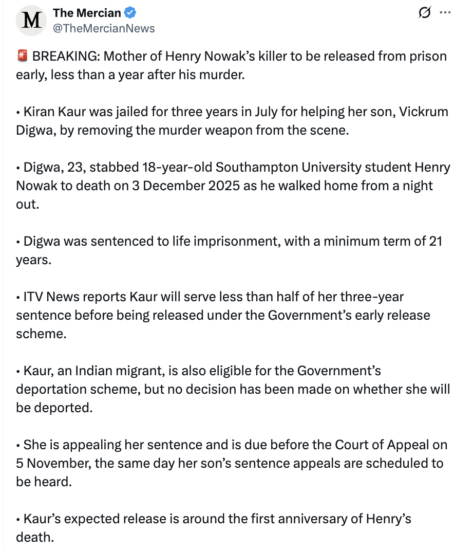
Her anticipated release, potentially around the first anniversary of Nowak’s death, has drawn criticism from Hampshire and Isle of Wight Police and Crime Commissioner Donna Jones, who has questioned the fairness of the decision and its implications for the victim’s family.
Henry Nowak, an 18-year-old finance student at the University of Southampton, was walking home after a night out with friends when he was fatally stabbed by Digwa.
The attack took place in Southampton on 3 December 2025. Evidence presented during the criminal proceedings established that Digwa stabbed the student five times, inflicting injuries that caused fatal internal bleeding.
Rather than immediately seeking medical assistance, Digwa filmed Nowak as he lay wounded.
His mother subsequently arrived at the scene and removed the weapon, taking it back to the family home before police could recover it.
Digwa attempted to justify his actions by claiming that Nowak had racially abused him. The jury rejected that account and found him guilty of murder and possessing a bladed article in public.
On 1 June 2026, Digwa, then 23, received a life sentence with a minimum term of 21 years.
Kaur was separately convicted of assisting an offender. The Crown Prosecution Service concluded that her actions had been intended to help her son and obstruct the police investigation by concealing crucial evidence.
She received a three-year prison sentence on 17 July.
The controversy surrounding Kaur’s expected release forms part of a wider debate about the Government’s efforts to reduce pressure on prisons in England and Wales.
Under expanded early-release arrangements introduced in October, certain eligible prisoners may be released after serving a substantially reduced proportion of their sentences.
Approximately 5,000 prisoners are expected to benefit from the measures over the coming year, although the Government has introduced exclusions for some of the most serious sexual offences.
Kaur had already spent 221 days on remand when her sentence was imposed. That time was taken into account, substantially reducing the period she would otherwise have remained in custody after her July sentencing.
Reports indicate that she could leave prison in December, around the anniversary of the murder.
Donna Jones, the Police and Crime Commissioner for Hampshire and the Isle of Wight, has condemned the prospect of such an early release.
Speaking to BBC Radio 4’s Today programme on 16 October, Jones argued that releasing Kaur so soon after her sentencing would be a significant blow to Nowak’s family.
She also questioned the application of a policy designed to relieve prison overcrowding to a woman serving a sentence in the female prison estate, where pressures differ from those affecting men’s prisons.
Jones said she intended to seek clarification from Justice Secretary Alex Norris about the decision.
The case highlights a difficult question for the criminal justice system: how should governments balance the practical pressures facing prisons against the public expectation that sentences imposed by judges will be meaningfully served?
Kaur’s immigration status has added another dimension to the case.
An Indian national who has lived in Britain for many years, she may also be considered for removal from the United Kingdom under arrangements applying to foreign national offenders.
However, as of 19 October, no final decision on her deportation had been publicly confirmed.
The Home Office has declined to comment on her individual circumstances, while reiterating its commitment to removing foreign criminals where possible.
Any removal would be a separate legal and administrative process from her eligibility for early release.
Kaur is also challenging her sentence. Her appeal is scheduled to be heard at the Court of Appeal on 5 November.
On the same day, proceedings concerning her son’s sentence are due to take place. Digwa is challenging the length of his minimum term, while the Attorney General is seeking a review on the grounds that the sentence was too lenient.
Digwa is also seeking permission to appeal against his murder conviction.
The murder of Henry Nowak attracted further attention because of the circumstances surrounding the police response.
Nowak was handcuffed by officers as he lay fatally injured, an incident which intensified public concern about how the authorities handled the aftermath of the stabbing.
The Independent Office for Police Conduct subsequently began investigating aspects of the police response.
The case therefore raises questions extending beyond the length of Kaur’s imprisonment, encompassing the treatment of victims, the handling of serious criminal investigations and public confidence in the administration of justice.
For Nowak’s family, the approaching anniversary of his death will inevitably carry particular significance.
The prospect that the woman convicted of helping conceal the weapon used to kill him could be released at almost precisely the same time has renewed scrutiny of the Government’s prison policy.
Although Kaur was not convicted of murder, her offence involved the deliberate removal of evidence following a fatal attack. Her expected early release therefore illustrates the tension between the legal distinction separating different offences and the emotional consequences of decisions made within the criminal justice system.
As the Government seeks to manage prison capacity, the case serves as a reminder that decisions about sentencing and release extend far beyond prison statistics.
At their centre are victims, bereaved families and the question of whether the criminal justice system can command their trust.
Source: Guardian, X
Photo: X@TheMercianNews
Tomasz Modrzejewski