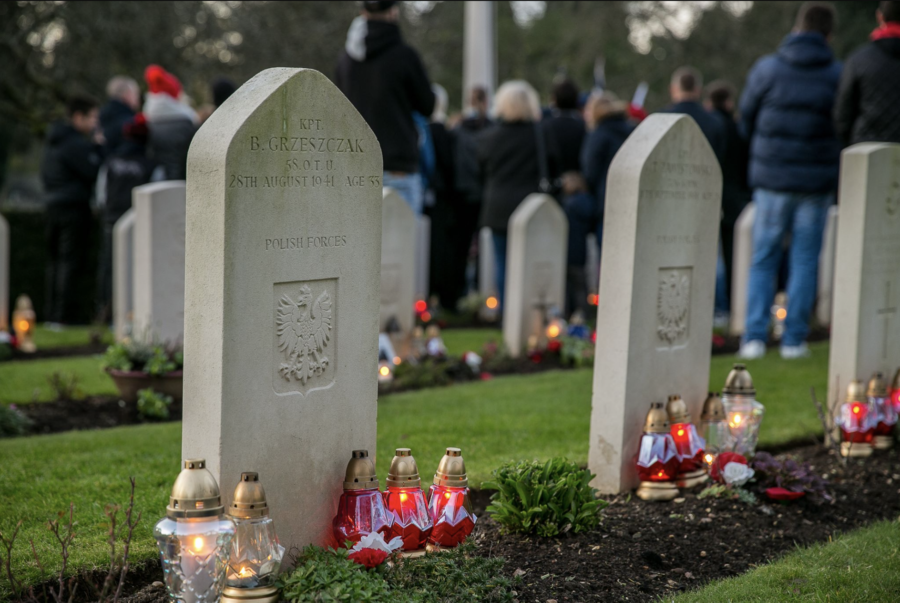
A Polish father has been sentenced to two years and six months in prison for his involvement in violent disorder following the murder of British-Polish student Henry Nowak. Meanwhile, the mother of the convicted murderer, who deliberately removed the murder weapon from the crime scene, is reportedly set to be released in December, less than six months after receiving a three-year prison sentence. The contrasting cases are raising uncomfortable questions about sentencing, early release and public confidence in British justice.
Kamil Klonek, a Polish-born father living in Southampton, has been jailed for two-and-a-half years after throwing an empty beer can towards police officers during protests sparked by the murder of 18-year-old Henry Nowak.
Klonek, who moved to Britain from Poland 15 years ago, appeared before Southampton Crown Court following the violent disorder in the city’s Belmont Road on 2 June 2026.
The court heard that he had been standing near the front of a crowd confronting police officers, shouting abuse and encouraging other demonstrators. Footage showed him drinking beer, gesturing towards officers and throwing an empty can in their direction.
His defence argued that the can had been thrown underarm and landed approximately six to nine feet short of the police line.
The defence described Klonek’s behaviour as drunken foolishness rather than a serious attempt to injure officers. He expressed remorse and acknowledged that his actions had been disgraceful.
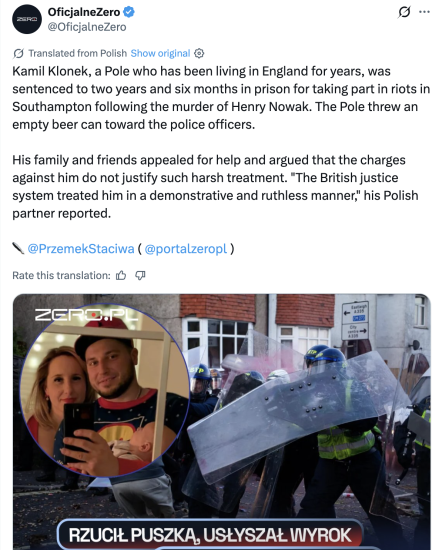
The court also heard that Klonek has a young child approaching their first birthday, which he is likely to miss while in custody.
Nevertheless, he was sentenced to 30 months’ imprisonment for violent disorder. He will also be required to wear an electronic tag while on licence following his release.
The sentence provides a striking contrast with developments in another criminal case arising directly from Henry Nowak’s murder.
Kiran Kaur, the 53-year-old mother of convicted murderer Vickrum Digwa, was sentenced to three years in prison in July after being found guilty of assisting an offender.
Her offence was not connected with the subsequent protests. Instead, she had actively interfered with the investigation into Nowak’s killing.
On 3 December 2025, Digwa stabbed the 18-year-old University of Southampton student five times with a large knife.
Rather than immediately assisting the critically injured teenager, Digwa filmed him and falsely claimed that Nowak had subjected him to a racially motivated attack.
Kaur subsequently arrived at the scene and removed the knife used in the killing, taking it back to the family home and placing it among other weapons in her son’s bedroom.
Prosecutors argued that her actions were intended to help Digwa avoid responsibility and obstruct the police investigation.
Although she received a three-year prison sentence on 17 July, ITV News and Sky News reported in October that Kaur was expected to be released under the Government’s early-release arrangements in December, around the first anniversary of Nowak’s death.
If those plans proceed, she could be out of prison in time for Christmas.
The reports have also raised the possibility that Kaur, an Indian national, could become eligible for deportation. However, neither her precise release date nor any deportation decision has been publicly confirmed.
The comparison is particularly sensitive because of the nature of the offences involved.
Klonek was convicted of violent disorder during a confrontation with police. His behaviour was threatening and unlawful, and the wider disturbances resulted in injuries to officers.
Kaur, meanwhile, was convicted of deliberately removing crucial evidence from the scene of a murder, helping her son conceal the weapon used to kill an innocent teenager.
Yet while the Polish father received a 30-month custodial sentence for his role in the unrest, Kaur could spend less than six months in prison following the imposition of her three-year sentence.
The difference does not, by itself, establish inconsistent sentencing. The two defendants were convicted of different offences, and the period someone actually spends in custody can be affected by time served on remand, statutory release provisions and other legal considerations.
Nevertheless, the contrast raises a legitimate question: how can a justice system explain such outcomes convincingly to victims’ families and the wider public?
For those already concerned about the authorities’ handling of Henry Nowak’s murder, the reported early release is likely to deepen frustration.
Henry Nowak’s death attracted national attention not only because of the brutality of the attack, but also because of the police response.
After being stabbed, the British-Polish teenager repeatedly told attending officers that he had been attacked and was struggling to breathe.
Instead of immediately recognising him as the victim of a life-threatening assault, officers initially accepted Digwa’s false account of the incident.
Nowak was handcuffed while critically injured. He subsequently lost consciousness and died.
The release of police body-worn camera footage in June provoked widespread anger, prompting demonstrations in Southampton and renewed scrutiny of Hampshire Constabulary.
Some demonstrations descended into serious violence, with protesters throwing objects at officers and confronting police lines.
Nowak’s family, however, have repeatedly warned against exploiting their son’s death for political purposes or using the tragedy to encourage further division.
Their central demand has remained unchanged: accountability for what happened to Henry and a full explanation of the decisions taken by police.
An investigation by the Independent Office for Police Conduct remains under way, while an independent review has been commissioned to examine possible failings surrounding the case.
The latest developments come as the Court of Appeal has increased the minimum term imposed on Vickrum Digwa.
On 5 November, judges ruled that his original minimum term of 21 years had been unduly lenient, increasing it to 25 years, subject to credit for time already spent in custody.
The court considered not only the repeated stabbing of an unarmed teenager but also Digwa’s conduct afterwards, including the cruelty shown towards his victim and attempts to conceal what had happened.
The decision represents an important development for Nowak’s family, although it does not resolve the continuing questions surrounding the police response or the expected early release of Digwa’s mother.
The imprisonment of Kamil Klonek and the anticipated release of Kiran Kaur illustrate two different aspects of Britain’s criminal justice system.
Violence against police officers cannot be justified by anger at the authorities, however understandable the original cause of a protest may be.
Equally, assisting a murderer by concealing vital evidence is a grave offence that strikes at the heart of the justice process.
The central concern is therefore not whether Klonek should have faced consequences, but whether the wider system delivers punishments and release arrangements that are proportionate, consistent and understandable.
For Henry Nowak’s family, these legal developments are taking place against an especially painful backdrop.
December will mark the first anniversary of the teenager’s murder. It will also bring another Christmas without a son whose life was cut short at just 18.
At the same time, the woman convicted of helping his killer conceal the murder weapon could be leaving prison.
Whatever the legal explanations for that outcome, many members of the public will undoubtedly find the contrast difficult to accept.
And it raises a question that extends far beyond Southampton: Is justice merely a matter of applying sentencing rules, or must it also deliver outcomes that command public confidence?
Source: X
Photo: X Christopher Walls, Agnieszka Stachura / East News, Zrzutka.p
Tomasz Modrzejewski