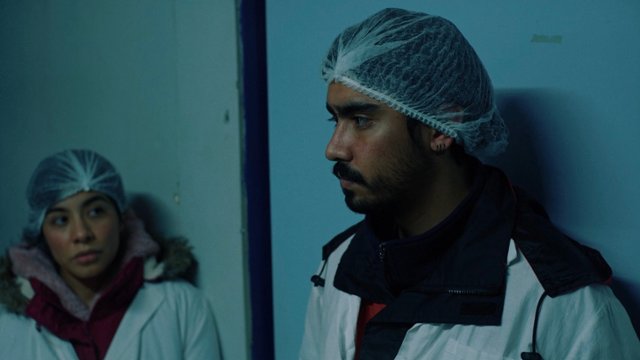
In Robert Kwilman’s feature debut, we learn what it is to be an immigrant arriving in Poland, to earn a living and fight for a decent life.
It’s a story based on real-life events, from 2020. We follow Adrián (Daniel Jiménez), an immigrant from South America, who works in a warehouse belonging to Przemek (Sebastian Stankiewicz), a typical supervisor who cares more about his earnings than his workers. When a new group of illegal workers arrive, and then a mysterious accident happens, Adrián will have to decide if he would rather stick with his boss or maybe support the people in need.
Capo, at times, feels slightly mundane, as if it really makes us feel we are participating in an experience just like the on-screen characters. Kwilman explores the everyday life of people who have no idea if they will ever be able to work legally in Poland. Whenever they wake up, some sort of inertia invades their bodies; a feeling that they don’t know when or how they might be deported. However, such aesthetics, of slow cinema, allow the film’s audience to really feel what those people have to go through.
Sadly, Poland is not the paradise our protagonist was once promised by one of Przemek’s untruthful advertisements. Unfortunately, for people like Adrián, it is a place where he cannot even obtain a work permit and start earning an actual living wage, to say the least. Despite working long hours and spending his evenings learning Polish with a language app, presumably Duolingo, Adrián feels like an intruder in a country that was supposed to be the land of milk and honey.
Capo is noteworthy, naturalistic cinema, which echoes the Dardenne brothers and any other films on the matter of workers. We haven’t had a film like this one in recent years in our filmography, so when it comes out, go watch Kwilman’s debut. It will show you another side of Poland, one which you won’t see either in modern media or on our politicians’ lips.
Photo: PISF
3,5/5 stars
Author: Jan Tracz