Eva Hussain, founder of Polaron, the world’s oldest and most experienced citizenship services company, discusses citizenship trends, Polish heritage and why now is the right time to explore your European roots.
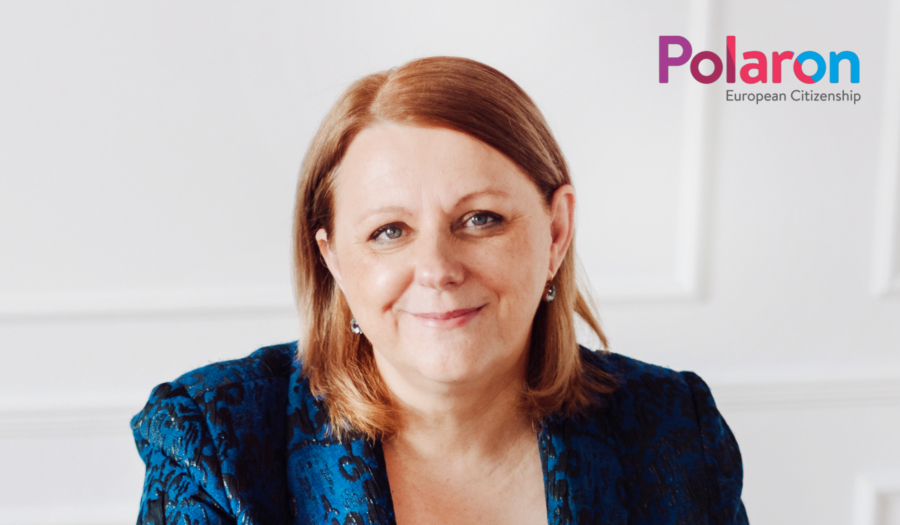
Eva Hussain is a keynote speaker, researcher and internationally recognised expert on European citizenship. As the founder of Polaron, an Australian-based company with offices across Europe and the US, she has helped more than 15,000 people reconnect with their heritage and secure EU citizenship.
Ahead of her visit to the UK, we spoke with Eva about the rising interest in Polish ancestry, how Polaron uncovers family stories and what recent legal discussions in Poland really mean for descendants abroad.
“What a journey!!! I tried other companies before Polaron but thought they had the most human approach. The company just kept moving forward and always kept me informed. They also answered every message I sent. I have had my Polish passport for 3 years now and often travel to visit my family there, feeling more part of it,” Anita H.
A community that has shaped the UK
What is the Polish community in the UK like today?
“Historically, the Polish community in the UK includes those who arrived as political exiles after WWII, refugees who fled during the communist era and a large wave of migrants who came after Poland joined the EU in 2004,” Eva explains.
“Although many have returned to Poland in the past decade due to Brexit or economic shifts, the community remains one of the UK’s largest ethnic groups. You see their contribution everywhere: in healthcare, farming, education, entrepreneurship. They’ve built cultural centres, festivals and Saturday schools. Polish is now the second most spoken language in England.”
As Eva notes, this long-standing community balances British life with Polish identity, creating a vibrant bilingual, bicultural presence throughout the UK.
A surge in people looking for their ‘Plan B’
With global uncertainty rising, second citizenship has become more than a convenience, it’s a safety net.
“More Brits with Polish heritage than ever are looking beyond their borders,” Eva says. “Students, digital nomads, young families and retirees are exploring Polish citizenship as a way to gain stability, mobility and access to opportunities across 27 EU countries.”
The trend continues to grow, especially among those who want flexibility in work, study, and long-term life planning. For many people, reconnecting with their heritage and honouring their Polish ancestry is no less important than reclaiming their Polish citizenship. It allows them to delve into their family’s history, celebrating the traditions, values and stories that have been passed down through generations, opening doors to opportunities and genuine connections.
From a side project to a global industry leader
Polaron was founded in 2000 as a translation company but interest from descendants of Polish emigrants quickly revealed a surprising niche.
“We started helping a few families just before Poland joined the EU in 2004,” Eva says. “It was meant to be a small side service. Suddenly, we had people from all over the world wanting to reconnect with their Polish roots. For many, whilst they kept in touch with family members in Poland, this was the first opportunity to see Poland as their ancestral homeland”
Today, Polaron has more than 50 staff across global offices, supporting clients from over 20 countries including the UK, US, Canada, Australia and South Africa.
“When you consider that millions of Poles left for economic and political reasons over the past 150 years, you realise how many people have Polish ancestry without even knowing the full story,” she adds.
“In some countries, especially in earlier generations, being Polish wasn’t considered ‘cool’. Due to assimilation pressures, people anglicised their names or distanced themselves from their origins. But that changed dramatically after the 1990s. As Poland modernised, people began travelling there again, discovering its history, culture and opportunities.”
The emotional rediscovery of family history
Some people might think the motivation is mostly practical; EU mobility, visas, careers. Is it really something deeper?
“Absolutely,” Eva says. “Most of our clients know very little about their family history. Their grandparents or great-grandparents often left Poland under traumatic circumstances. Many were displaced after WWII and could never return home. Silence was common.”
Eva’s team often works with fragments of information: names, old photos, a handwritten letter, or a rumour of where someone once lived.
“It becomes a giant puzzle,” she says. “We read between the lines, compare archival records, trace movements through Germany, the UK, the US. And the discoveries can be extraordinary. We find stories of wartime displacement, noble families, hidden marriages, even entirely new branches of family trees.”
One client’s grandfather, she recalls, “went out to buy cigarettes and never came back.” Archival research eventually revealed he had reinvented himself in another city, adding a “Von” to his surname and starting a second family.
“Every family has secrets. We approach them with care and respect.”
“Eva has been incredibly helpful, truly the only person who gave us clear answers. She knows the laws and protocols inside out, actively helps people on Facebook, and shares advice without expecting anything in return. Our phone consultation was so thorough that we knew exactly how to complete our application. Her quoted fees were very reasonable. I’d highly recommend Polaron and Eva to anyone needing guidance, research, or translation on their Polish citizenship journey,” Julia R.
Family dynamics: the sensitive side of ancestry work
Eva admits that citizenship cases sometimes uncover past events that can spark conflict.
“We have a saying in Poland: the only time you look good with your family is in a photo,” she laughs. “But in all seriousness, these moments require sensitivity. People often feel both curiosity and fear. We remind them they’re not alone, nearly every family has unexpected stories.”
How Polaron determines eligibility
Polaron’s process begins with a free assessment.
“We start by mapping out a family tree and gathering any documents a person may already have,” Eva explains. “Some families preserved records meticulously; others lost everything in war, migration or natural disasters.”
Once the team has enough pieces, they test the family history against Polish citizenship legislation.
“Polish citizenship by descent is surprisingly liberal. You don’t need to speak Polish. You don’t need to live in Poland. You simply need at least one ancestor who lived in Poland or former Polish territories after 1920. Even if your ancestors left earlier, we can often help.”
Eva emphasises that accuracy matters: “We check eligibility very carefully, so people don’t waste time or money. And because we guarantee the outcome of the cases we accept, it’s also in our best interest to get it right.”
Poland’s borders underwent massive changes in 1945, with large chunks of the territory changing hands. For this reason, we work with international archives including in Poland, Ukraine, Belarus, Germany, Lithuania as well as UK, France, Czechia, Belgium, US, Australia and New Zealand, tracing people’s movements and stories. Most of the archives we work with have well-preserved records and we have excellent relationships with them that our specialist researchers have developed over the last 20 years or so. They help us cut out many months out of genealogical research that could typically take a year or more. We are well known and have a reputation for being diligent, respectful and patient and it is extremely rare that we’d find no ancestral records for our clients. You just need to know where to look!
Polaron specialises in complex, difficult to prove Polish citizenship cases, especially those where ancestors left Poland before 1920. We’re just about the only company in the world that is able to assess your eligibility and pursue these cases with 99.7% success rate.
A note on proposed legal changes
In recent months, discussions around updates to Polish citizenship and immigration regulations have created a sense of urgency among applicants.
Eva clarifies: “Although there are proposed changes to general citizenship pathways, like Karta Polaka, naturalisation and certain grants, citizenship by descent is not likely to be affected. It remains governed by long-standing laws. However, the overall uncertainty has made people more eager to start sooner rather than later.”
“Polaron made my dream of confirming Polish citizenship a reality. From the first conversation to final approval, the team, especially Katarzyna and Michał, were professional, attentive, and communicative. Their dedication reinforced my connection to my Polish ancestry and opened doors for my personal and professional future,” Alina U.
What happens once someone qualifies?
After confirming eligibility, Polaron provides an action plan, a fixed, all-inclusive fee and a guaranteed outcome.
“If a client proceeds, we assign them a dedicated project manager,” Eva says. “We check every document, because even minor errors on birth or marriage certificates can cause delays. We gather and authenticate records, translate everything with our team of sworn translators and submit the full application directly to the Polish government, namely to the Mazovian Voivodeship Office in Warsaw. This saves several months of processing compared to going via the consulate.”
Processing times vary widely, but Polaron’s average is around 12 months.
“Some complex cases can stretch to two years or more, especially those involving missing identities, contradictory documentation or cases where people immigrated prior to 1920, but they’re rare,” Eva notes.
A privileged role
Eva reflects warmly on the work: “Polish law is very generous when it comes to descent. Being part of someone’s journey, helping them reclaim something that was almost lost, is an incredible privilege.”
She will be in London in April and May and welcomes enquiries from anyone wishing to meet.
Want to explore your Polish heritage?
Polaron’s experts help you at every step: uncovering family history, finding archives, preparing documentation, managing translations, and liaising with authorities.
They assess your eligibility free of charge and guarantee the outcome if you qualify.
Learn more about their citizenship, translation and interpreting services at polaron.eu.