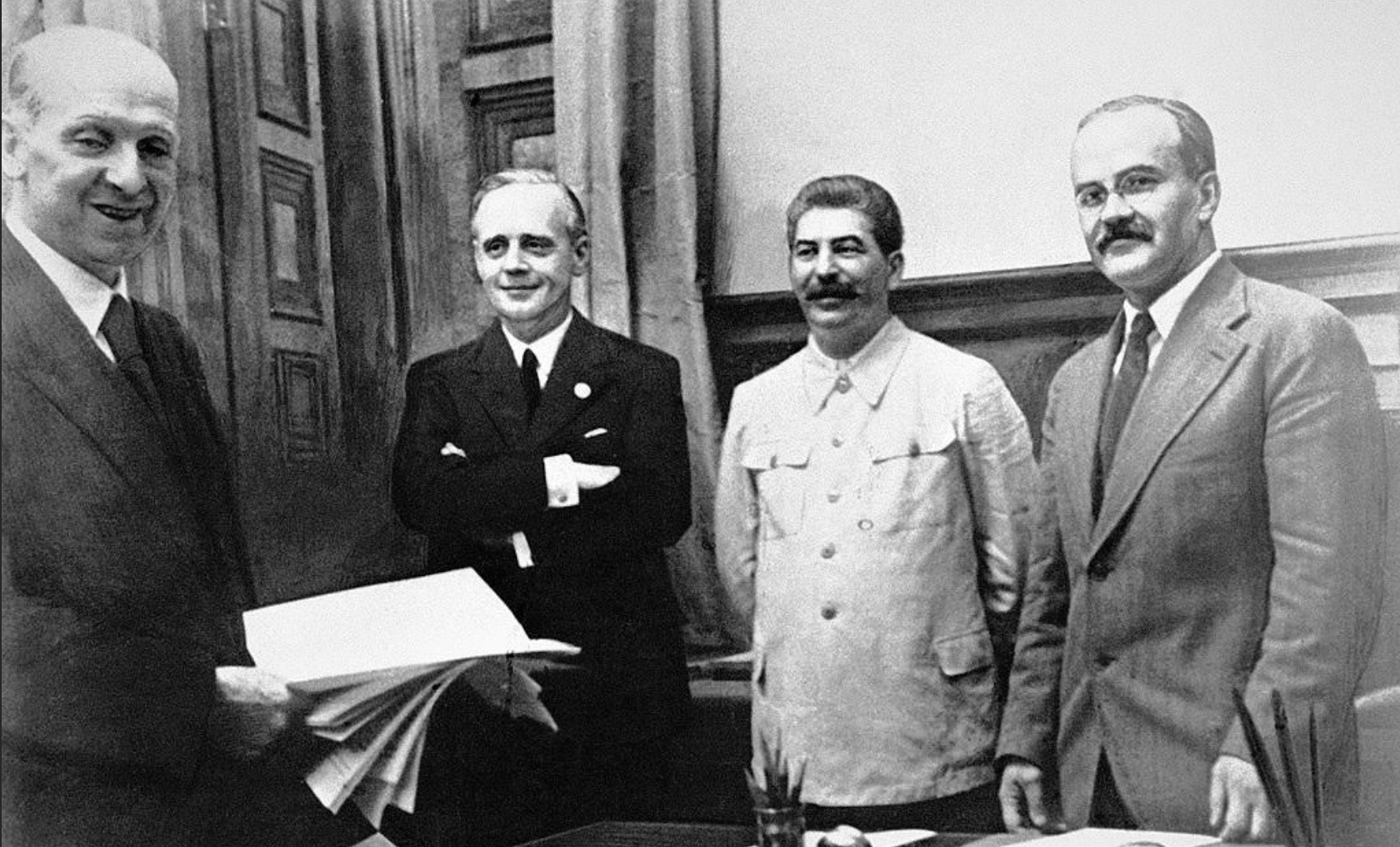
On 23 August 1939, Nazi Germany and the Soviet Union signed a non-aggression pact, commonly known as the Molotov–Ribbentrop Pact. Hidden within its secret additional protocol was an agreement that carved up Central and Eastern Europe into spheres of influence, effectively extinguishing the sovereignty of Poland, Lithuania, Latvia, Estonia, Finland and Romania.
The secret additional protocol, signed in Moscow by Joachim von Ribbentrop and Vyacheslav Molotov in the presence of Joseph Stalin, formed an inseparable part of the “non-aggression pact” between the Third Reich and the Soviet Union. The document consisted of four clauses.
The first clause dealt with the Baltic region. It stipulated that in the event of any political or territorial changes affecting Finland, Estonia, Latvia or Lithuania, the northern frontier of Lithuania would also serve as the dividing line between the German and Soviet spheres of influence. Both parties further acknowledged Lithuania’s claim to the Vilnius area.

The second clause referred explicitly to Poland. Should territorial or political changes occur there, the boundary between German and Soviet spheres would roughly follow the courses of the Narew, Vistula and San rivers. Whether Poland was to remain as an independent state, and if so, within what borders, was left deliberately unresolved: the two governments agreed that such matters would be determined later, in the light of unfolding political events, and settled by mutual “friendly” understanding.
Less widely known was the additional agreement, which was concluded only a month later, on 28 September 1939. This so-called Second Ribbentrop–Molotov Pact, formally titled the Treaty on Borders and Friendship between the German Reich and the Soviet Union, went beyond the earlier general division of interests.

It fixed precise boundaries, laid down rules for population transfers, and regulated property questions. Between 28 September and 4 October 1939, the two powers negotiated the practical details, and on 27 February 1940, a supplementary accord on the “demarcation of the frontier line” was signed, after which boundary markers were erected along its entire length.
To supervise the process, a joint Soviet–German Border Commission was established, with six local subcommittees operating within occupied Poland: three in the Soviet zone (Augustów, Brest and Przemyśl) and three in the German zone (Ostrołęka, Tomaszów Lubelski, and Sanok).
The new border was intended to follow natural geographical features such as rivers, lakes and terrain. In Poland, it largely traced the course of the San and Bug rivers, which led to its nickname, the “wet frontier.”
The treaty also addressed population issues. Two categories were distinguished: organised evacuations of individuals of a particular ethnic background who found themselves on the “wrong” side of the new frontier, and refugees who wished to cross over voluntarily but were not covered by evacuation rules.
Ethnic Germans were resettled to the Reich, while Russians, Ukrainians and Belarusians were transferred to Soviet territory. Both sides resisted extending evacuation rights to anyone else. The Red Army was required to remove populations that “preferred” Soviet rule, but by mid-October 1939, responsibility for policing the frontier had passed to the NKVD. On the German side, the task was entrusted to the SS and the Gestapo.
In total, some 133,000 people were relocated, including ethnic Germans released from prisons and POW camps, former Polish soldiers, and civilians detained by the Stalinist system.
A bilateral agreement on the exchange of prisoners of war, based on their pre-war place of residence, was signed on 20 October 1939. The transfers took place between 25 October and 15 November. Each side maintained two handover points: Dorohusk and Przemyśl for prisoners delivered to Germany, Brest-Litovsk and Chełm for those transferred to the Soviet Union.

The Germans deliberately obstructed the process, for example, by restricting the working hours of evacuation commissions and closing the Przemyśl point ahead of schedule. As a result, tens of thousands of people remained in Soviet hands and were absorbed as cheap labour, often dispatched to industry in the Far East in line with Moscow’s five-year development plan.
The methods tested in Poland were later extended along the wider demarcation line. A further Soviet–German agreement of 5 September 1940 authorised the resettlement of ethnic Germans from Bessarabia and Northern Bukovina. Between 23 September and 15 November that year, evacuation commissions carried out the transfers. On 10 January 1941, two additional accords were signed in Moscow: one concerning the relocation of Germans from Lithuania to the Reich, alongside the removal of Lithuanians, Ruthenians and Belarusians from former German territories into the Lithuanian SSR; the other governing the resettlement of Germans from Latvia and Estonia.
Property questions proved equally contentious. According to the agreements, evacuees were permitted to take personal belongings and a small number of farm animals, but remaining property was seized by whichever state controlled the territory.
Only after evacuations were completed was a final balance of assets to be drawn up. The Soviets, however, declared that only private possessions would be accounted for, meaning they refused responsibility for nationalised German assets such as factories. Technical archives, cadastral records and other documentation from transferred areas became another point of dispute: Germany demanded their return, but Moscow withheld them, arguing they might prove useful.
Both powers engaged in systematic plunder. A secret Soviet order instructed the Red Army to remove from abandoned areas “all military equipment and property,” a phrase interpreted broadly to include virtually anything of potential use in warfare.
Beyond weapons, ammunition, tanks, aircraft, communications equipment and fuel, the seizures extended to railway stock, motor vehicles, grain in silos, livestock (including cattle, horses and poultry), animal feed and valuable goods. The Germans acted similarly.
Despite the formal “treaty of friendship,” cooperation between the two regimes was fraught. The Soviet Union and Nazi Germany were, in effect, ill-matched partners: bound together by strategic need yet separated by deep mistrust. The border they had created, ostensibly the realisation of shared aims, quickly became a source of friction.
The final confrontation of the totalitarian regimes in Europe was only possible when the two defeated their most important regional enemy, the 2nd Polish Republic.
Source: Przystanek Historia, Dzieje
Photo: IPN ENG
Tomasz Modrzejewski