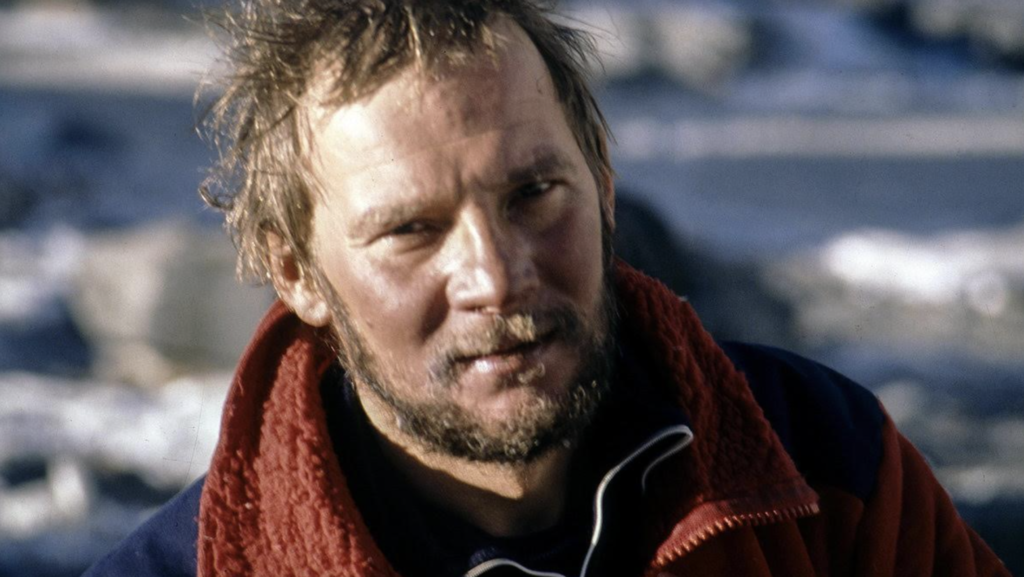
Jerzy Kukuczka was a Polish alpinist and Himalayan climber, the second man on Earth to conquer the Crown of the Himalayas and Karakorum – all 14 major peaks over 8,000 metres high. Until today he is considered one of the best climbers in history.

Jerzy Kukuczka was born in 1948 to a Polish Highlander family that came to Katowice from Istebna, Silesia.
As a pupil at Primary School No. 12 in Bogucice, he was never considered a top student but was very keen on physician activities. He also showed a huge interest in learning geography. Later, he studied at Vocational School and started to work as an electrician at the Signal Devices Factory.
It seems that the most important day of Kukuczka’s life was about to come. On 4 September 1965 one of his friends persuaded him to join him for a climbing trip in the Kraków-Częstochowa Jurassic Highland. It was then that he first came into contact with climbing, which became his trade until the last moments of his life.
As most of the Poles during the communist era Kukuczka served in the military. He was stationed in units in Brzeg, Gdańsk and Gdynia. His military service lasted until 1970. He came back to his greatest passion just after leaving the service.
In 1975 he married Cecylia Ogrodzińska, with whom he had two sons, Maciej and Wojciech. When Jerzy and Cecylia married, unlike most people, he spent his honeymoon on an expedition to the Alps, where he took part in marking out new routes.
The 1980s were the time when Kukuczka took part in the most important competition in his life – he was trying to overtake Reinhold Messner in completing the Crown of the Himalayas. Jerzy Kukuczka decided to join the race, which he publicly announced in the autumn of 1985.
Unfortunately, he eventually lost out to Reinhold Messner, who had completed the ascent of all 14 eight-thousanders in 1986. However it is important to add that unlike Messner, Kukuczka often tried to use new routes while climbing. When Kukuczka completed the race, Messner sent him a message saying: You are not second. You are great.
The most valuable feature of Kukuczka’s achievements was his pioneering and innovative approach to Himalayan climbing. Of the fourteen eight-thousand-metre peaks that make up the Crown of the Himalayas, he climbed ten by new routes, four peaks he was the first to climb in winter, thirteen without oxygen, seven in alpine style and one by himself.
The list of Kukuczka’s most important achievements:
- Lhotse, 04.10.1979. Jerzy Kukuczka with Andrzej Czok, Zygmunt Andrzej Heinrich and Janusz Skorek.
- Mount Everest, 19.05.1980. Jerzy Kukuczka with Andrzej Czok.
- Makalu, 15.10.1981. Jerzy Kukuczka.
- Broad Peak, 30.07.1982. Jerzy Kukuczka and Wojciech Kurtyka.
- Gasherbrum II, 01.07.1983. Jerzy Kukuczka and Wojciech Kurtyka.
- Gasherbrum I, 23.07.1983. Jerzy Kukuczka, Wojciech Kurtyka.
- Dhaulagiri, 21.01.1985. Jerzy Kukuczka, Andrzej Czok.
- Cho Oyu, 15.02.1985. Jerzy Kukuczka and Zygmunt Andrzej Heinrich.
- Nanga Parbat, 13.07.1985. Jerzy Kukuczka, Carlos Carsolio, Zygmunt Andrzej Heinrich and Sławomir Łobodziński.
- Kangchenjunga, 11.01.1986. Jerzy Kukuczka and Krzysztof Wielicki.
- K2, 08.07.1986. Jerzy Kukuczka and Tadeusz Piotrowski.
- Manaslu, 10.11.1986. Jerzy Kukuczka and Artur Hajzer.
- Annapurna, 03.02.1987. Jerzy Kukuczka and Artur Hajzer.
- Shisha Pangma, 18.09.1987. Jerzy Kukuczka and Artur Hajzer.
Jerzy Kukuczka died tragically in 1989 during an attempt to climb the legendary south face of Lhotse, which was unattainable for any climber at the time. Many theorists consider him to be the most outstanding Himalayan climber in history.
A memorial plaque dedicated to him was placed near the south face of Lhotse on the initiative of the Foundation in Support of Polish Mountaineering. He was posthumously awarded the Officer’s Cross of the Order of Polonia Restituta.
Source: ciekawostkihistoryczne.pl, Wirtualne Muzeum Jerzego Kukuczki
Tomasz Modrzejewski