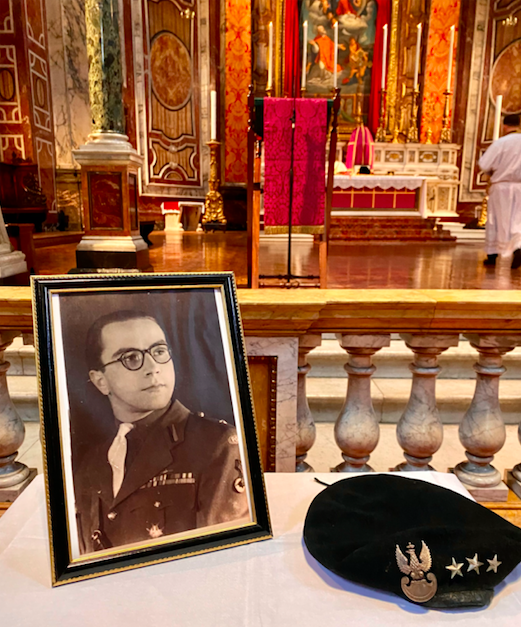
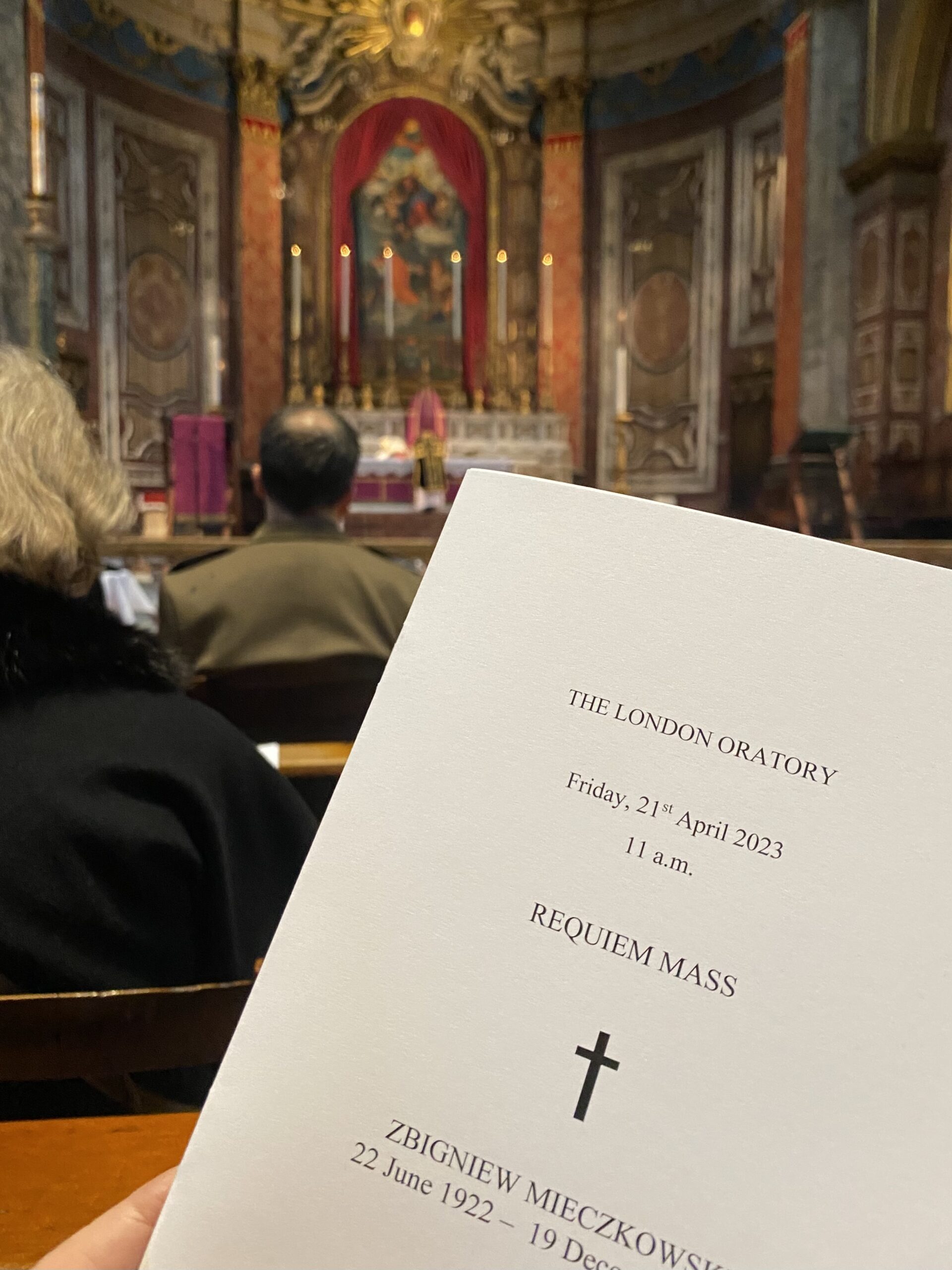
The Polish community of Britain lost an active member of the Polish diaspora in the UK just before Christmas. Major Zbigniew Mieczkowski, a former soldier of General Maczek’s 1st Armoured Division, died peacefully at home at the age of 100 on 19 December 2022. Today, his family, friends and representatives of the Polish Embassy in the UK took part in a touching memorial service at the Brompton Oratory in London.
We had the honour to participate in Zbigniew’s last farewell. Together with his family, friends and the representatives of the Polish Embassy in the UK, we paid tribute to one of the last Polish veterans of WW2.
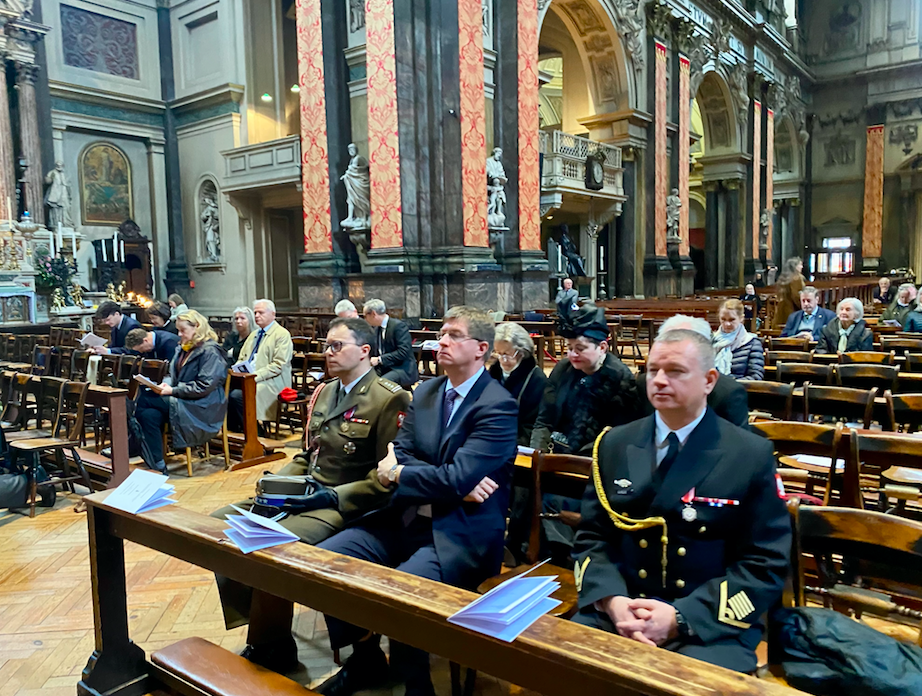
Father Maciej Michałek celebrated the Requiem Mass. Mateusz Stąsiek, Consul General, read the poem ’In connection with the 1st Polish Armoured Division’, and Stefan Mieczkowski delivered the eulogy for his late father.
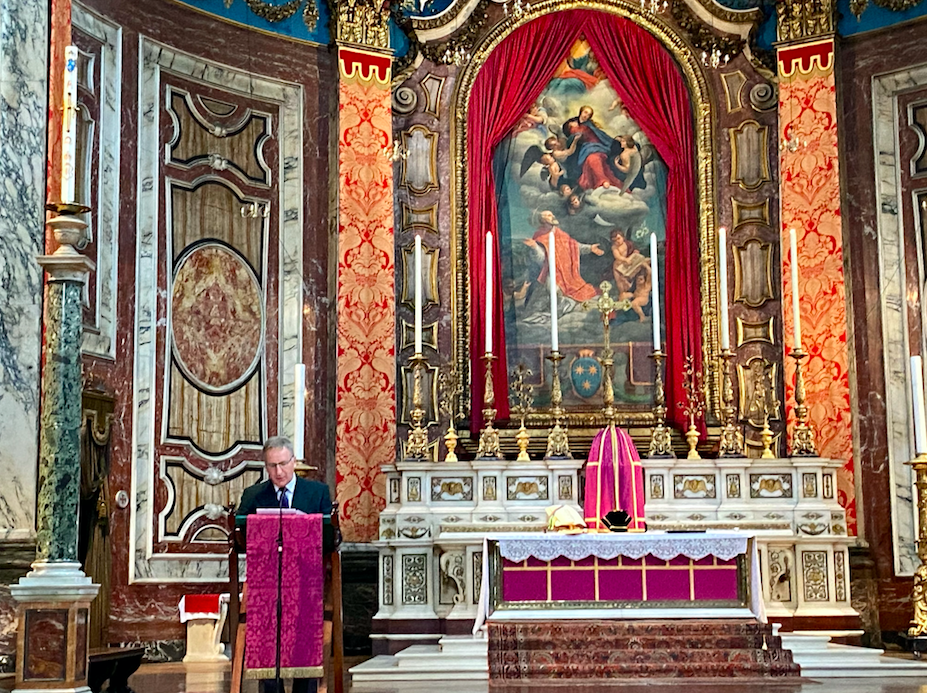
Below you can read the whole eulogy:
„My father Zbyszek was born between wars, at Dzierzanowo, a family estate owned by his father, Stefan, until 1945.
His home, a new manor house replaced the old one, which was fired by invaders during the first world war, his father returned from that war just a year before he was born.
My father was raised in the traditions of the landed gentry of the Second Polish Republic and always described his own father as a man whom he loved and admired but also feared. By contrast in his mother’s eyes, he could do no wrong.
Young Zbyszek was home tutored by a governess until, having ‘escaped and evaded her’ one too many times, in the fields of tall crops around the estate, he was sent to boarding school.
Like most young men in Poland, Young Zbyszek was captivated by the heroic exploits of his forefathers and indeed his own father who saw wartime service with the Polish Chevau-Legers in 1920. This might have explained a certain amount of daydreaming in class and why he found it necessary to foray out on horseback at the beginning of school holidays to intercept the postman bearing his end-of-term school reports.
He often told me how he was shooting partridges in September 1939, the eve of war and I often wondered if he felt a sense of an era coming to an end and if he could have imagined how different things would be, in the years ahead.
As the invaders approached Dzierżanowo, he left his home with a pistol, one of his father’s cars, the equivalent of £100 in cash and with the words of his father resonating in his mind… “I may not see you again, in life, go straight.” His mission was to escort his sister to a maternity clinic in Warsaw (unknown to her, her husband a cavalry officer, had already been killed defending Warsaw) and having completed that mission there was no more guidance and he had to start making his own way. I often reflected that my father’s blue print for his own fatherhood ended abruptly at 17 years old.
Zbyszek volunteered to support the Air Force Evacuation Column as the driver in the car given to him by his father, this unit was responsible for conveying Polish pilots to airbases on the Romanian border where they intended ‘last stand air operations’. The needed replacement aircraft never came.
When Soviet troops entered Poland on 17th September and the defence of Poland became untenable, Zbyszek, crossed the Romanian border determined to rejoin the Polish military reorganising in France.
In November, Zbyszek reached France, joining the Polish Army as a volunteer under the command of General Sikorski. When France capitulated after a very short campaign in 1940, Polish troops alongside allies, were evacuated to Great Britain in order to re-form to continue the fight.
The Polish Army initially guarded the North East Coast against an expected invasion and when this risk reduced they were trained and equipped for Operation Overlord, the Normandy Landings. During his time in Great Britain, Zbyszek completed his Officer Cadet school and, under sufferance, obtained his matriculation certificate at the Lyceum of Juliusz Słowacki in Scotland. He often told me how difficult it was to apply himself to education again and how much he longed to join his regiment.
In 1942, Zbyszek returned to his unit, the 2nd Armoured Regiment of the 10th Armoured Cavalry Brigade part of the 1st Polish Armoured Division, commanded by General Maczek as a 2nd Lieutenant Troop Commander of a Troop of Sherman Tanks.
Having landed at Courcelles Sur Mare using the famous Mulberry Harbour, Zbyszek saw action around Caen, where his sister regiment were all but wiped out in an ill-fated tank charge. Later his own regiment played a pivotal role within General Maczek’s 10th Armoured Cavalry Brigade at the Battle of the Falaise Pocket. His unit conducted a night time flanking manoeuvre which completed the allied encirclement of the 5th and 7th German Armies. For several days his unit, one of two, held the Falaise Pocket closed in the face of desperate efforts by German SS Panzer units to forge an escape route from the West through Polish lines. Other SS units tried to open a route from the Polish rear. Difficulty linking up with flanking formations left the Poles at times surrounded and desperately low on ammunition, before link up operations with the Canadian Corps succeeded.
Zbyszek served throughout the entire France Germany campaign, once slightly wounded, decorated with the Cross of Valour, the Medal of the Polish Army and a number of French, Belgian and Dutch campaign medals.
In 1947 my father was demobilised and, seeing no immediate future in a life in Poland under Russian occupation he opted to settle in Great Britain. Equipped with a scholarship from the School of Foreign Trade in London he made a start in a foreign land and I often wondered how he managed to start making a living barely speaking English. He described to me how he held down many different jobs simultaneously to make ends meet.
Finally his initiative and perseverance paid off and he gained a foot hold in a career in the supply of manufacturing machinery to industry which in due course and after a lot of hard work, led to a lucrative agency.
My father often described to me how he managed to convince buyers of machinery to enter into large contracts on the strength of his book learning, I found one of the training manuals he used when sorting through his personal effects after his death. I suspect his success had a great deal more to do with his confidence: Due to perhaps to his exploits in Normandy (which must have made sales meetings seem something of a picnic) the knowledge of ‘where he was from’ his family and his panache, always immaculately ‘turned out’. Whatever, he clearly impressed his clients, with whom he forged strong business and personal relationships.
In 1966 Zbyszek married our mother, Caroline. He always maintained that he didn’t have a moment’s hesitation, seeing that she was sweet and kind and the daughter of a Baron, Lord Grenfell, coming from nobility herself. She was the perfect wife and mother for his children. Unfortunately due to a misplaced address a year passed between their meeting and the resumption of their courtship. Thankfully, she waited for him. In 1967 I was born and in 1970 my sister Helena, named after our grandparents.
We had a happy childhood on the whole, we were loved, we felt as with many sons and daughters of émigré fathers, the weight of expectation upon us. We were aware that our father worked hard, often leaving before we awoke and returning while we slept, I remember him coming into my room late to give me a kiss goodnight on my head.
Our father tried to recreate something resembling his former life in Poland. Our home, Rose Cottage, was set in park land, he kept horses in which we were expected to take an interest.
We attended church on Sunday at the Devine Mercy college, a Polish mission school run by the Marian Fathers; always late and led in procession to a pew at the front of the church to our acute embarrassment. We too had a part time Polish governess and we too ‘gave her the slip’ to avoid Sunday afternoon Polish language training.
Fiercely proud of his family history and our coat of arms “Za Groba Vel Za Głowa”, our father instructed us in the ways of Polish landed gentry and informed us about the many family heirlooms in our house that my father has somehow managed to retrieve from communist Poland.
We recall the happy weekend routines of family lunch, at which we had to sit up straight, elbows!, a rest (often interrupted by noisy sibling on sibling combat that led to smacks), an afternoon horse ride on an uncontrollable pony, later horse and finally afternoon tea in our small kitchen as the sun went down.
We wanted for nothing and I often wondered what it took to make this transition from relative comfort in Poland to relative comfort in Great Britain in less than 30 years and a world war.
He often told me that his life would be like ‘a bridge’ to establish our family in a new land observing the behaviours and traditions that his father and forefathers knew. Perhaps that is how he interpreted his mission ‘ go straight’.
His plan worked, he saw his children happily married and conscientious of his ideals and loyal to Poland. He saw his grandchildren Henry and Sophie who he loved and in whom he took the greatest pride.
He was mischievous and liked nothing more that to make controversial statements in the hope of getting a reaction, especially amongst extended family.
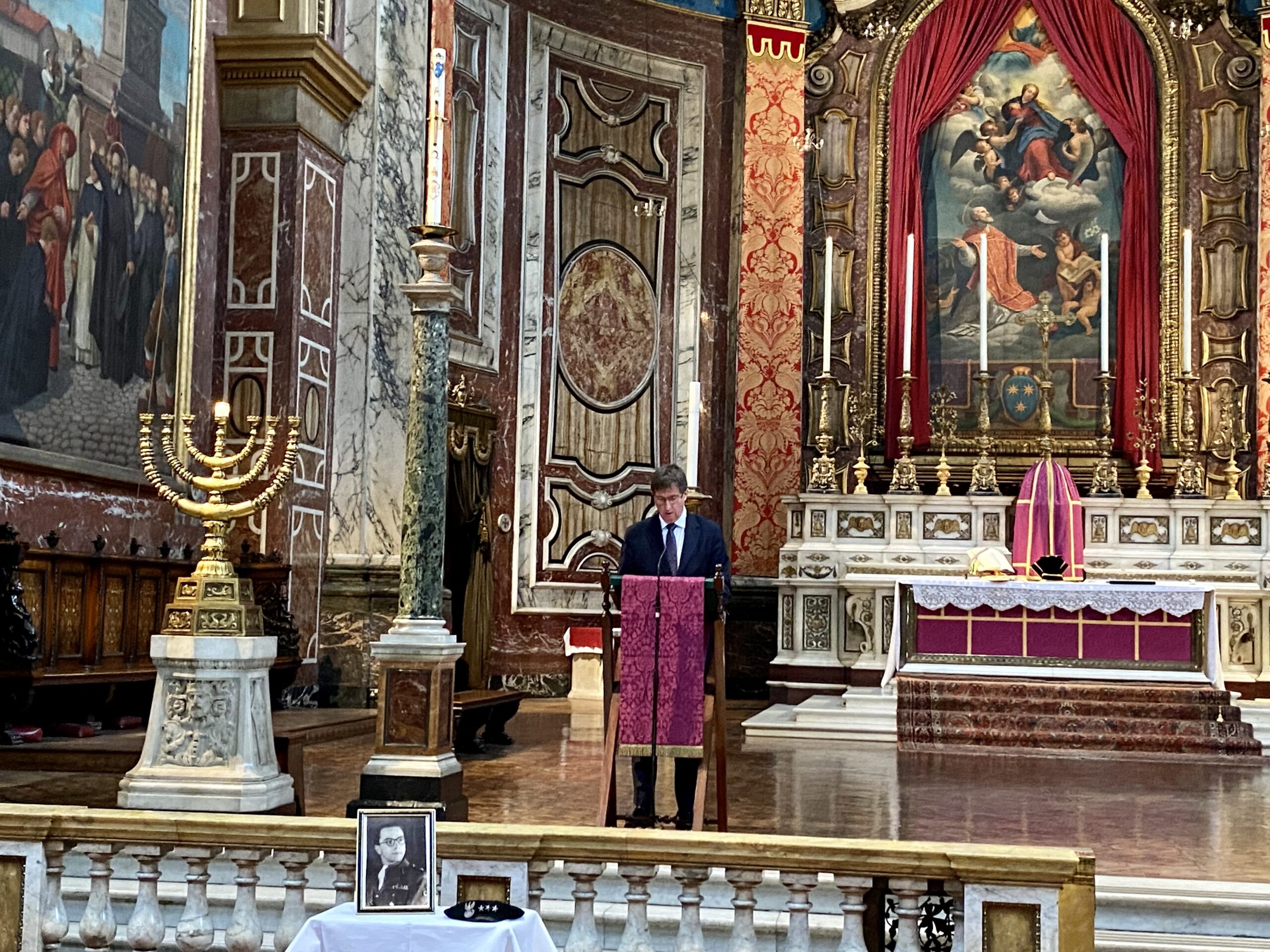
My father after his war, never stopped fighting for Poland. He would often admit to me that his day job was a necessity and not a passion for him. He was driven by sense of injustice at the outcome of the war for the land of his birth, Poland, lost behind the iron curtain.
Through the 1970’s my father played an active role amongst Polish diaspora, for example in the securing and preservation of cultural archives for Poland in Great Britain and further afield. He was active in supporting the Polish Institute and the Museum of General Sikorski in London, and in relocating and organising the Polish Library, as Chairman of the Polish Library Council. He helped to construct and furnish of the Joseph Conrad Centre, being awarded the title of honorary patron of the Society.
He was also an active ‘veteran army officer in retirement’ not least because he felt, with some justification that the Polish tri service contribution to WW2 victory was underestimated, misunderstood and often misrepresented by malign actors. How could it not have been, given our contemporary experience today with Russia.
Through the 1980s our father was often engaged in fierce correspondence with both British and Polish press on matters concerning the misrepresentation of events in Polish History.
He would often show me newspaper cuttings with which he took issue and his response to the hapless editor concerned, which was often published. Both article and response had to be mass photocopied in Henley by our ever patient mother, for further distribution in London from the boot of his car.
Putting humour aside there is no doubting our father’s impact, his ability to promote a cause, whether: The matter of the succession to the Office of the President of the Republic of Poland, the preservation of the concept of government in exile; securing European / Atlantic recognition for War time Polish Generals; raising monuments to the exploits of Polish soldiers and fallen comrades across Europe) and his ability to engage the British and European elite (whom he regarded as nothing more than his social circle) was formidable, always with secretarial and social execution support from our mother. I often wondered, had it not been for those lost 30 years, what might he have achieved in free Polish politics or diplomacy.
For many years of such work our father was awarded: Commander’s Cross of the Order of Polonia Restituta (by President Lech Walęsa himself), Order Wojenny Virtuti Militari, Order of Leopold Officers Cross (Belguim), Chevalier de La Légion D’Honneur and recently in 2021 our father was awarded the Medal of the Centenary of Regained Independence, a medal awarded by the President of the Republic of Poland as a token of gratitude and an expression of respect for those who have made particular contributions in the service of the State and society.
Maybe it was as a result of sharing some of those uncomfortable truths about Poland’s fate after the War that he was never recognised with a British Honour? …… He did however receive his telegram from the Queen on reaching his 100th birthday.
For all the ‘titles’ that he earned in his life, the one of which he was most proud was: Major Zbigniew Mieczkowski, Polish Forces and the one of which fate largely deprived him: Zbigniew Mieczkowski Squire of Dzierżanovo and Cibórz, Poland.
Born 22 June 1922, died 19 December 2022,
Rest in Peace.”
You can read more about Zbigniew in our article: Zbigniew Mieczkowski, a former soldier of General Maczek’s 1st Army, died at age 100.
Zbigniew’s autobiographical book “Horizons. Reflections of a Polish Émigré” gives an exciting insight into the rich life of this remarkable patriot and his efforts as an indefatigable freedom fighter. You can buy the book here.
Images: family Mieczkowski’s archive, British Poles
Author: Maria Byczynski