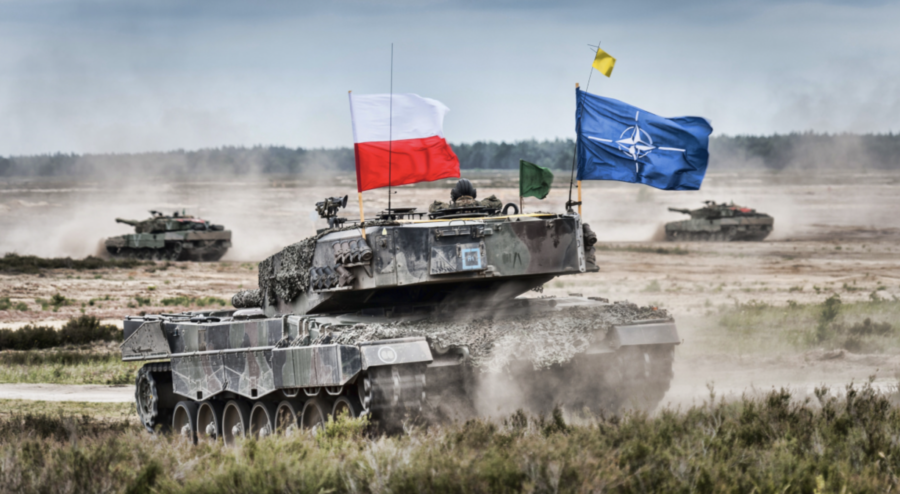
It was 26 years ago, on 12 March 1999, when Poland, Czechia and Hungary joined the North Atlantic Alliance. After years of standard membership, all countries exposed to the military threats from the East unite to demonstrate their willingness to defend each other.
Polish foreign policy efforts aimed at linking Poland with the West and its institutions began after the political breakthrough in 1989. The initial goal of the Poles was to create ties with the West in the defence sector as they believed NATO membership was impossible with the USSR as its neighbour.
In October 1989, for the first time, two Polish MPs, who formally were still representatives of a member state of the Warsaw Pact, were invited to the NATO Parliamentary Assembly in Rome.
Poland established diplomatic relations with NATO in March 1990, when the head of the Ministry of Foreign Affairs, Krzysztof Skubiszewski, paid a visit to the NATO Headquarters in Brussels.
In July 1990, during a summit in London, the Alliance offered the Warsaw Pact members a partnership and invitation to explore military relations, recognising that the two blocs were no longer adversaries.
In a letter to Prime Minister Tadeusz Mazowiecki, US President George Bush announced an invitation to Poland and other countries in the region to establish functioning relations with NATO.
During the Atlantic Council meeting in September 1991, Prime Minister Jan Krzysztof Bielecki called for opening NATO membership for Central and Eastern European countries.
That idea was supported by Polish Prime Minister Jan Olszewski in a parliamentary expose, announcing closer ties with NATO and recognising the Alliance as “a pillar of European security and the presence of US troops in Europe as a stabilising factor”.
As early as 1992, the Polish defence doctrine included the goal of Poland’s membership in NATO. At that time, for both the USSR and the West, the only state that was about to join the Alliance was united Germany.
The Russian Federation, like the USSR before it, expected guarantees that there would be no bases on the territory of the new member states where troops of other Alliance countries would be stationed.
In many talks, Russian representatives said the US promised no NATO enlargement to the East, but any previous declarations in that matter were never a part of an international law act and also did not apply to the Russian Federation as being made to its predecessor, the Soviet Union.
Also, the talks of the US Bush administration and the USSR head Gorbachev were never turned into an official bilateral agreement as the latter was desperate for financial aid from the US at the time of the crisis connected to the collapse of the Soviet system.
The argument that blames the US for breaking NATO expansion “agreements” with the USSR/Russia is perfectly explained in the video you might watch below.
In 1996, US President Bill Clinton recommended the admission of new members no later than 1999, on the 50th anniversary of NATO’s creation.
In October 1997, Poland’s accession talks with the Alliance were concluded. In November, Poland, the Czech Republic and Hungary participated in a multilateral defence planning session for the first time.
In 1998, the official ratification process began. The first instruments of ratification were submitted to the US State Department by Canada in February, with the Netherlands being the last to do so in December.
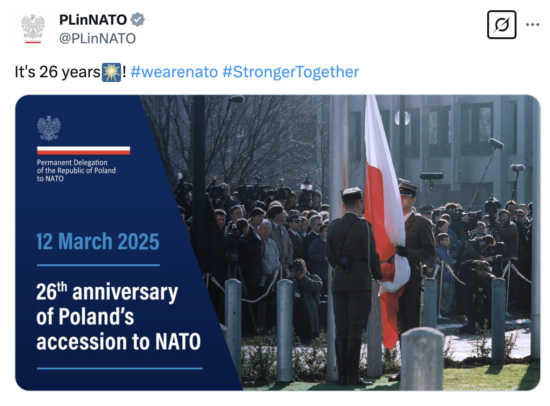
On 12 March 1999 in Independence, Missouri, Poland, the Czech Republic and Hungary were officially admitted to NATO. The foreign ministers of the three countries handed over the so-called instruments of ratification to Secretary of State Madeleine Albright.
Even before the formal admission of the new members, the diplomats of these countries were given free access to the offices of the International Secretariat at NATO headquarters in Brussels. The following day, the flags of Poland, the Czech Republic and Hungary were hoisted in front of the Headquarters in Brussels.
On 11 February 1999, the Polish parliament empowered the President to ratify the Washington Treaty.
On 18 February 1999, President Aleksander Kwaśniewski signed the Act of ratification to the Treaty, which was later approved on 23 February by Prime Minister Jerzy Buzek.
From the very beginning of its membership, Poland was an active contributor to defence missions coordinated by NATO, first in Yugoslavia and then in the Middle East.
In 2004, more countries from Central and Eastern Europe were allowed to join NATO. Lithuania, Latvia, Estonia, Romania, Slovakia, Slovenia and Bulgaria joined the Alliance in a single enlargement.
The important factor was also that those countries included former member states of the Soviet Union until 1991. Lithuania, Latvia and Estonia were able to distance themselves from their previous oppressor, which controlled them in the form of republics.
The Bucharest Summit in April 2008 brought a declaration to invite new CEE countries, namely Georgia and Ukraine, as future members of NATO.
After that declaration, Georgia was invaded by Russia, and Ukraine transformed into a more pro-Western country, which eventually forced it to fight a defensive war since 2014 and full Russian aggression from 2022.
Since the beginning of the war, Poland has become the most important NATO member state in the CEE region for transporting Western weapons to Ukraine and has also become a humanitarian hub that accepted some 2 million Ukrainian war refugees.
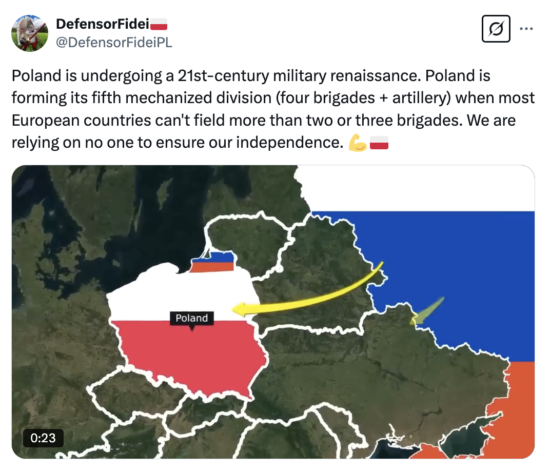
Today, Poland is one of NATO’s top financial contributors, with more than 4,7 percent of its GDP allocated for defence and its plans to develop an army of 300,000 soldiers already making it the 3rd largest military force of the Alliance after the US and Turkey.
Source: Dzieje.pl
Photo: Shape NATO
Tomasz Modrzejewski