A video circulating on social media has been presented by several Ukrainian accounts as yet another example of hostility towards Ukrainians abroad. The footage shows a man, apparently Polish and driving a Bentley with Polish registration plates, confronting a group of Ukrainians in London who were collecting donations for the Ukrainian Armed Forces.
Some reports described the incident simply as a Polish man “verbally abusing” or “insulting” Ukrainian volunteers. One widely shared account stated that the man shouted at people raising money for Ukraine’s military, calling them “Banderites” and “nationalists”.
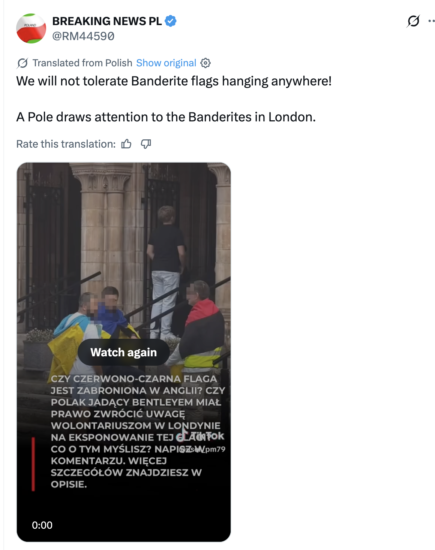
There is, however, an important element of the footage that substantially changes the context of the confrontation: one of the Ukrainian fundraisers appears to be displaying the red-and-black flag associated historically with the Bandera faction of the Organisation of Ukrainian Nationalists (OUN-B) and the Ukrainian Insurgent Army (UPA). The Polish-language post which circulated the footage explicitly presents the man’s intervention as an objection to the display of a “Banderite flag”.
For a Polish observer, this is far from an insignificant detail.
The red-and-black flag is not Ukraine’s national flag
The official Ukrainian flag is blue and yellow. The black-and-red banner belongs to a very different political and historical tradition.

The flag became associated with the Bandera faction of the Organisation of Ukrainian Nationalists and subsequently with the Ukrainian Insurgent Army. Academic accounts of its historical symbolism have interpreted the combination as representing **blood and soil**: red for bloodshed in the struggle and black for the Ukrainian soil or homeland.
That symbolism inevitably carries particularly disturbing connotations in a European context because the concept of “blood and soil” — *Blut und Boden* — was also a central element of Nazi racial and nationalist ideology.
In Poland, the red-and-black banner is inseparably associated with the OUN-B and UPA and with the massacres of the Polish civilian population in Volhynia and Eastern Galicia during the Second World War. Tens of thousands of Polish civilians were murdered during the ethnic-cleansing campaign carried out by Ukrainian nationalist formations.
For this reason, displaying the flag can provoke a reaction among Poles fundamentally different from that produced by the ordinary blue-and-yellow Ukrainian national flag. The red-and-black banner is widely perceived in Poland not simply as a patriotic Ukrainian symbol but as the emblem of a political movement responsible for the murder of Polish civilians.
The controversy remains very much alive. Polish President Karol Nawrocki has called for the red-and-black flag associated with the UPA to be legally prohibited in Poland, explicitly referring to its historical “blood and soil” symbolism and distinguishing condemnation of Bandera’s ideology from hostility towards Ukrainians as a nation.
Criticism of a symbol is not necessarily hostility towards Ukrainians
None of this automatically justifies abusive language. Nor can a short social-media video establish everything that was said before or after the recorded exchange.
But describing the incident merely as “a Polish man attacking Ukrainians collecting money for their army” removes a crucial piece of information.
According to the footage and the accounts circulating it, the confrontation was not taking place in a vacuum. The Polish man appears to have reacted specifically to a symbol historically connected with the Bandera movement and the UPA. He used precisely those terms “Banderites” and “nationalists” during the exchange.
Supporting Ukraine in its defence against Russian aggression does not require Poles to accept the public display of every symbol used by Ukrainian nationalist movements. It is entirely possible to support Ukrainian sovereignty, raise money for Ukrainian soldiers and condemn Russia’s invasion while simultaneously rejecting the political tradition of Stepan Bandera and the OUN-UPA.
Indeed, presenting every objection to Bandera-associated symbolism as **anti-Ukrainian hostility** risks making serious Polish-Ukrainian historical reconciliation more difficult rather than easier.
The more accurate description of the London episode is therefore not simply that “a Pole encountered Ukrainian volunteers and verbally attacked them”. It is that “a Polish man confronted Ukrainian fundraisers, one of whom was displaying a highly controversial red-and-black nationalist flag, and reacted verbally to that symbol”.
Whether his language was appropriate can certainly be debated. But the symbol that apparently triggered the confrontation should not be edited out of the story.
In Polish-Ukrainian relations, historical memory matters. So does context.
Tomasz Modrzejewski