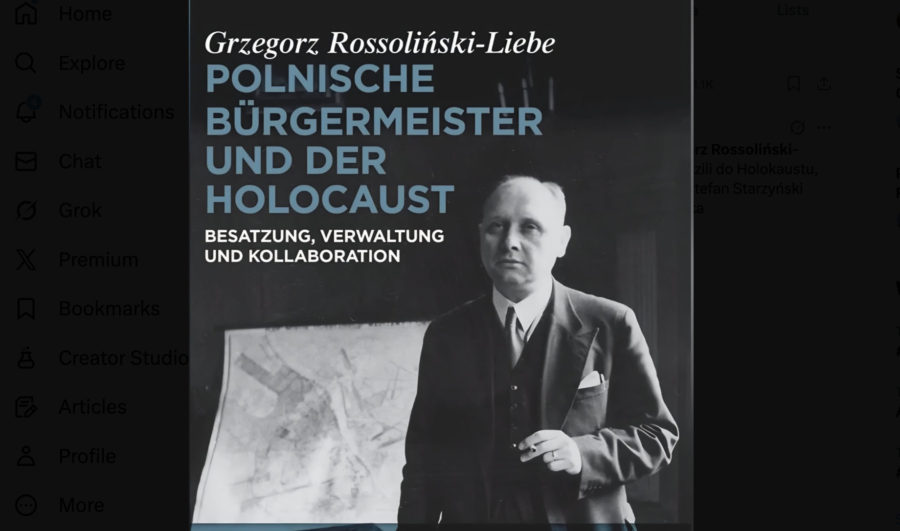
Grzegorz Rossoliński-Liebe’s book on Polish local authorities during the Nazi German occupation of Poland was sharply criticised by both the Polish Press Agency (PAP) and Polish Television (TVP) in December 2025. The subject has now returned to Poland’s public media agenda following a new PAP article that presents the book in a positive light and calls for a more open approach by both public and private institutions responsible for preserving the memory of the Holocaust and the German occupation of Poland. This change in narrative drew the public attention of historians and the media.
In his publications, Rossoliński-Liebe describes the Holocaust as a “transnational crime” committed by Europeans. The role of Poles is portrayed as that of actors who frequently initiated crimes against Jews and were enthusiastic participants in the extermination of ethnic minorities.
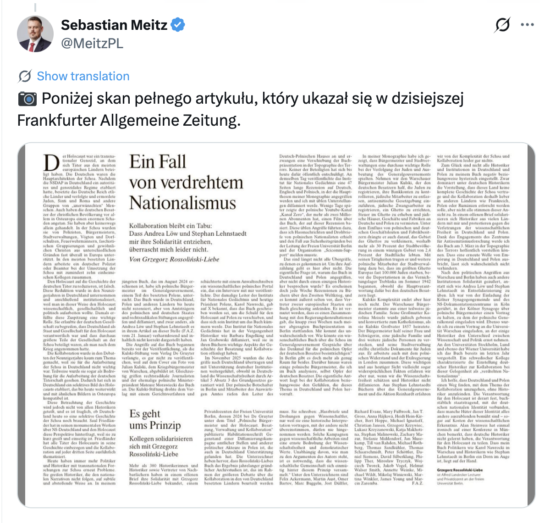
According to the recent PAP article, historians now “emphasise that the issue of relations between Polish and German officials cannot be swept under the carpet.”
Some scholars, including Prof. Majewski, argue that the fact that the book examines the fate of around 35 out of approximately 1,000 Polish officials working under German occupation does not render the publication biased or worthless simply because it is based on a small sample of cases.
“A study based on a small sample is, by its very nature, exploratory. There is nothing wrong with that. In such cases, the value of a historian’s findings depends on how the sample was selected and whether it is representative. Describing all representatives of the local administration exceeds the capacity of a single scholar and may in fact be impossible, since not all documents from the period of occupation have survived to the present day. Future historians will examine the activities of mayors in other towns and may arrive at the same, similar, or entirely different conclusions. There would be nothing extraordinary about this—that is how scholarship develops,” said Prof. Majewski.
In an interview with PAP, Rossoliński-Liebe explains:
“[…] I studied Polish mayors. I did not study Ukrainian. I also examined four who signed the Volksliste and who, until signing it, had been Poles. Moreover, as I have already said, there was no German administration in the General Government. There was a German–Polish
administration. The General Government was established by the Germans and ruled by Germans, whereas in municipal offices virtually all employees were Polish.”
He adds:
“Polish mayors were more involved in the persecution than in the killing of Jews, although they also contributed to their extermination.”
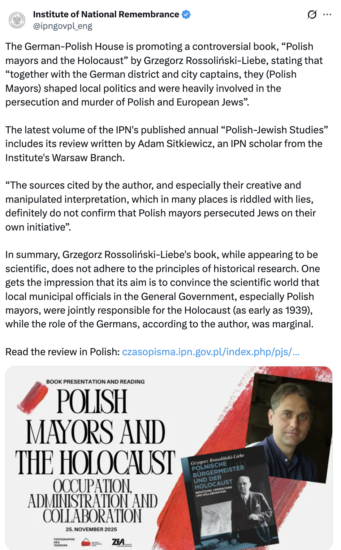
Notably, in mid-December 2025, PAP published a statement by Poland’s Institute of National Remembrance, which stated:
“Rossoliński-Liebe disregards the context of terror employed by the Germans, including the introduction of the death penalty for hiding Jews, as well as the subordination of the so-called Blue Police to the German police forces. The reviewer also criticises the claim of legal continuity between the Second Polish Republic and the General Government, attributing to the author an intention to demonstrate collaboration, whereas the facts point to the coerced nature of the work performed by Polish officials.”
According to the website Niezależna.pl, the shift in narrative results from the selection of scholars invited to present their views in the PAP article, most of whom are alumni of German academic programmes sponsored by institutions representing German national interests or institutions with historical links to Nazi Germany.
“PAP presents its interlocutors as impartial Polish historians, suggesting that virtually the entire academic community is calling for a serious debate on the author’s theses. We have examined who the cited experts actually are. The conclusions are shocking: three of the four individuals quoted by the agency are fellows or former employees of German institutions, while the fourth has ‘gained notoriety’ for removing Polish national heroes from a museum in Gdańsk,” Niezależna.pl writes.
The content of the book was also criticised in a fact-checking programme broadcast by Poland’s national television, the TVP.
In a segment entitled “Manipulations on the Holocaust”, a TVP journalist invited Polish researchers and representatives of institutions dedicated to preserving the memory of the Second World War to comment on Rossoliński-Liebe’s publication.
“The conclusions that are in this book are, in fact, not based on the quoted sources, but are rooted in commentary-driven beliefs of the author,” said Hanna Radziejewska, head of the Pilecki Institute in Berlin.
“The title is scandalous, because the use of such a methodological device—selecting only Polish mayors for analysis—is in fact an attempt to equate them with the Nazi German occupation authorities in Poland,” said Prof. Witold Mędykowski.
“The book is based on generalisations. For example, the issue of involvement in the extermination of Jews is illustrated using the case of three mayors, all of whom were Volksdeutsche. And there are even more generalisations in that book,” Prof. Mędykowski added.
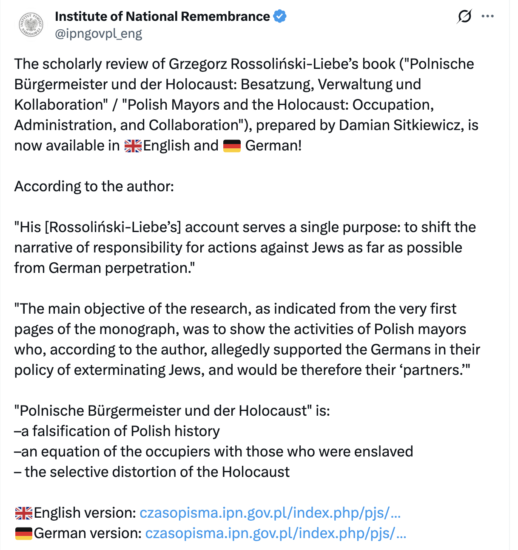
The opinions, scholarly reviews and statements previously published by both PAP and TVP are now being openly challenged by a selected group of historians who share a positive sentiment about the book in the same media.
Photo: X/@KrokTomasz
Tomasz Modrzejewski