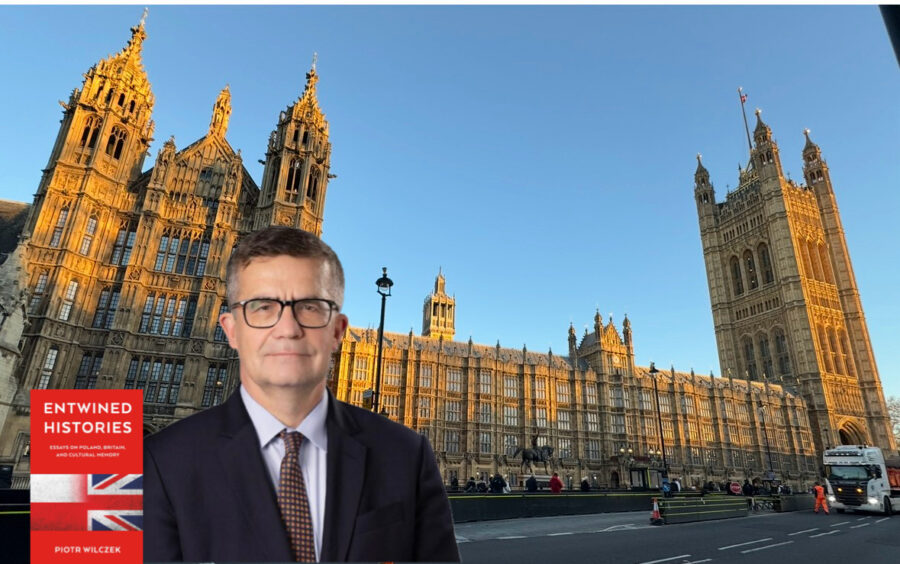
In his recently published book Entwined Histories: Essays on Poland, Britain, and Cultural Memory, Professor Piotr Wilczek takes the reader through more than five centuries of Polish–British encounters. He writes about Jan Dantyszek’s mission to the court of Henry VIII, Lord Byron and Adam Mickiewicz, Winston Churchill and the Yalta Conference, Polish London, the BBC, Joseph Conrad, Krystyna Skarbek, and London’s bookshops, clubs and restaurants.
In conversation with British Poles, he explains why London can be described as one of Poland’s capitals; how British and Polish memories of the end of the Second World War differ; how a British prince might have become King of Poland; and why living between two cultures need not mean being torn between them, but can instead offer an especially valuable perspective.
British Poles: Professor Wilczek, the book contains many personal recollections, yet you stress that it is not a conventional ambassador’s memoir. So what exactly is Entwined Histories?
Piotr Wilczek: I did not want to write yet another volume of a former diplomat’s memoirs in which the main focus is on meetings with politicians, what goes on behind the scenes in negotiations and official events. Nor is it an academic monograph. It is a collection of 37 short essays, written, as it were, in the margins of official life.
Their point of departure may be a place, an object, a painting, a book or a chance conversation. I sit at Edward Raczyński’s desk in the embassy and begin thinking about the continuity of Polish diplomacy. I look at a portrait of General Maczek and am reminded of the fate of Polish soldiers who won the war but could not return to a free homeland. I walk into a London bookshop and wonder why some Polish writers become part of the world canon while others remain almost unknown. The book is less about political decisions than about what happens in between them: memory, symbols, language and encounters that often leave a more lasting mark than official communiqués.
British Poles: Why did you choose the title Entwined Histories?
Piotr Wilczek: Because the histories of Poland and Britain do not run alongside each other like two independent lines. Again and again, they intersect, diverge and come together once more. Sometimes this happens at moments of high drama, as during the Second World War; at other times, in far less obvious realms – literature, religion, art or the history of ideas.
Five hundred years ago, Jan Dantyszek came to England as King Sigismund the Old’s envoy to the court of Henry VIII. During the Reformation, Polish and British religious texts circulated between the two countries, translated and adapted to local controversies. In the nineteenth century, Byron became almost a national poet for the Poles, although he never visited Poland. In the twentieth century, London was the seat of the Polish government-in-exile, while British radio provided Poles with a lifeline to the truth.
These are not simply examples of ‘bilateral relations’. They are stories of mutual influence. Each side, in looking at the other, also learnt something about itself.
British Poles: One of the most important essays is entitled ‘London, the Other Polish Capital’. A revised version appeared in the online edition of The Spectator in June and, for several days, remained among the five most-read articles on the site. Can London really be described as a second Polish capital?
Piotr Wilczek: It is a metaphor, of course, but one with very concrete historical foundations. For decades, London was the capital of Poland in exile – the place where the Polish president, government, military institutions, publishing houses and intellectual circles were based. Here, the symbols of the continuity of the Polish state were preserved while Warsaw was governed by authorities subordinated to Moscow.
But Polish London was much more than a collection of offices. It was a world of bookshops, periodicals, parishes, cafés, theatres and Saturday schools. It was a place where people unable to return to their homeland tried to preserve its language and memory. The Polish Institute and Sikorski Museum, Ognisko Polskie, POSK and Polish churches were not simply émigré institutions. Together they created a substitute sphere of Polish public life.
Today, London no longer functions as Poland’s political capital in exile. It remains, however, one of the most important Polish metropolitan centres outside Poland – a city where successive waves of Polish presence overlap.
British Poles: Is there a genuine continuity between the wartime émigré community and the Poles who came to Britain after 2004?
Piotr Wilczek: These are very different experiences. Post-war émigrés often lived with the knowledge that they could not return home without risking repression or accepting a system they did not recognise. For today’s migrants, the border is open, the journey to Poland takes only a few hours, and the decision whether to stay or return is usually of an entirely different kind.
That does not mean, however, that there has been a complete break. The post-2004 community inherited institutions, places and a certain symbolic capital created by earlier generations. It makes use of Polish schools, parishes, clubs, libraries and cultural centres that did not spring up yesterday. At the same time, it brings them new energy and a new language.
The questions that remain shared are those of identity, bringing up children, preserving the language, and the relationship between where one comes from and where one lives day to day. There is no need to choose one identity at the expense of the other. Living in two cultures can be a privilege rather than a source of division – allowing us to see things in both societies that are invisible to those looking from only one perspective.
British Poles: How did your experiences as a scholar and a diplomat come together in this book?
Piotr Wilczek: A diplomat has access to people, places and ceremonies that remain inaccessible to most. A scholar, by contrast, has the professional habit of asking questions: where does this ritual come from, what does that symbol mean, what history lies behind an apparently ordinary object?
When I worked at the embassy in Portland Place, I could not forget that I was sitting at a desk once used by Edward Raczyński, one of the most distinguished Polish diplomats of the twentieth century. Living on Grosvenor Square, I could see from my window the former American embassy and a place associated with Eisenhower, Reagan and the history of British–American relations. As a former ambassador in Washington, I suddenly found myself at a point where my two diplomatic experiences met.
I was not interested, however, in revealing what went on behind closed doors. I was more fascinated by the ways in which history remains present in rooms, paintings, books and even in the manner in which conversations are conducted. In that sense, diplomacy sometimes begins in a bookshop or at a café table.
British Poles: In the book you describe an unusual situation: you presented letters of credence to Queen Elizabeth II twice, yet never met her in person.
Piotr Wilczek: It is one of the more curious paradoxes of my diplomatic service. The first time I presented letters of credence was in the Bahamas, where the Queen was represented by the Governor-General. The ceremony took place in tropical surroundings, but with all the majesty and precision of monarchical tradition.
A few years later, as ambassador to the United Kingdom, I travelled by ceremonial carriage to Buckingham Palace. By then, in March 2022, the Queen’s health was fragile and she was staying at Windsor, so the audience took place by video link. When I told her that this was the second time I had presented letters of credence addressed to her – the first had been in the Bahamas – she looked slightly surprised.
The story shows that tradition need not mean rigidity. The British monarchy was able to preserve the significance of the ceremony while adapting its form to exceptional circumstances.
British Poles: You devote a separate chapter to Winston Churchill. Why is he viewed so differently in Poland and Britain?
Piotr Wilczek: For the British, Churchill is above all the leader who, at the most difficult moment, refused to contemplate capitulation and rallied the country to fight on. That view is entirely understandable. Without his determination, the history of Europe might have been very different.
Poland’s experience of 1945, however, was different. For Britain, it was the year of victory. For Poland, it marked the end of German occupation but also the beginning of subordination to the Soviet Union. Poles fought from the first day of the war to the last, yet when it ended they found themselves outside the free West.
I am not interested in simply blaming Churchill. He was operating in dramatic circumstances, when the Red Army already occupied Central Europe and the West’s options were limited. Yet Poles lived with the consequences of the Yalta settlement for nearly half a century. The same figure can therefore symbolise victory and freedom for one nation, and for another a compromise whose price was the loss of sovereignty. A mature historical conversation should be able to accommodate both truths.
British Poles: One of the most surprising stories concerns a British prince who might have become King of Poland. How serious was the idea?
Piotr Wilczek: In the late 1930s and early 1940s, when Poland found itself caught between the growing power of Hitler and Stalin, an idea emerged to restore the monarchy and invite Prince George, Duke of Kent, the younger son of King George V, to take the Polish throne. I am not claiming that this was a fully formed plan on the verge of implementation. It was rather an idea at the intersection of strategy, symbolism and diplomatic imagination.
A British prince as King of Poland could have become a visible sign of Poland’s alignment with the West and an additional guarantee of British commitment. The war, and Prince George’s death in an air crash in 1942, ensured that the idea remained only a fascinating question of what might have been.
Yet the story has an afterlife. Prince George’s son, the present Duke of Kent, has maintained close relations with the Polish community for many years, visits Ognisko Polskie and takes part in commemorations of Polish airmen. It is a good example of how a diplomatic idea, even one never realised, can leave behind a lasting bond.
British Poles: You also write very personally about the BBC Polish Section. What role did it play for your generation?
Piotr Wilczek: In Poland in the 1970s and 1980s, merely tuning a radio to a foreign station was an act of disobedience. Through the crackle, interference and static came a calm voice from London, describing reality without the slogans of propaganda.
The BBC did more than report the news. It also embodied a certain style of public debate: factual, restrained and free of shouting. For many Poles, it was a link to normality. Even the weather forecast from London had a particular charm, because it came from a world in which information was not treated solely as an instrument of power.
Disinformation works differently today. Jammers are not always needed; algorithms, emotionally charged messaging and closed information environments are enough. That is why the history of the BBC Polish Section is not merely a nostalgic curiosity. It reminds us that credible media and calmly presented facts can have political and moral significance. Polish diaspora media also play an important role, because they bring the community together, preserve its memory and help interpret events in both countries.
British Poles: One chapter bears the provocative title ‘Polish Nobel Prize Winners — Were They Really Polish?’. Are you questioning whether our Nobel laureates were really Polish?
Piotr Wilczek: Quite the opposite. What I question is the assumption that a writer’s identity can be neatly confined to a single national category. Isaac Bashevis Singer was born and raised in Poland, wrote in Yiddish, and received the Nobel Prize as an American citizen. Czesław Miłosz was a Polish poet born in Lithuania and also an American citizen; he lived for many years in France and the United States, while belonging at the same time to several cultural traditions. Wisława Szymborska seems a much more straightforward case. Olga Tokarczuk is deeply rooted in Polish reality, but her literature speaks to readers around the world.
So the question is: what determines a writer’s national affiliation – language, citizenship, birthplace, subject matter or self-identification?
Translation, too, plays an enormous role. A writer may be outstanding, but without a superb translator, the right publisher and critics willing to introduce them to readers, they may never reach an international readership. In that sense, the translator is one of the most important, though often invisible, diplomats of culture.
British Poles: You write engagingly about the British monarchy, but also about the thousandth anniversary of Bolesław Chrobry’s coronation. Why should a modern republic celebrate the coronation of a king?
Piotr Wilczek: Because this is not about nostalgia for monarchy, nor about any idea of restoring it. Bolesław Chrobry’s coronation in 1025 was above all an affirmation of Poland’s sovereignty and its place among the Christian states of Europe.
The British see the monarchy as a living institution that provides continuity. Poles tend to view the crown more as a symbol of historical independence. Our state has repeatedly been destroyed, partitioned and occupied, which gives symbols of continuity a particular importance. The crowned White Eagle is, after all, still the emblem of the Republic of Poland.
Watching British ceremonies helped me to understand more clearly that ritual need not be empty spectacle. It can preserve a community’s memory and remind us that institutions are older than the political conflicts of the moment. In Britain, the monarchy symbolises continuity. In Poland, the memory of the old monarchy symbolises above all the state’s capacity for renewal.
British Poles: The book can also be read as a personal guide to London. Which places mattered most to you?
Piotr Wilczek: It is difficult to rank them, because each represents a different dimension of London. The Warburg Institute was formative for me intellectually – I conducted research there in the 1990s and later, as ambassador, organised a meeting marking the 500th anniversary of the first Polish diplomatic mission to England.
The National Gallery reminds me of my first visit to London in 1988, when, as a young scholar from communist Poland, I saw for the first time paintings I had previously known only from reproductions. Wigmore Hall is a place where one can step away from the official routine for a while and concentrate entirely on the music.
Then there are the bookshops: Daunt Books, Hatchards, Foyles, and the Polish bookshop at POSK. And, of course, the centres of Polish social life – Ognisko Polskie and Daquise. In these restaurants, history is not an exhibit behind glass. It lives in conversations, menus, photographs and encounters between successive generations. I wanted to show that memory is preserved not only by monuments and archives, but also by parks, concert halls and bookshelves.
British Poles: What might British readers learn from this book about Poland, and Polish readers about Britain?
Piotr Wilczek: The British image of Poland is sometimes confined to the Second World War, communism, Solidarity and the most recent wave of migration. All of these subjects matter, but Poland also has a long tradition of Western Christianity, Renaissance humanism, religious pluralism, literature and republican political thought. It was not merely a peripheral part of Europe, but took part in the continent’s most important intellectual and political debates.
Poles, for their part, often see Britain through a handful of simplified images: empire, monarchy, aristocracy and pragmatic foreign policy. Yet it is a society full of contradictions – deeply attached to tradition, yet able gradually to transform it; outwardly restrained, yet possessed of an exceptionally sharp sense of humour; conscious of its own history, but not always aware of how others remember that history.
The most interesting moment comes when we look at our own country through the other side’s eyes. We then notice things that had previously seemed too obvious to be seen.
British Poles: Is the book addressed particularly to Poles living in Britain?
Piotr Wilczek: I think Poles living in Britain may recognise much of their own experience in the book. They inhabit two landscapes of memory at once. They understand Polish references, but can also understand British codes, institutions and customs. They often have to interpret one country for the other – not only linguistically, but historically and culturally as well.
They are not, then, people suspended between two communities. Rather, they stand where the two meet. That is an especially valuable position. They can see similarities and differences that are invisible both to people in Warsaw and to Britons who have never had close contact with Poland.
I would also like today’s Polish community in Britain not to treat the legacy of earlier émigrés as a museum piece. Institutions survive only when successive generations make them their own and give them new life. The history of Polish London did not end when the insignia were handed to the authorities of a free Poland. It is still being written by those who run schools, businesses, media and community organisations, and by families going about their everyday lives.
British Poles: What would you like readers to take away when they close the book?
Piotr Wilczek: I did not want to offer final conclusions or a single interpretation of Polish–British relations. An essay is, by its nature, an attempt – an invitation to think further. I hope readers will close the book more curious, and begin to look more closely at places, people and stories they once passed by without a second thought.
Politics is indispensable, but its language ages quickly. Communiqués, strategies and declarations soon become dated. Literature, art, family memory and personal encounters can prove far more enduring. Culture speaks where politics cannot.
If the book prompts someone to visit the Polish Institute and Sikorski Museum, read Conrad or Mickiewicz, step into a Polish bookshop, speak to a member of the older generation of émigrés or simply see London as part of Polish history, I shall feel it has done its job. The conversation between our countries continues, and everyone can add a chapter of their own.
British Poles: Thank you for the interview. We recommend Entwined Histories, available in paperback and as an e-book from the publisher: (https://www.collectiveinkbooks.com/chronos-books/our-books/entwined-histories-essays-poland-britain-cultural-memory)
Professor Piotr Wilczek is a literary historian and diplomat, and a former Ambassador of the Republic of Poland to the United States (2016–2021) and the United Kingdom (2022–2025).
Interview by Maria Byczynski