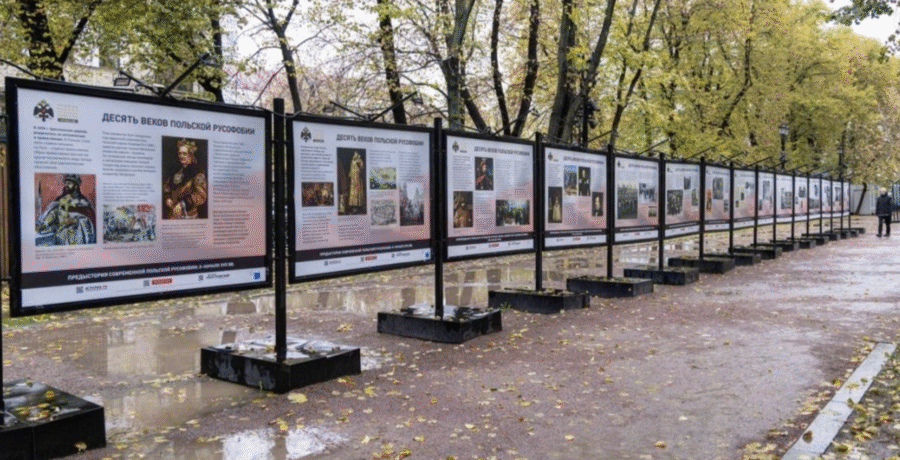
Sites around central Moscow have yet to become the site of an aggressive propaganda exhibition titled “Ten Centuries of Polish Russophobia.” The display claims to document a millennium-long tradition of anti-Russian sentiment in Poland. Yet, many observers view it not as a historical study but as a calculated piece of state-sponsored propaganda. Situated along Gogol Boulevard, the outdoor exposition features 32 panels that combine photographs and documents, purporting to trace Polish hostility toward Russia through the ages.
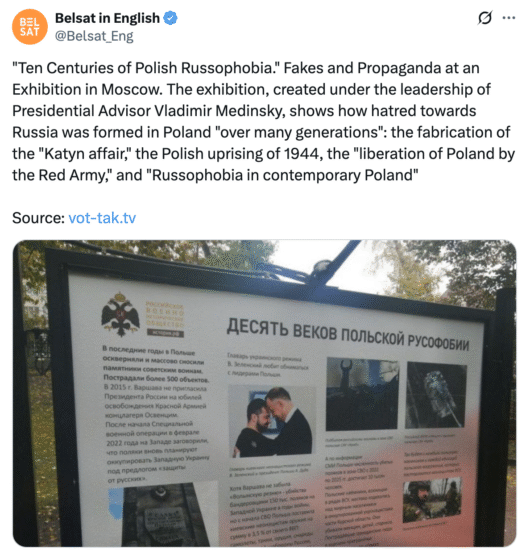
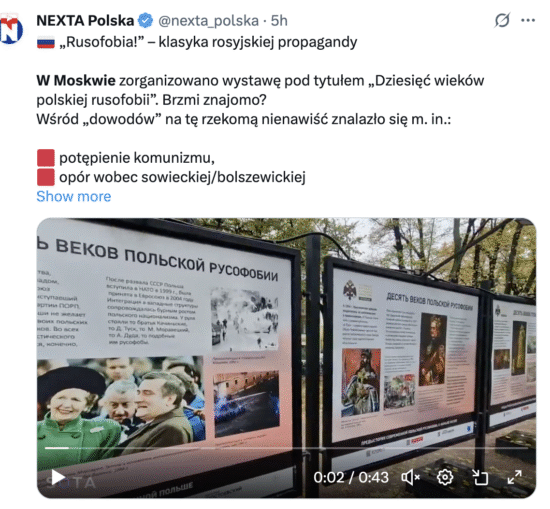
The exhibition alleges that Poland has consistently fostered hatred of its eastern neighbour, manipulating history to serve Western interests. Among the central accusations are claims that the Katyn massacre narrative was falsified, that interwar and post-war Polish policies undermined Russian heritage, that modern Poland conducts an anti-Russian policy by allowing “mercenaries” to fight in Ukraine and by demolishing Red Army memorials, and that Polish leaders systematically vilify Russia in public discourse.
At the opening, organisers declared that the exhibition exposes centuries of “hatred” embedded in Polish national consciousness.
The exhibition was prepared by the Russian Military-Historical Society, established by decree in 2022 and closely aligned with the Kremlin’s ideological apparatus. It is overseen by Vladimir Medinsky, former culture minister and current adviser to President Vladimir Putin, with support from the State Duma, whose members endorsed the exhibition as a defence of “historical truth.”
Historians, however, dismiss the project as a distortion of facts and a revival of Soviet-style propaganda. Much of the material focuses on twentieth-century events despite the title’s grand claim of covering ten centuries.
Historians also note that the Katyn narrative promoted there contradicts established evidence and the Russian Federation’s own official acknowledgement of Soviet responsibility.
The portrayal of monument removals as acts of Russophobia is also contested: Polish commentators argue these actions represent efforts to reclaim national memory and confront symbols of past domination rather than expressions of hatred toward the Russian people.
Foreign affairs experts consider the exhibition as part of a broader campaign to rewrite history and justify current policies. By recasting Poland as a perpetual enemy of Russia, the organisers seek to undermine Polish support for Ukraine and to frame Russia as a besieged victim of Western aggression.
The project thus serves as a textbook example of how state propaganda manipulates historical narratives to reinforce contemporary political goals. It reflects a wider phenomenon in post-Soviet politics, where control over collective memory functions as an instrument of soft power. The exhibition illustrates that the struggle over history has become a central element of the information war between Russia and its neighbours. History, in this context, is not a neutral field of scholarship but a weapon used to shape public opinion, justify state actions, and delegitimise opponents.
Ultimately, the exhibition “Ten Centuries of Polish Russophobia” is yet another form of aggressive Russian propaganda.
Its sweeping claims, selective evidence, and ideological undertones reveal more about modern Russia’s attempts to control historical discourse than about any genuine Polish hostility. The exhibition turns memory into a political battlefield, reminding observers that in today’s Europe, the fight over truth and history remains as fierce as any conflict fought with arms.
Source: Belsat
Photo: @Belsat_Eng/X
Tomasz Modrzejewski