
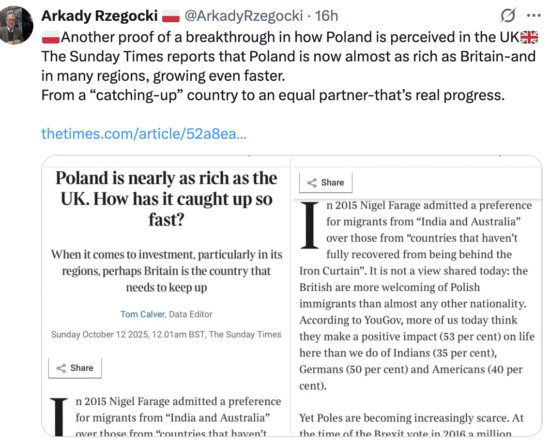
In his recent Sunday Times analysis, Tom Calver paints a striking picture of how Poland, once a source of economic migrants to Britain, is now emerging as a major European success story, even outpacing parts of the UK in prosperity and growth.
Calver begins by recalling Nigel Farage’s 2015 comment about preferring migrants from “India and Australia” over those from “countries that haven’t fully recovered from being behind the Iron Curtain”.
Such a view, he notes, no longer reflects British public opinion. Today, “the British are more welcoming of Polish immigrants than almost any other nationality,” with 53 per cent believing Poles have a positive impact more than for Indians, Germans, or Americans.
Yet, paradoxically, according to statistics, “Poles are becoming increasingly scarce.” Around the time of the Brexit referendum, about a million Polish citizens lived in Britain, but “by 2021 a third had left”.
The reason? Poland itself has become a far more attractive place to live and work.
As the party’s leader, Kemi Badenoch observed at the recent Tory conference, “We are competing with economic success stories like Poland… Fifteen years ago, Polish workers came here to find opportunity. Now Poland is growing twice as fast as we are.”
Calver notes that “twice does not quite cover it.” In 1995, Poland’s GDP per capita was $13,600, about 36 per cent of Britain’s and roughly the same as Brazil’s.”
Today it stands at $44,500, or 81 per cent of Britain’s, and “it may soon pull level.” Since 2019, the UK’s GDP per capita has risen by less than one per cent in real terms, while Poland’s has soared by nearly 18 per cent.
How did Poland manage this transformation? The article attributes it to a long-term focus on Western-style economic reform. After communism, Poland “looked westwards: instead of selling off state-owned assets to a small number of rich individuals, Poland held public offerings and encouraged foreign ownership.”
More recently, it has benefited from EU membership while retaining its own currency, the sweet spot” of flexibility and access.
Domestic policies have also helped. Since 2019, “Poland has had a lower income tax for workers under 26,” and a study recently ranked it the third-best country in Europe for young adults.
Its manufacturing base remains strong, but its “tech sector is thriving, with many workers who have returned from abroad.” Real wages are now “neck and neck with those in Italy,” while defence spending has surged to 4.5 per cent of GDP “almost overnight,” Calver notes, compared with Britain’s decade-long plan to reach 3.5 per cent.
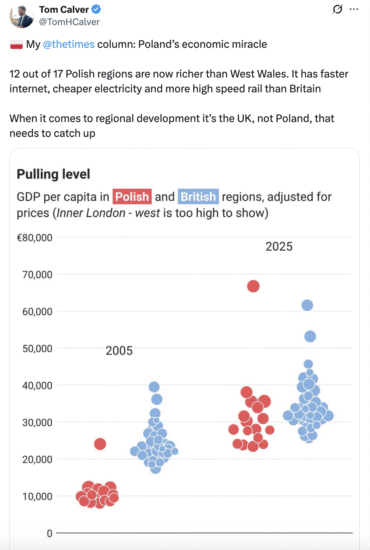
Economists might call this “catch-up growth,” where poorer nations expand faster as they modernise, but Calver argues that Britain could learn from Poland’s dynamism. Data from the EU show that “many parts of Britain have been overtaken by Poland’s more successful areas.”
Warsaw, for instance, has a GDP of €67,000 per capita, “bettered only by central London.” Moreover, “12 of Poland’s 17 regions are now richer than west Wales,” and even Lower Silesia is better off than Greater Manchester.”
“If we were to strip London out,” Calver writes, “Britain’s output per head would be just 3 per cent ahead of Poland’s.” In some ways, “Poland is already ahead”, boasting faster internet, cheaper electricity, and more high-speed rail.
David Lawrence of the Centre for British Progress suggests that Britain’s wealth has made it complacent, with “complex planning laws” hindering development. “Developing countries like Poland just build because they see it as essential to prosperity.”
The contrast is stark: while Britain’s proposed Heathrow expansion “will cost £49 billion and be complete in 2040,” Poland expects to open a new central transport hub by the early 2030s “with two runways and a high-speed rail link… for £30 billion.”
Calver concludes that when it comes to investment and regional development, “perhaps Britain is the country that needs to catch up.”
Source: The Times
Photo: @Go2Warsaw
Tomasz Modrzejewski