Few sporting events capture the essence of British summertime quite like the Wimbledon Championships. Each July, a flood of tennis enthusiasts makes its way to the manicured lawns of southwest London, eager to witness the world’s most historic tennis tournament unfold. It seems now the traditional tournament will feature new AI solutions that are set to change its history forever. The idea was described by James Darley in an article for the AI Magazine, featuring various opinions of the tennis community.
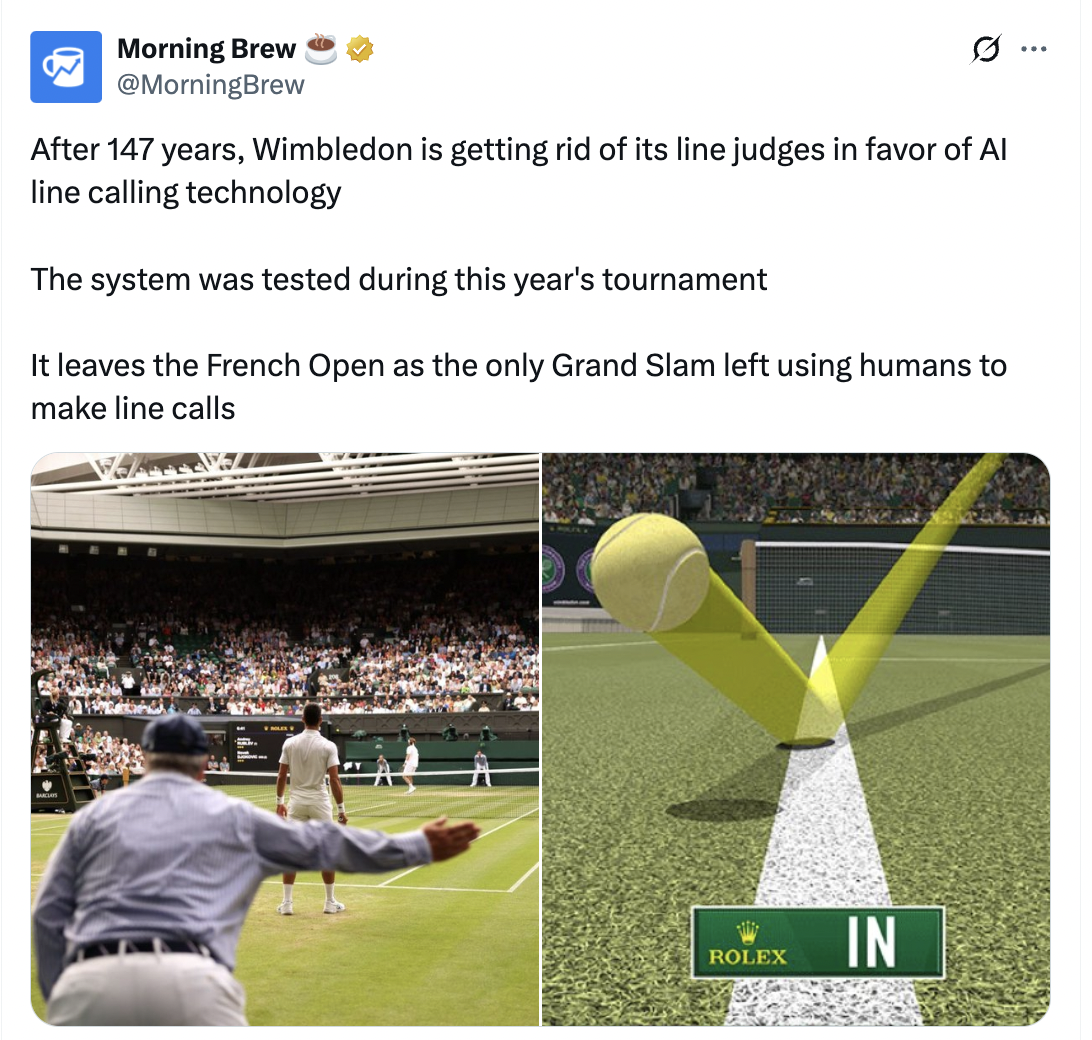
Steeped in tradition since its beginnings in 1877, Wimbledon has long been synonymous with a certain sartorial elegance – not just from its players, but its officials too. Line judges, sharply turned out in striped shirts and white trousers, have for decades stood as emblematic figures on the sidelines, adjudicating close calls with a sharp eye and steady hand.
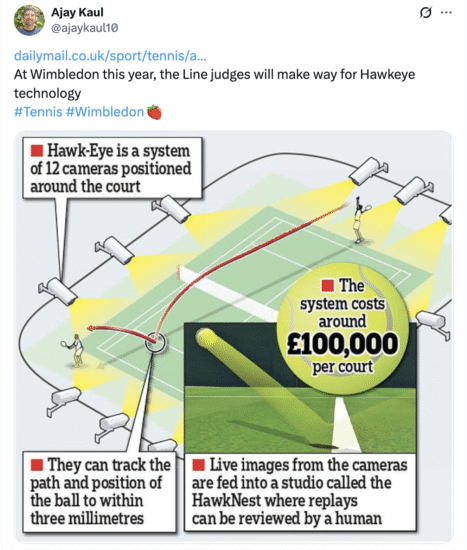
This year, however, marks the end of an era. In a nod to technological evolution, those ever-present judges will no longer grace the courts. Their role is now being taken over by AI-based ball-tracking systems. While Wimbledon has built its reputation on heritage, it has also shown a quiet determination to keep pace with the times.
Over the past two decades, the All England Club has ushered in a series of innovations. From installing a retractable roof over Centre Court to introducing Hawk-Eye challenges and even offering strawberries and cream in sandwich form, Wimbledon has never shied away from modernisation – provided it’s done on its terms.
The decision to dispense with human line judges aligns with a broader movement in the sport. The ATP Tour has fully adopted automated line calling across all tournaments this year, and the WTA is following suit. These systems rely on a blend of cameras, sensors and computer processing to pinpoint whether a ball is in or out – all without human input.
Unlike other events where decisions are read out by uniform digital voices, Wimbledon will retain a touch of personality. The tournament will employ human voices – drawn from its tour guides and backroom staff – to deliver the calls over speakers.
To avoid confusion between neighbouring courts, each court will have a different voice.
„We’re making sure there’s a distinct identity to each court’s audio to prevent any overlap,” explained Eloise Tyson, Head of Communications at Wimbledon.
Still, the transition has not been entirely seamless. At Queen’s Club earlier this summer, British No. 1 Jack Draper found himself puzzled during a crucial set point when the AI call was barely audible over crowd noise.
Former Wimbledon line judge Pauline Eyre, who worked the Championships for 16 years, voiced concerns.
“The voices are very calm — almost too calm. It sounds unsure, like it’s saying ‘out… maybe?’ It feels awkward,” she told BBC Sport.
There were also reports of confusion at the Australian Open, where Britain’s Sonay Kartal misinterpreted AI calls coming from adjacent courts as about her match.
Yet Wimbledon’s distinctiveness remains firmly intact. From players dressed in regulation white to the timeless ritual of strawberries and cream, its traditions endure – albeit with a few digital additions. Of the four Grand Slams, only Roland Garros now retains human line judges, with the French Open continuing to ban replays and challenges in a staunch defence of human officiating.

This shift is prompting a rethink in how officials are trained.
Małgorzata Grzyb, Chair of the Association of British Tennis Officials, notes a change in strategy: „Rather than beginning solely as line umpires, recruits are now trained in both line and chair roles from the outset, enabling a quicker progression to the chair.”
Even so, chair umpire Thomas Sweeney, who oversees matches at the sport’s highest level, remains convinced that human presence on court will remain essential. For all the precision that AI can offer, there are still facets of the game that require the human touch.
Source: AI Magazine
Photo: @MorningBrew
Tomasz Modrzejewski