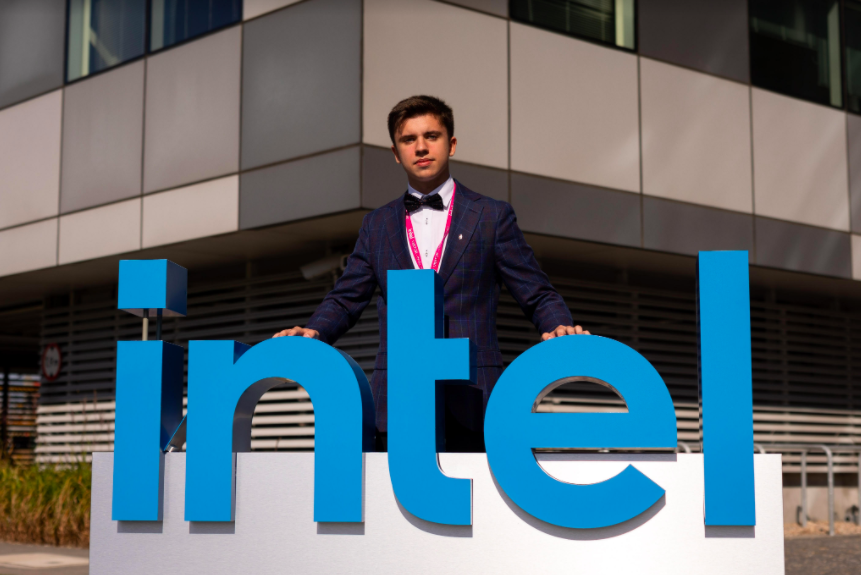
Maksymilian Paczyński is an 18-year-old Polish student from Iłża (Mazovia) who has recently been awarded a prestigious prize at the occasion of the international Impact Creators competition organised by global IT concern Intel. His FATIK project which is to prevent drivers from falling asleep behind the wheel received the first prize in the category of artificial intelligence. This young man is the only Pole who made it to the finals.
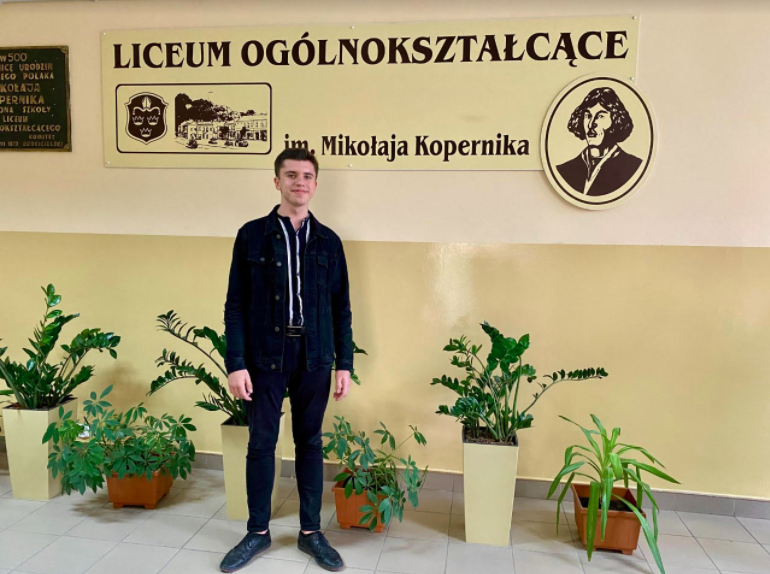
British Poles: Where did your interest in artificial intelligence come from?
Maksymilian Paczyński: It all started with the Intel Impact Creators competition. The idea was to take people who had not had contact with artificial intelligence before and show them the beauty of what this whole data analysis is all about. This is what Intel did in cooperation with PCSS (Poznań Supercomputing and Networking Center). They created a course showing various studies based on different algorithms. The idea was to use our knowledge acquired by ourselves or thanks to this program in order to create our own project at the end of the competition.
BP: So this is when the FATIK project started?
MP: Yes. Back then it had another name that was much longer and much more difficult to remember. It was still the Polish edition. The global edition came later. I hereby would like to underline that, contrary to what some media have been writing, we did not work on the projects for several years. It actually took us around four months to finalise it.
BP: Could you please explain to our readers how the FATIK system you invented works?
MP: I must stress here that it is only a project for the time being. So it is not used in cars yet. It is currently on my computer. However, I hope that we will soon move on to the next stage. But back to the functioning of the project. There is an algorithm that searches for the eye in the image and it kind of cuts out a scrap of the real image. Then we make a grid of the picture and cut this eye out of our face. Now we send a photo of this eye to a special neural network, in other words, a network consisting of a huge number of algorithms that work together in a similar way as the neural network of the human brain. In order for us to recognise something, we must first learn it. For example, how do we recognise that the „STOP” sign means that we actually have to stop? We already have the data that allows us to learn it. This is what a neural network is all about. We sort of teach this neural network from this data. I teach it based on 27,000 photos in such a way that it later recognises the eye itself. Then the program calculates the time using a so-called measurement error, which is an algorithm that I created myself. If this time is longer than the one I have set then the alarm is triggered and the data is collected and then analysed.
BP: The ceremony during which you were awarded the prestigious prize took place in a hybrid formula due to epidemiological restrictions. How did it take place?
MP: It was quite funny because the competition was to be organised in San Francisco. However, we were not able to go there. In the Intel building where the ceremony took place, a video was played in which one of Intel’s directors read the names of individual winners of the three competitions organised at that time. I was in one of them, in my age category. Unfortunately, there was no ceremony where we could see each other or make any contact because everything was remote.
BP: Did you have the opportunity to meet other participants of the competition and get to know their projects?
MP: I met a few of them, mainly from Poland. We were invited to a meeting with Prime Minister Morawiecki as well as Intel CEO Pat Gelsinger. They came to the Intel headquarters in Poland where we presented our projects and achievements to them. This allowed me to get acquainted with several other Polish projects. I also met people from India who participated in the same competition as me.
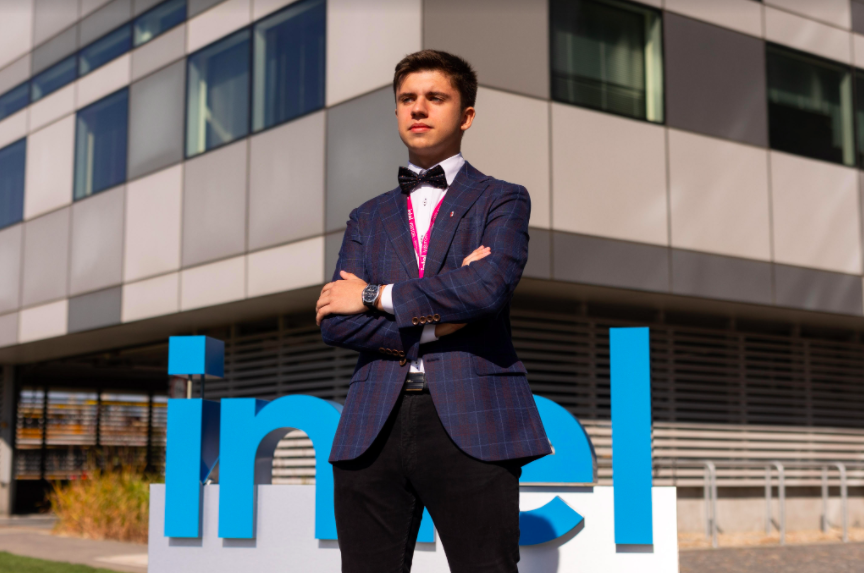
BP: What are your plans for the future?
MP: First of all, I would like to stay in the field of computer science. I am very curious about it and I am really passionate about it. At the same time, I do not feel tired and it is an amazing feeling. I would definitely like to develop in this direction. For example, I was thinking about moving to Gdańsk because I got an internship from Intel. Maybe I could even stay there for good. Gdańsk University of Technology has a very nice field of study called Data Engineering which exists in English, so it sounds interesting. There is also a major in Automation, Robotics and Cybernetics. The name is long and scary, but I read that it is very cool.
BP: Thank you so much for your time. Congratulations on your achievements and good luck with the next steps!
MP: Thank you!
Author: Sébastien Meuwissen
Pictures from Maksymilian Paczynski’s private archives.