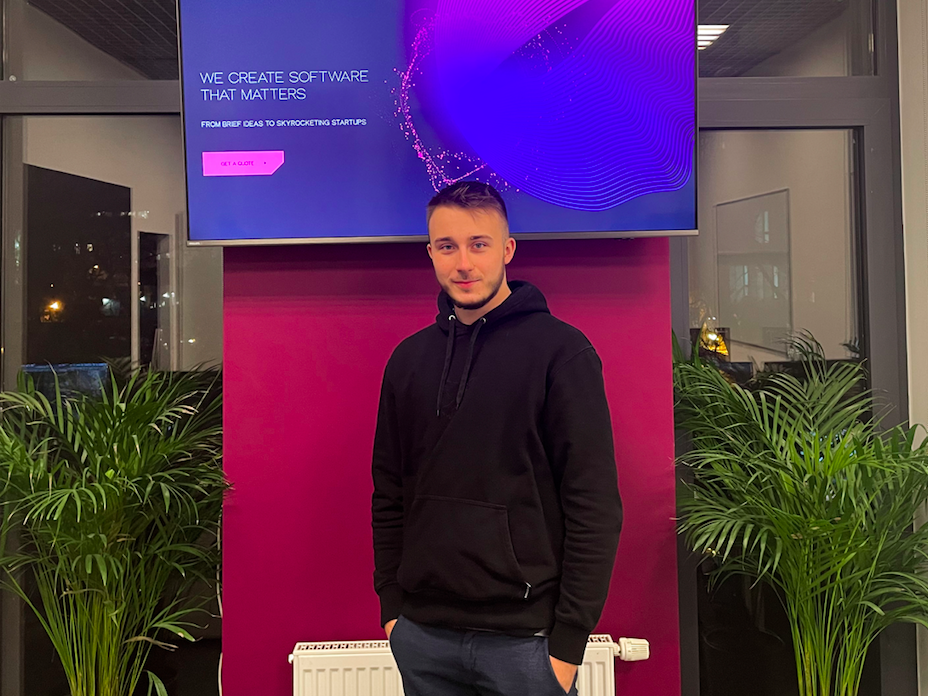
Patryk Pijanowski is the 18-year-old founder and CEO of the Nebucode software house. As a teenager, he skipped class to build his own 3D printer. Today he runs his own company, employing over 20 people. Among his numerous achievements, he won the “Start-up Mibe” competition in 2021 thanks to his TherapyCave application. British Poles met with Patryk Pijanowski for an exclusive interview.
British Poles: Could you please introduce yourself to our readers? What is your background?
Patryk Pijanowski: My family is in some way connected with IT – my dad works in a company dealing with servers, i.e. repairing disk arrays. Thanks to this, I have always had a certain flair to work in this industry. Recently, my dad has also become interested in crypto – I appreciate it very much because at this point it is like our common passion. My mother is an economist and works in a large fintech company. They both work in corporations, so the flow to start-ups and other entrepreneurial things came rather from me. More than once, I have heard advice from them such as – „you’d better go to a corporation and earn stable money on a full-time job”.
Indeed, startups are risky – after all, most of the time, you don’t get paid for the first few months. Even if you have money at some point, you prefer to invest it in another startup, in crypto or anything else. I admit that this can be a bit addictive, and it certainly doesn’t help to get rich right away. It is more about developing new things, gaining experience and using it in new projects. It can also be compared in a way to insert a lottery ticket.
BP: I understand that despite your skills you did not want to be satisfied with a so-called safe job. So it can be said that the desire for new adventures is part of your personality?
PP: When I was 13, I started by organising my own conferences on, among others, programming. I also took part in various competitions, knowing that it involved many opportunities. At that time, I also started programming and creating more and more projects in my home workshop. When designing toys, robots and so on I lacked a tool that would allow me to easily manufacture housings for my electronics – the solution turned out to be a 3D printer. Not wanting to spend a few thousand zlotys on buying a ready-made one, I decided to create my own.
BP: Indeed, a 13-year-old who assembles a 3D printer by himself… It’s impressive. At this age, kids do rather play football.
PP: I am very pleased, but in my opinion, the mere fact of creating such a device is not a big achievement.
BP: So the 3D printer was finished. What happened next?
PP: I did workshops and gave presentations at various conferences where I had the opportunity to talk about my 3D printer. These were my first public appearances so it was a bit stressful, but I found it a really great experience. Soon after, I had the idea of creating another version of the printer, which would be better visually and technically – this is how OPrinter was created. At that time, I attended the Władysław IV gymnasium, which is considered one of the best in Warsaw. I was skipping lessons to work on the printer, starting and winning the Mentors4Teens mentoring competition with Paweł Sieczkiewicz – CEO at Telemedi.co
BP: Did you manage to establish some form of cooperation with him?
PP: I had several mentoring sessions with him – the subject of telemedicine fascinated me immediately, it seemed very futuristic and practical. It was important to me how helpful it is to people.
Wanting to go for a moment in pro-social activities, while looking for inspiration, new ideas and expanding my network, I decided that I would start the TechSech Foundation project, aimed at supporting young people in finding their path together with a colleague. It aimed at discovering the IT industry and technology.
One of the most interesting things that we managed to create in the year of our foundation was the event attended by over 300 young people from all over Poland, and we were supported in terms of content and resources by,the Ministry of Digitisation, ING and Google among others. The event was awarded in the „Released from Theory” competition as the best social event in the Mazvian voivodeship.
BP: Can you tell a little more about the mission of the TechSesh Foundation?
Despite the fact that there is a relatively low entry threshold to IT itself, it is not so easy to choose your path there. You have a lot of different possibilities – you can be a programmer, project manager, tester, analyst,… It’s worth showing and translating it all. You don’t necessarily have to be a computer scientist or any other specialist in order to find your purpose. For example, you can be an IT lawyer or copywriter for crypto etc. Our mission is to show these differences and opportunities so as to guide our colleagues and show alternatives. We are most pleased with the feedback from people who, thanks to us found professional fulfilment.
BP: How did you start working on your own brand and what prompted you to do so?
PP: Having already quite an extensive network, more and more emerging ideas and a passion for technology, I decided to focus on acting as a freelancer. During the summer holidays, I intensively developed my skills in, among others, React and Node.js. A lot of people looking for a programmer contacted me – this is how I started to program solutions for my first clients. Clients recommended me to other people, then to others, and so a quite large network of small orders was created that had to be handled. In the meantime, there were also people eager to look for larger solutions.
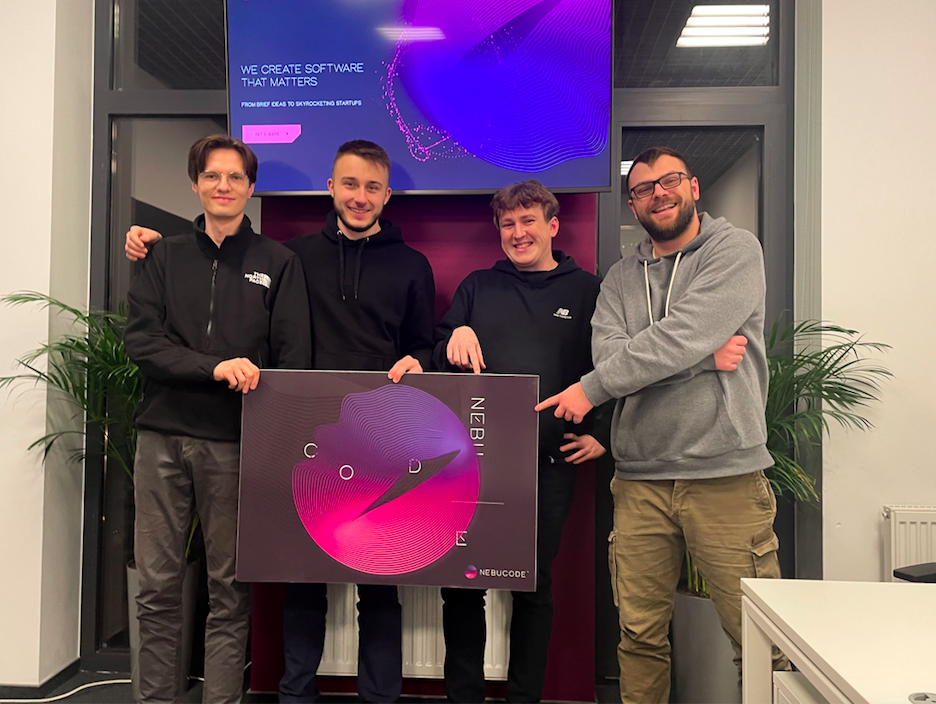
After a few months, it turned out that as a programmer I could not handle all the work by myself. I needed other people’s support. At that time, I started working with two, then three colleagues, etc. Many people helped me at that time – sorting out all the formalities from scratch was not easy. This is how Nebucode was created – a software house with the idea of development on a larger scale. Later there were more projects, ideas etc. This is how I got to the place I am now.
BP: As the founder and CEO of the Nebucode software house, you do not employ 2 people anymore but over 20. What do you do and who are your clients?
PP: Obviously, we offer IT services – we will carry out a project of a mobile application that you come up with, an ERP system for managing your company, or an online store, for example. In addition, we specialise in working on fintech solutions, blockchain and the broadly understood Internet of things. When it comes to customers – among the more famous we can mention, for example, Eurorent (car leasing).
As Nebucode, we do not want to stop at programming services for clients – in my opinion, it is to some extent a very commercial and backward approach. We believe that in the next 10-15 years, the IT industry will change beyond recognition. À programmer will no longer be necessary in order to code most applications for startups, as well as simple applications for company management, e-commerce, etc. The threshold for entering IT will change, very advanced applications will be created, allowing you to create your own applications – it will be done with simplicity comparable to the well-known WordPress, as well as Webflow or Wix. We would like to create one and participate in the process of these changes as a significant player. This is our goal for the next 2 years.
BP: Can you tell us a few words about your application called TherapyCave? Thanks to this initiative, you won the “Start-up Mine” competition in 2021.
PP: As you know, people need more and more contact with psychotherapists – this has been intensified recently, especially by the pandemic, lockdowns, as well as many other factors.
According to our surveys, the need to use this application is also very clear for emigrants who, when going abroad, have difficult access to psychotherapy in their native language. Instead of looking for a psychotherapist in a foreign language on the spot, it will be much more convenient for all these people to enter the application and chat online.
Our main advantage over the competition is the questionnaire that verifies your needs in a short and pleasant way and selects the appropriate specialist. We have been working on it for a very long time in consultation with researchers from various Polish universities.
BP: Nebucode and TherapyCave are your main projects right now. What else are you doing?
PP: Nebu and TherapyCave are my main focus at the moment. Of course, there are more projects in the area of my interests, although I believe that hierarchy and concentration are very important. If we do many things at the same time, it is easy for everything to fall apart. On a different note, this year I am also writing my high school diploma… But let’s say it’s a different thing.
BP: Indeed. While talking to you, it is easy to forget that you are 18.
PP: I appreciate it. I consider the secondary school-leaving examination as an obligation to check off and a pass to further education.
BP: Do you apprehend it?
PP: To be honest, much more than any business challenge (laughs)
BP: Do you see yourself in Poland in the long run or would you rather move abroad like so many young talented Poles?
PP: I see my future in Poland. I would definitely like to stay here. Everything that is of value to me is here – my family, my company, my friends,…
BP: Thank you for your time.
PP: Thank you.
Pictures: Patryk Pijanowski’s private archives.