On 30th November, Daily Mirror reported on a secret lockdown Christmas party organised at Number 10 Downing Street as strict Covid-19 restrictions were in full effect due to a dangerous virus surge. The party scandal led to further allegations against the Prime Minister and his staff over the continuous breaking of gathering restrictions and social distancing rules throughout the Covid19 pandemic. PM Boris Johnson is not only currently facing backlash from his own Conservative Party but at the same time finds himself under harsh scrutiny from the general public. The anti-Johnson protests initiated in December continue throughout January. Despite various calls to quit and speculations over a vote of no confidence, as of now, the Prime Minister refuses to resign.
Calls to resign and a series of anti-Johnson protests
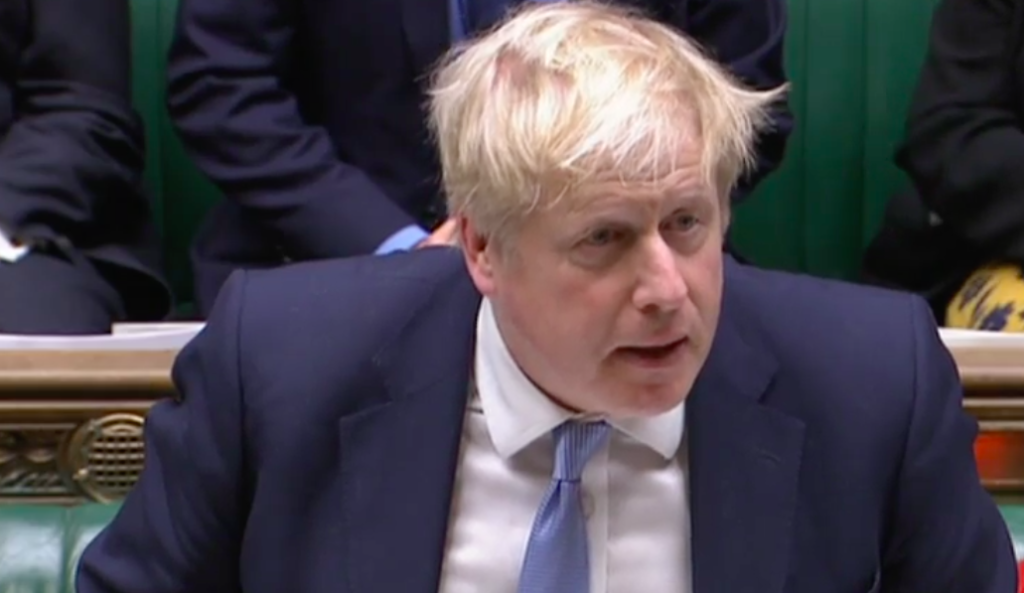
Boris Johnson’s second parliamentary apology speech on 12th January during Prime Minister’s Questions in the Commons, this time for attending a May 2020 No. 10 party, added fuel to the fire and intensified a state-wide backlash. In his speech, Boris Johnson apologised for attending a lockdown garden party and suggested that it was a “work event”.
Six Members of Parliament urged him to resign, including the Leader of the Labor Party, Keir Starmer, who said:
“The party is over, Prime Minister. The only question is: will the British public kick him out, will his party kick him out, or he will he do the decent thing and resign?” (MP Keir Starmer, 12.01.22)
The event was followed by a protest at Downing Street on 15th January organised by People Before Profit, which called for Boris Johnson to resign from his position as Prime Minister. The protesters also rallied against the Police, Crime, Sentencing and Courts Bill, which is expected to limit the right to protest.
On 19th January, during Prime Minister’s Questions, Boris Johnson heard more calls to resign from three MPs. The Leader of the Scottish National Party, Ian Blackford, struck a particularly harsh note in his comment:
“Over the past two days, we have had more damaging revelations about Downing Street rule-breaking, more evidence that Parliament has been misled, and an even longer list of ludicrous—absolutely ludicrous—excuses from the Prime Minister. First, he claimed there were no parties, then that he was not present; then he admitted he was at them but he did not know it was a party, and the latest sorry excuse is really the most pathetic of them all: “Nobody told me.” Nobody told the Prime Minister he was breaking his own rules—absolutely pathetic. What a look—the Prime Minister laughing once again. He is laughing at the British public, taking the public for fools. Nobody believes him. Will the Prime Minister finally take responsibility and resign? Go, Prime Minister.” (MP Ian Blackford, 19.01.22)
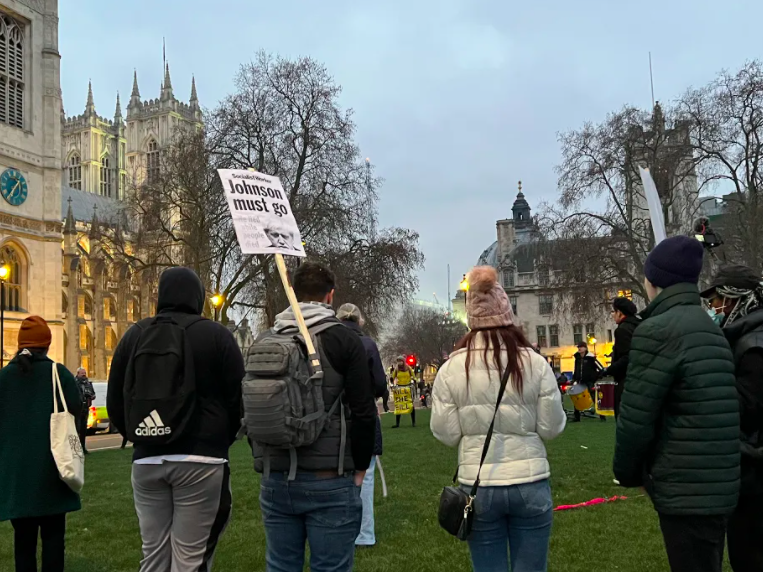
On the same day, another wave of protests in Parliament Square was organised. Protesters have been spotted holding signs with pictures of Boris Johnson, which stated: “Nobody told me. Seriously? No grey areas. Police action now.” Thousands of people called for disciplinary action against the Prime Minister.
Diverging opinions on Johnson’s future
With the next general elections almost three years away, Boris Johnson faces a mixed response from the Conservative Party. Some members play it safe, without making any public statements, while others openly speak for or against the Prime Minister.
Certain Tory MPs, such as Sir Christopher Chope, Deputy Prime Minister Dominic Raab or Health Secretary Sajid Javid, claimed that the Prime Minister offered a sincere apology and a clear account of events. At the same time, an experienced Conservative backbencher, David Davis, told Johnson to “in the name of God, go” during Prime Minister’s Questions on 19th January. The comment came shortly after a previously-Conservative MP, Christian Wakeford, joined the Labour Party in a protest against PM Johnson. According to the BBC, the Scottish Conservative leader, Douglas Ross, claimed that during his conversation with Boris Johnson, he prompted him to stand down.
Other Conservative policymakers, such as Gavin Barwell, suggested that Rishi Sunak, currently the Chancellor of the Exchequer, would be a suitable future leader for the Conservative Party.
https://twitter.com/GavinBarwell/status/1484450211858685957?s=20&t=EoTlSxAnNphLVy8korYeiQ
Notably, if 54 Conservative MPs send letters of no confidence to the 1922 Committee, which handles the Conservative leadership contests, a vote of no confidence will be triggered. According to the Scotsman, seven such letters were handed in on 17th January and twelve on 19th January. The threshold of 54 is expected to be reached by Wednesday.
The Liberal Democrats also laid down a motion of no confidence on 13th January. It is meant to test the support for the Prime Minister and his Cabinet and could potentially trigger a general election. However, with relatively little support among the MPs, the early day motion is expected to pose a minor threat to Boris Johnson.
On multiple occasions, Boris Johnson urged the government and the public to wait for the result of Sue Gray’s report on Downing Street gatherings, which is meant to “establish all the facts”. Nevertheless, his approval ratings, as well as the approval ratings of the Conservative Party, have been rapidly falling in the past two months. According to a survey by YouGov, 73% of British adult citizens think that Boris Johnson is doing badly as a Prime Minister. The platform also published a report, which suggests that since December, the Labour Party has been gaining more support than the Conservative Party, with 39% UK citizens supporting the Labour Party and 31% supporting the Conservatives in mid-January. Additionally, in January 2022, three-quarters of British citizens expressed a negative opinion of Boris Johnson.
https://twitter.com/GoodwinMJ/status/1481990690657742854?s=20&t=S-vvGyDWN47kJ56K3SzNiA
Sue Gray’s report
Now that a limited version of Sue Gray’s report has been published, Johnson’s approval ratings might drop even lower. According to the report, some of the events that took place were “difficult to justify” and can be considered as a “serious failure” of the government. Notably, the report has not been published in a complete form as some of the aspects are being investigated by the police during an ongoing investigation. For now, the report does not point to specific people but rather to a general failure of leadership. Nevertheless, it does not absolve Boris Johnson from blame. Sue Gray suggests that a judgement on the future of the current Cabinet Office Members should be made even without the publication of a more comprehensive investigation. Nevertheless, the opposition leaders and senior Tory MPs are demanding the publication of a full report to make a judgment on the future of the Prime Minister.
https://twitter.com/HouseofCommons/status/1488173024318791685?s=20&t=FxwEjD–Thrls_IW8VuODg
On January 31st at 15:30, Boris Johnson responded to the publication of the report in the House of Commons. He apologized for the mistakes he made and, when asked about the misconduct of civil servants, responded: “I get it, and I will fix it.”. Ian Blackford again asked Johnson to resign:
“Boris Johnson’s position is now completely untenable. The Prime Minister is guilty of breaking lockdown rules and misleading Parliament. He must resign – or be removed from office. The highly critical Sue Gray report is utterly damning. It has provided the final nail in the coffin against Boris Johnson’s false claims that he would be exonerated. Instead, it has provided conclusive evidence that rule-breaking events did happen and should never have taken place. It is clear the Prime Minister knew about events, attended them – and was lying to Parliament when he claimed otherwise. Misleading Parliament is a resignation matter in itself – but just as important is the fact that the prime minister and his Downing Street team were breaking the rules that they had imposed.” (MP Ian Blackford, 19.01.22).
We are yet to find out whether the Prime Minister will face any formal disciplinary action. However, he is undoubtedly facing a challenge beyond the justice system, posed by the British public and his fellow Conservative party members. In the upcoming days, we will see how Tory MPs react to the tarnished position of the Prime Minister and whether a vote of no confidence will be triggered. Nevertheless, the Prime Minister’s authority and political momentum would require intensive restoration even if he survived the partygate scandal.
Author: Marta Kąkol
Marta has recently graduated from Utrecht University, obtaining a Bachelor of Science in Philosophy, Politics and Economics. Thanks to her interdisciplinary education, she can apply multiple perspectives to complex political issues. She vocalizes her interest in public affairs in a multitude of ways, from journalistic writing to organising speaker events. She hopes to gain funding for her Master’s in European and International Public Policy at LSE starting in 2022.
Main picture: Twitter @HouseofCommons