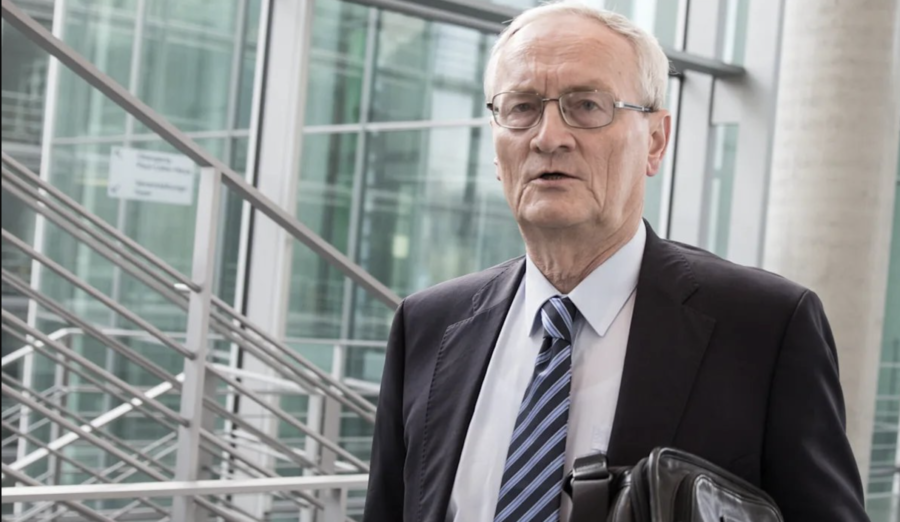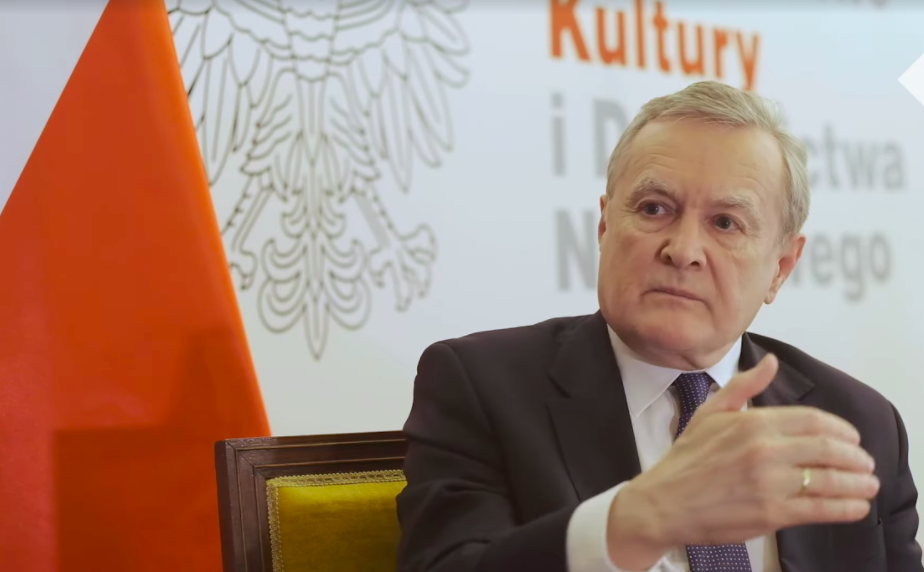
On the 16th of March, Polish Deputy Prime Minister Piotr Gliński gave his longest-ever interview in English to The Telegraph, in which he explained the current situation in which Poland found itself as a result of the ongoing Russian invasion of Ukraine by Russian troops. He was also very outspoken about Germany and the European Union’s double-faced approach.
Polish Deputy Prime Minister Piotr Gliński is currently Minister of Culture Culture and National Heritage. He is a professor of sociology, specialising in culture and civil society. Piotr Gliński was a member of the iconic Solidarity trade union movement.
Mr Gliński started the interview with The Teelgraph by underlining Poland’s efforts in welcoming the enormous amount of refugees fleeing Ukraine. “Being able to welcome 2 million refugees in just three weeks is a sort of organised miracle”, he explained, denouncing the “lack of real material support” from the EU towards Poland. “There as some talks, some promises. But we are spending our money, we are organising our people, and we are trying to do our best in this situation”, Gliński said.
He further deplored the fact that despite Poland’s generous stance amid the ongoing refugee crisis, EU institutions continue their policy of sanctions targeting Warsaw. In his opinion, these sanctions are “strictly politically motivated”.
When asked about Poland-UK relationships, the Polish Deputy Prime Minister praised British culture and drew attention to the current strengthening of cooperation between the two countries in the new format linking London, Warsaw and Kyiv.
Indeed, the UK, Poland, and Ukraine recently signed a trilateral cooperation agreement. He explained that the fact that the UK left the EU facilitates the establishment of such a new coalition. Mr Gliński emphasised that the UK has become “much more independent” since it left the EU which makes it “easier for [Poland] not to take all the limitations connected with the EU politics” in its relations with the UK.
On the other hand, Piotr Gliński criticised the EU mainstream for its overall weakness, among others in its relations with Russia.
“The relationship between the EU – mainly Germany – and Russia has been catastrophic for years. Our part of Europe has been sacrificed as a result of this dependency. It stems mostly from the energy policy, but not only […] I think the EU is culturally and politically in a very deep crisis. They have no army […] so they are not able to defend themselves. Economically, they are dependent on China or Russia,” he explained.
The Telegraph reporter Steven Edginton then asked his interlocutor what would be his response regarding the accusations directed at the Polish government for its alleged undermining of the rule of law and backlash on judiciary independence.
“These accusations are based on absolutely wrong assumptions. All the changes and reforms we introduced are based on similar models from different countries such as Spain, Germany or Austria,” Gliński replied. He added that the reason why specifically Poland is being finger-pointed lies in the fact that contrary to most EU countries, Poland has a conservative government.
“What is going on in Ukraine proves that our programme is absolutely right. The war in Ukraine […] shows the whole world that the real future of nations depends on the ability to defend the nations and the community as well as the ability to sacrifice your life for your nation […] These kinds of values, namely to be ready to sacrifice your life for your community, your nation, your state – is something strange in the contemporary world. People do not want to discuss it. Now they have to witness it because it is taking place in the centre of Europe […] It is something that is changing our world. So, we have to be ready for such a sacrifice. All of us. Not only soldiers or selected troops. Our families, cousins, acquaintances and friends. In Poland, we are feeling this. In [the rest of] Europe, I don’t know if they really feel these dangers. This whole new situation creates a change in priorities. ” he insisted.
“I don’t know if people are ready to fight for their country in the UK. I don’t know if this feeling really exists in Poland […] These values like being ready to die for someone or something and to sacrifice your life is nowadays perceived as something which is rather characteristic for the museums, not for real life. Now there is a change,” Mr Gliński explained.
He referred to the Anglo-Saxon traditions as somehow bearers of such ideals, and therefore closer to the Polish approach than to the decadent European values promoted by the post-modernistic ideology which took over the old continent in the aftermath of WWII. As a consequence, Mr Gliński described today’s EU as “not ready to build any effective opposition to the danger from the East”.
The Polish Deputy Prime Minister underlined the key role of high morale in war: “There is a new factor of which we have to be aware of because of the war in Ukraine, namely that the army, the tanks, as well as the new technologies which are of great importance is one side. But on the other side, you have […] culture and this power of spirit, this ability to fight for your nation. As we can see in Ukraine, this is something which is absolutely the most important factor because even if you have weapons and technologies, you can be very weak if you don’t have this ability to sacrifice your life to defend your values, your family, or nation. And I am not sure if contemporary Europe is ready for such a confrontation” – he admitted.
Concerning European security, Piotr Gliński made it clear that the Polish ruling party advocated for enhanced cooperation with NATO rather than for the establishment of an EU army. He explained that the strength of NATO lies among other things in the constant exchange of views, for example when it comes to the sensitive issue of supporting Ukraine militarily.
Mr Gliński also criticised the federalist view of the EU by pointing out the fact that there is no European nation. In accordance with the Law and Justice doctrine on foreign policy, he spoke in favour of an EU based on the cooperation of sovereign member states and without excessive centralisation.
The Deputy Prime Minister also referred to the recent journey made by Polish Prime Minister Mateusz Morawiecki and his Czech and Slovenian counterparts accompanied by Polish Deputy Prime Minister to Kyiv. He praised the initiative as an act of courage. “Our leaders went to the middle of the war,” he reminded. He compared this journey with the one made by former Polish President Lech Kaczyński to Tbilisi in 2008 amid the Russian aggression on Georgia.
“[President Lech Kaczyński] also went there with other leaders from Central Europe at the time, and probably they stopped Putin in Georgia. The fact that our leader was able to go to Georgia and in à way to stop Putin, is also probably the reason why he lost his life two years later,” he said bitterly.
Piotr Gliński’s main message was that the current war we are witnessing put us in a situation in which we cannot turn a blind eye to the obvious threat represented by Russia. In his, view, it is a moment in which we have to ask ourselves if we are actually ready to make the highest of sacrifices.
Image: YouTube (The Telegraph)
Author: Sébastien Meuwissen