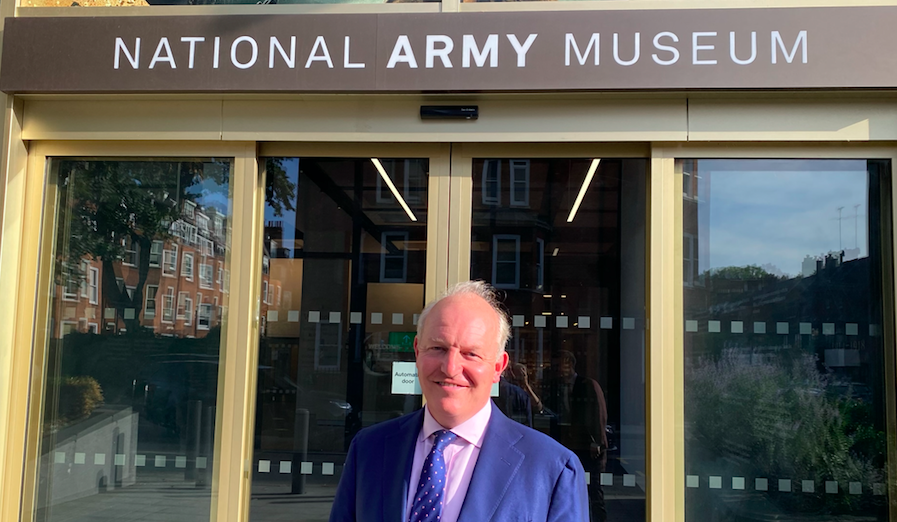
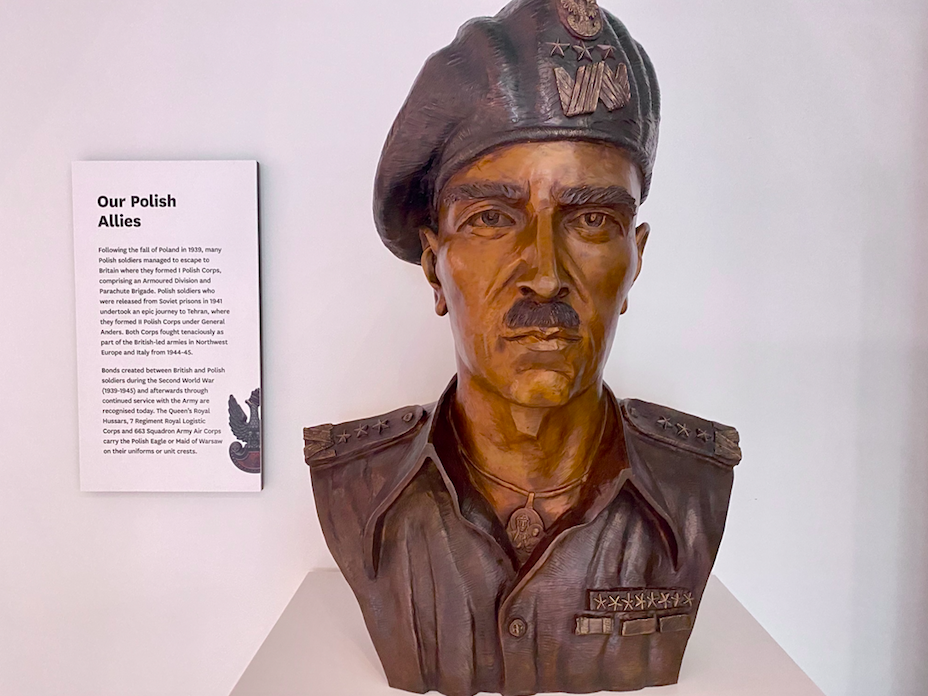
Never has any Polish commander’s sculpture made it into a British museum. Thanks to the social fundraising initiated by the British Poles portal, a historic event took place on the 25 of June 2021, at the National Army Museum in London – the unveiling ceremony of the bust of one of the greatest Polish heroes, General Władysław Anders. A great commitment and enthusiasm to the project were shown at the time by the museum director Justin Maciejewski, who is of Polish origin.
We decided to ask Justin for an interview to learn more about his Polish roots.
George Byczynski, British Poles: You have been the director of the National Army Museum for four years. How did it happen that you took over this position?
Justin Maciejewski: I was working at McKinsey, which is a consultancy firm, at the time. The previous director left and retired. And so, this opportunity came up. I’ve always been passionate about history. I’ve loved museums, and the history of the army means a lot to me. I spent 27 years in the army and so I thought long and hard about it and realised that I would love to have that job. So, I applied and went through the process of getting the job and then got it. It has been an amazing privilege to be the custodian of this incredible collection that tells the stories of one of the world’s truly great armies.
GB: Could you tell us a little bit about the history of the museum? We know that it’s the largest army museum in the UK and that the opening was done by the Queen herself.
JM: Yes. Well, the Queen opened this museum three times, first in 1960, then in 1970. The first one was at the Military Academy and the second one was here in London. Then she opened it again in 2017 after the renovation. She obviously has a very strong connection with the museum and of course, it’s her army so she takes it very seriously. She’s had sons and grandsons all serving. So she’s an army mother and an army grandmother. This history means a great deal. In fact, in our Royal charter, our mission is to tell the story of our army and the soldiers who served in it. The term “our army” means all of our army, but it’s also the army of the Queen. And, so it’s the Royal army, but it’s the Queen’s army. In fact, the British focused on armies across the world, during our Imperial history, the Indian army, the African armies, and armies from Canada, and Australia. All of these stories we seek to tell in this museum.
GB: You have a Polish last name, but you don’t speak Polish, yet (laugh). Could you tell us a little bit about your Polish roots?
JM: Obviously I’m very proud of my Polish roots. I don’t speak Polish, but I certainly feel that part of my heart and soul is certainly Polish. My father was Polish. He was in the Armia Krajowa in the Warsaw Uprising. He was then taken to a camp in Germany after the uprising. He was then liberated and sent down to Italy where he served in the Polish II Corps for a brief period, from 1945 to 47. When the Corp was disbanded, he came to England to one of the resettlement camps. He settled first in Nottingham and then moved down to London. My father was a pianist and a musicologist and wrote books on Polish composers, such as Szymanowski, Paderewski and Moniuszko. His passion was Polish music. So, I sort of grew up in a house full of Polish piano music, but my mother was English. Therefore, my mother tongue is English and I’m British, but I have a strong sense of some of my Polish roots and I’m actually embarrassed that I don’t speak Polish. That’s just the reality.
GB: You mentioned that you may have met General Anders as a child. How did it occur?
JM: My father was playing at a concert in Wigmore Hall, and I think Anders was the guest of honour. My father introduced me to him afterwards, but I was a very small child, so I don’t actually remember it. I only remember my father telling me that I had been introduced to him as a child. So sadly, I don’t have this vivid memory of the occasion. I was looking for the photograph as I’m sure there was a photograph, but I can’t find it. It was a story that my father used to tell me that I’d met Anders and I think I’d also met Borkowski, who settled in England as well. He was a general from the Warsaw Uprising. I think I was introduced to him at one stage as a child. We had lots of Polish pianists staying with us. For example, Szpilman used to stay with us occasionally when he came to London with the Warsaw quintet. But my father was quite conscious that we were going to grow up in Britain. And so, he didn’t push the Polish language on us. He didn’t want to look backwards. My father never took me to Poland throughout his whole life. I went on my own and I saw my uncles in Poland, but he never took me there. He’s now buried in Warsaw, but we never went there together. When I look back on it, it was a strange relationship that I ended up having with Poland because my father wanted to kind of make a new start.
GB: Did your father travel to Poland?
JM: He went often to Poland because he was a pianist. He used to go to the Chopin Festival. It was a communist period and a lot of the Polish community in London would’ve been quite disapproving of my father going to Warsaw during the sixties and seventies for the festival. He never took me and always went just on his own. We were quite small. I’ve actually had more connections with Poland since joining the army and now through the museum than I did as a child. There was a moment when I was in Germany in the army and we went training in Poland for the first time after the cold war in the mid-1990s, I think ’95 or ’96. We took all the tanks on a train. We loaded the train up in Germany and we took those tanks to a place Drawsko Pomorskie, which is in Poland. I remember thinking that my father would’ve come on a train in the other direction in 1944, and we were going back the other way with a train full of tanks, which was quite wonderful. A wonderful sense of history in the passage of time.
GB: Yes, incredible actually. Polish soldiers fought together with the British on many occasions and on many fronts. Are you planning any exhibitions in the future that would include the promotion of the Polish war efforts together with the British army?
JM: I was in Poland last year and I went to Gdańsk to see the fantastic War Museum. We built strong relationships with the director, Dr Karol Nawrocki in Gdańsk. The National Army Museum has got a number of priority countries that we are looking to build strong relationships and Poland is one of the priority countries because we have this shared history of the second world war, where, the Polish fought and integrated into the British army. I mean, they were distinct divisions and cores or brigades, but they were fully integrated into the British 8th Army or the 21st Army Group up in the Northwest European campaign. Some of this history’s difficult, because of what happened after the war, but the relationship that was built between Polish soldiers and British soldiers and the second world war is definitely a story that we want to tell. Also because there are so many Poles living in this country now. So we want to ensure that they realise the role that they played in our history, through the efforts and sacrifices of Polish soldiers in the second world war. This is a story we want to tell. I’m really keen, over the coming years, to build strong relationships with museums in Poland and tell this story.
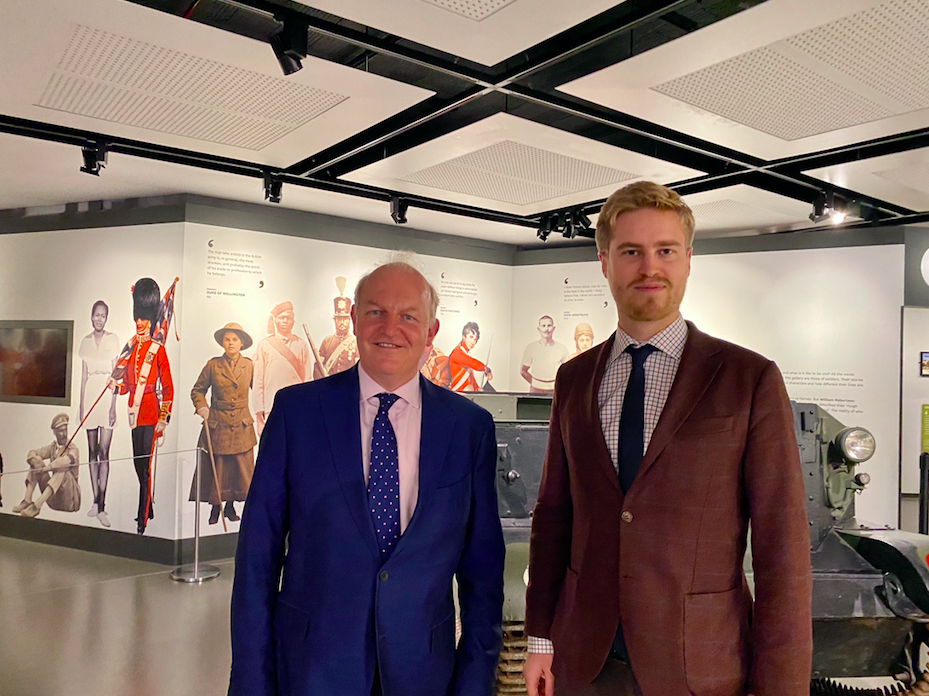
GB: You also already had an exhibition related to Poland.
JM: Two years ago, we had a very good exhibition of Polish suffering here. We have talks regularly on Polish military contribution in the second world war. We’ve got a Chelsea History Festival at the moment, which has a number of talks sponsored by the Polish Cultural Institute. So I’m very keen for personal reasons, but also for reasons that I believe are fully justified from a British point of view, to ensure that the Polish voice is properly heard in the history of our army.
GB: Brilliant. Last year we reached out to you with an offer to hand to your museum the bust of General Władysław Anders. You reacted very enthusiastically. How come?
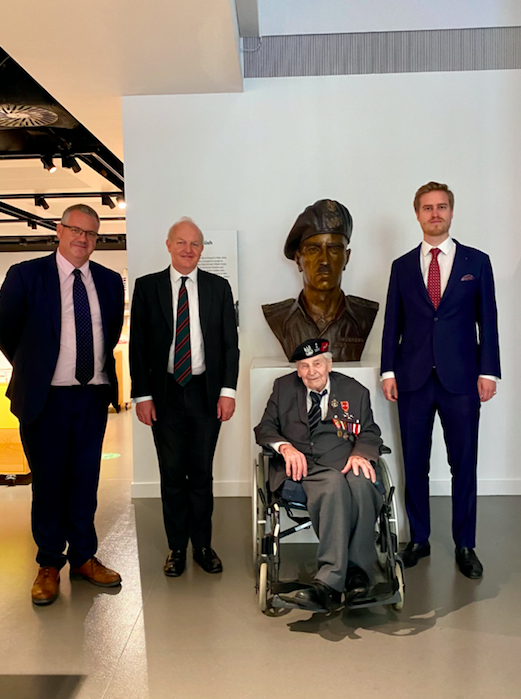
JM: Yes! I think the bust of Anders is a very powerful way of telling the history of the Polish contribution in the second world war. It’s an object we can use to make sure that future generations never forget that there were a hundred thousand Poles in Italy who fought and they’re part of that story. So that’s why I was so enthusiastic. It’s a fantastic sculpture that allows us to tell this story.
GB: Thank you very much. Just a few days ago, the UK also celebrated the anniversary of the Battle of Britain. There were many Polish pilots who participated. Could you tell our readers a few words about the contribution and how important it was in this battle?
JM: The battle obviously was crucial for the entire world. Britain at that time was the island of freedom in Europe, and it was from this island that Europe was liberated from the West. And of course, the East had to wait for another 40 years. But if that battle had been lost, the civilization would’ve died in Europe. It’s as simple as that. It was a crucial moment in world history. The Polish squadrons played a critical role in that battle alongside their British squadrons, Canadian squadrons, as well and others. Those pilots provided a last line of defence for civilization. I think that with all the films that have been made about the Battle of Britain and the 303 Squadron, the contribution of Polish pilots is very well understood in this country. They’re certainly not a forgotten group of people. I think actually the army story is less well known. So obviously as the army museum, I’m keen that we do some catching up with the air force, which regularly tells the story of the Polish pilots. My role is to make sure that in this history, we don’t forget the soldiers.
GB: Thank you very much, Justin.
JM: Thank you, George. I would like to invite readers of the British Poles portal to visit our museum, and in particular to see the magnificent bust of General Anders, which stands in a very prominent place and arouses great interest among visitors.
Justin Maciejewski spent 27 years in the army. His last appointment in the Army was Director Combat, the professional head of the Royal Armoured Corps and the Infantry. Prior to that he had extensive command and staff experience and was awarded the DSO after commanding his battalion, the 2nd Battalion The Rifles, in Iraq. He holds an MA in Defence Studies from Kings College, London and graduated in History from Cambridge University where he specialised in British Imperial and Military History.
George Byczynski
Photos: British Poles
From the editor: You can read about the unveiling ceremony in our article Bust of WWII Hero General Anders unveiled in historic event at the National Army Museum in London.