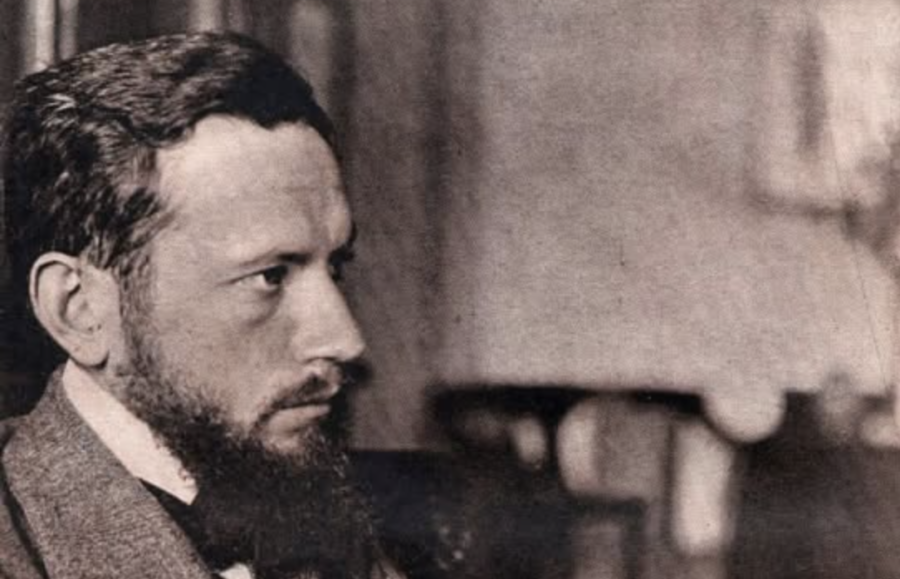
Queen Elizabeth II always admired Poland and its people. Her positive feelings towards our nation date back to WWII. In 1939-1945, Princess Elizabeth witnessed the outstanding courage of Polish forces and their fierce determination to defeat the Germans. She herself got actively involved in the war effort and admired, among others, the efficiency of Polish pilots who significantly contributed to defending Britain.
Princess Elizabeth was crowned in 1952, when Poland was under Communist terror, with Joseph Stalin still alive. The 1960s and 1970s were a period in which Western leaders rather avoided paying visits to countries of the Eastern bloc. In 1978, the wind of change started to be felt across Central Europe following the election of Karol Wojtyła as Pope.
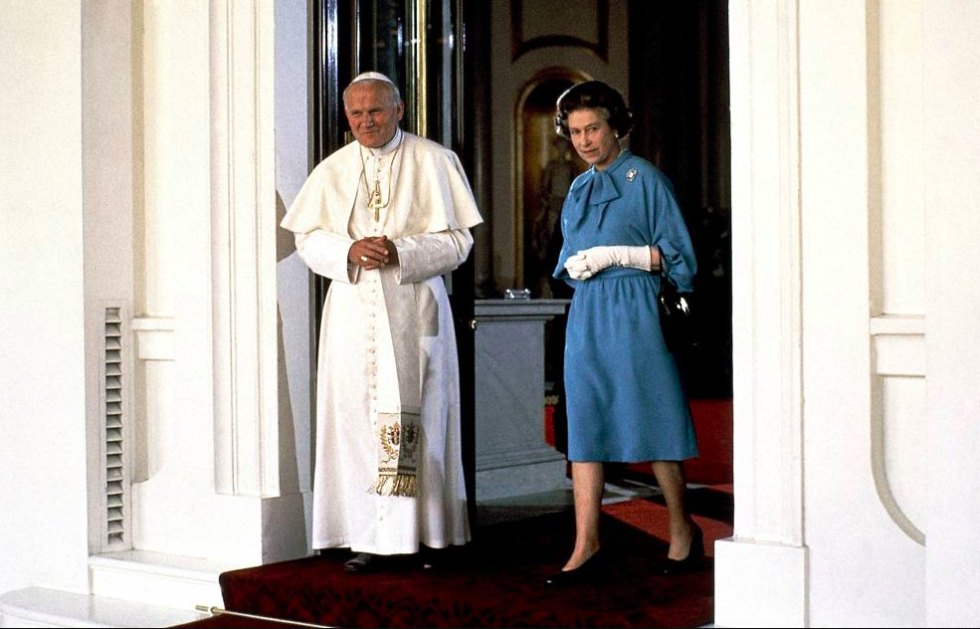
Queen Elizabeth II met John Paul II for the first time on 17 October 1980. As the BBC reported, Pope John Paul II welcomed Her Majesty and the Duke of Edinburgh for what was described as a „warm and relaxed” encounter. Although this was the first encounter between two of significant figures of the 20th century, the Polish Pope’s visit to Great Britain on 28 May 1982 occupies a larger place in history books.
The Pope visited Elizabeth at a difficult time for the British because of a war with Argentina over the Falklands and an internal religiously motivated conflict in Northern Ireland. John Paul II’s pilgrimage to Great Britain in 1982 was the first visit of the head of the Catholic Church to this country since the Reformation. During six days of a pilgrimage around Great Britain, the Holy Father visited eight cities, celebrated 7 Masses, and delivered 31 speeches and sermons.
Almost a decade later, in April 1991, the British monarch welcomed Polish President Lech Wałęsa and his wife, Danuta, to Buckingham Palace. Poland had just regained sovereignty following the fall of Communism in Central Europe.
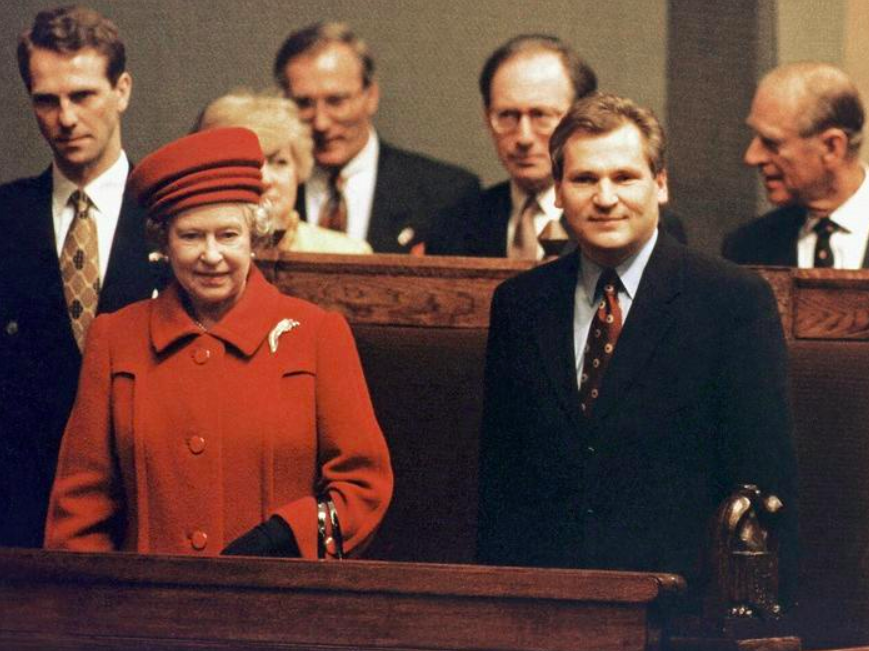
On 25 March 1996, the British ruler paid her only visit to Poland. She opened an exhibition entitled “Eagle and Lion. 900 years of Polish-British relations” at the Royal Castle. The British royal couple paid tribute to the Jews murdered by the Germans at the Umschlagplatz monument at Stawki street and laid a wreath at the Tomb of the Unknown Soldier.
In an interview given to Wirtualna Polska, former Polish President Aleksander Kwaśniewski recalled that the Queen was well-prepared for her visit. On the occasion of an encounter with Polish soldiers, she recited the poem “Czołem, żołnierze” in Polish, to the local’s amazement.
The last time Elizabeth II met John Paul II was on 17 October 2000 in the private library of the Vatican Pope. The audience lasted about twenty minutes. The Queen was then in Italy on a four-day state visit. Aleksander Kwaśniewski and his wife visited Elizabeth II twice more during their journeys to London in 2004 and 2005.
https://twitter.com/DamianPKujawa/status/1567952003434958848?s=20&t=ygGV1PlBfryp7rRwk7e_Rg
The third Polish President which had the honour to meet the British monarch was the late Lech Kaczyński on 6 November 2006. The following day, the Polish head of state and his wife Maria were received by Her Majesty for a private audience at Buckingham Palace.
After the Smolensk plane crash, which killed the presidential couple and 94 high-rank Poles on 10 April 2010, the Queen wrote a condolences letter honouring the memory of the deceased President. “It is with deep sadness that I learned about the death of President Lech Kaczyński and the first lady, Mrs Kaczyńska. On this sad occasion, I recall President Kaczyński’s long and respectful career in the service of the state and his role in the Solidarity movement […] I would like to express my deepest condolences to the entire Polish nation,” – we read in the letter.
It can be said that Queen Elizabeth II was a larger-than-life figure of authority whose aura impacted all those who had the opportunity to meet her. She was animated by a genuine feeling of sympathy towards Poland and the Polish nation. The latter reciprocated this feeling, seeing the profound respect the British monarch always displayed regarding our country and heritage.
There is no doubt that the Queen’s death represents a considerable loss for the UK, for Poland, and for mankind in general. We are witnessing the end of an era. May the legendary Queen Elizabeth II, a genuine friend of Poland, rest in peace.
Images: Getty Images, Wojtek Laski, East News
Author: Sébastien Meuwissen