After years of lethargy, it seems like the Weimar Triangle (Paris – Berlin – Warsaw) is showing signs of life.
For the past week or so, Poland’s PM Donald Tusk has been exchanging with the leaders of France and Germany on burning geopolitical issues. On 12 February, Tusk visited Paris and Berlin to enhance close cooperation with the EU’s most powerful actors.
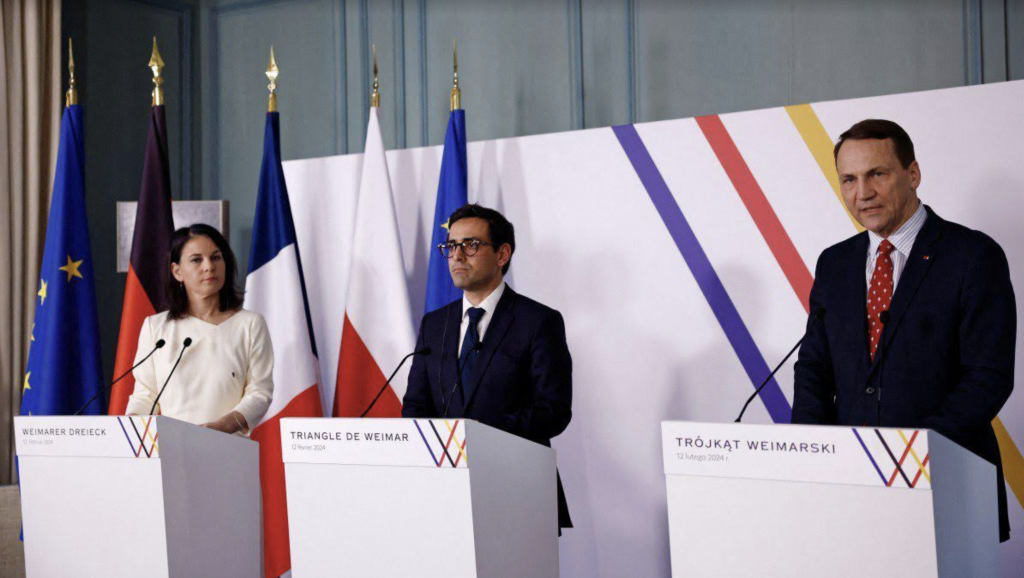
The PM’s visit was more than just a public relations move. It was meticulously planned in close collaboration with foreign ministries, coinciding with a long-awaited Weimar Summit of Ministers of Foreign Affairs. During this event, a new plan for cooperation among the three countries was announced.

The signed declaration, comprising three points, reaffirms France, Germany, and Poland’s commitment to collaborate in promoting peace and stability in Europe. It emphasises democratic security principles, pledging to bolster the NATO alliance through the European defence initiative and joint foreign policy actions.

The sense of urgency conveyed in the declaration primarily stems from the imperative to support Ukraine’s war effort and its ongoing integration with the EU. This aligns closely with the foreign policy priorities outlined by Donald Tusk, who pledged in his December opening speech to harness the full potential of all Western allies in supporting Ukraine’s war effort.
The Weimar Triangle is a diplomatic platform of cooperation relationship between Germany, France, and Poland. It was named after the city of Weimar in Germany, where the first meeting between these nations took place in 1991. The purpose of this cooperation is to strengthen political, economic, and cultural ties between the three countries, promoting peace and stability in Europe. The Weimar Triangle often addresses issues related to European integration, security, and regional cooperation.
Photo: Photo by Sarah Meyssonnier / Pool / AFP
Author: Sébastien Meuwissen