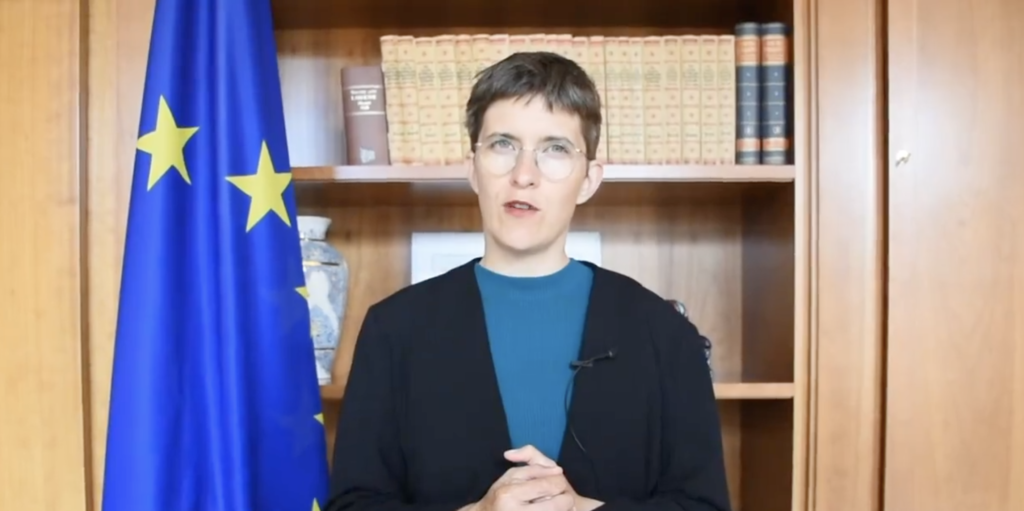
German State Minister for Europe, Anna Lührmann of the Greens, highlighted the imperative of transitioning to qualified majority voting to pave the way for EU enlargement, drawing insights from Polish history.
Following the re-election of Polish Prime Minister Donald Tusk from the Civic Platform party within the European People’s Party, the rapport between Poland and Germany has seen a significant upswing, notably with the revitalisation of the „Weimar Triangle” framework involving Germany, France, and Poland.
https://twitter.com/AnnaLuehrmann/status/1784940628012421429
Addressing an audience at the Polish Embassy in Berlin commemorating the anniversary of the Polish Constitution on 3rd May, Lührmann underscored the symbiotic relationship between EU enlargement and reform.
Asserting that a larger EU doesn’t inherently equate to a more robust EU, Lührmann advocated for internal reforms alongside enlargement. „This necessitates deliberation on qualified majority voting in the EU,” she remarked, cautioning about the potential pitfalls of unanimity by drawing parallels from Polish history, particularly the Liberum veto.
The Liberum veto, a decree in the Polish-Lithuanian Commonwealth during the 17th and 18th centuries, granted any member of the Polish parliament, the Sejm, the authority to obstruct legislative processes. Criticised as a conduit for foreign interference, notably from Russia, this historical context underscores the importance of collective learning. „We must have the courage to collectively glean wisdom from Polish history,” Lührmann concluded.
Poland’s current government under Tusk’s leadership has exhibited greater receptiveness. Foreign Minister Radoslaw Sikorski of the Civic Platform party conveyed to the Greek newspaper Kathimerini in April that „the Polish public would endorse dispensing with unanimity in certain domains, such as sanctions.” Nevertheless, he clarified that Poland’s stance on the matter remained to be clearly specified.
The Polish governing coalition finds itself divided on this issue. While the Left advocates for the abolition of veto powers for individual countries, Paweł Zalewski, the centrist Poland 2050 candidate in the EU elections, argues for its retention.
Image: X (@AnnaLuehrmann)
Author: Sébastien Meuwissen