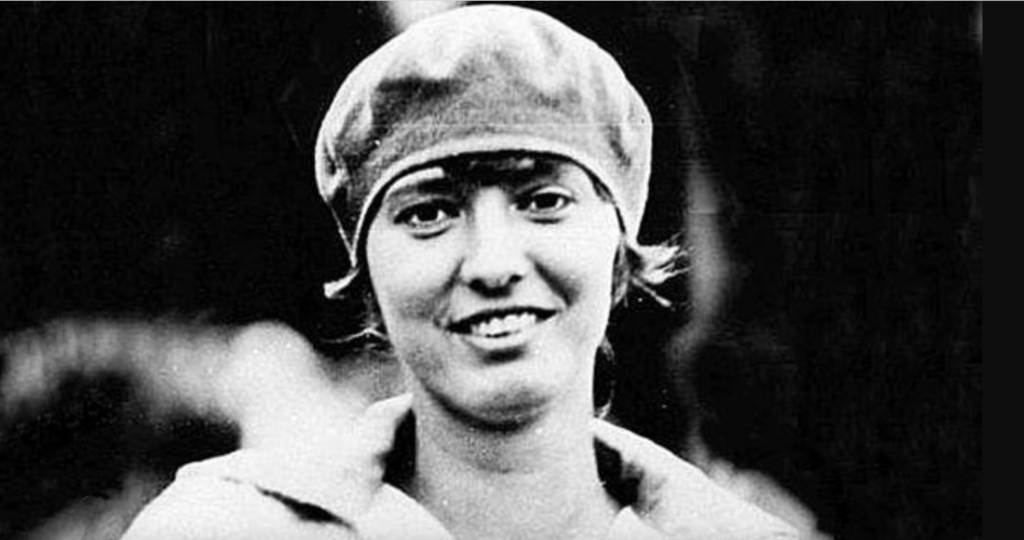
Konopacka was the first Polish athlete to win Olympic gold for Poland after the country returned to the map of Europe in 1918. She set several world records and was a symbol of Polish sports excellence. Her wartime service to Poland crowned the biography of one of the most important Polonia Restiuta cross recipients.
She was born on 26 February 1900 in Rawa Mazowiecka, under the name Leonarda Kazimiera. She later chose the name Halina as a nickname to avoid scandal because she participated in professional sports as a woman, which was not common at the beginning of the 20th century. She came from a wealthy family with long patriotic traditions. Interestingly, King Sigismundus the Old himself wrote of the Konopacki family in 1543, that they had “magnificence of soul, firmness of body and faithfully serve the Fatherland”. And these words proved prophetic for Halina.
She started her studies as a philology student but soon engaged in student sports organisations, and began practicing skiing at the Warsaw AZS Sports Club.
She has practised discus throw, javelin throw, ball push, high jump and long jump. In 1924 she won her first Polish championship in the discus throw. In 1926 she set the first of her world records in the discus throw at 34.15m. In the same year, at the Second Women’s Games in Gothenburg, she also won in discus throw with a result of 37.71 m. Halina Konopacka won 27 champion titles in Poland in several different sports competitions.
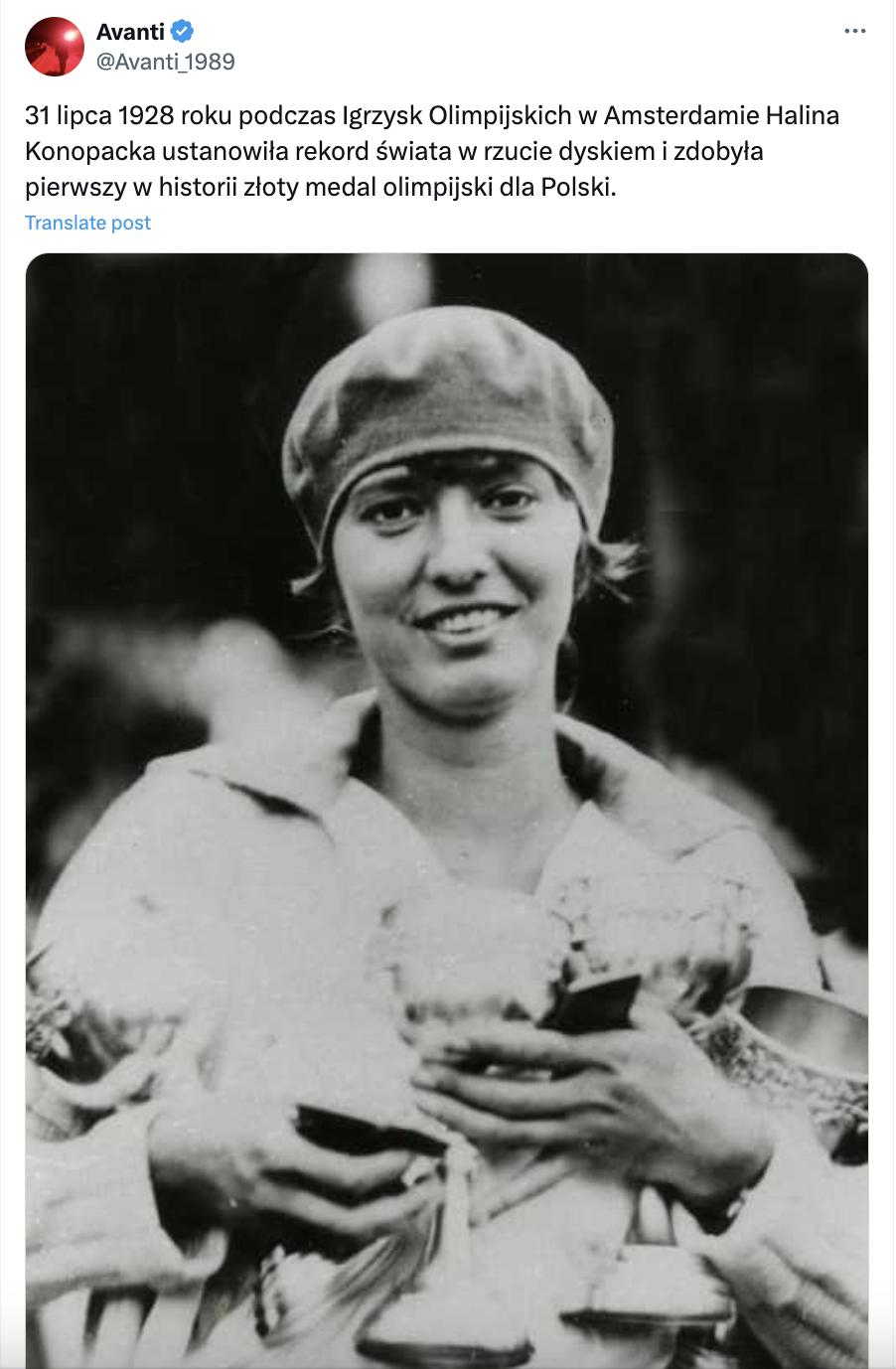
Her greatest success came on 31 July 1928, during the Olympic Games in Amsterdam where she set a world record in the discus throw with 39.62 m and won the first Olympic gold medal for Poland. She was also voted to be the Miss of the Amsterdam Games in a survey among sports journalists.
As the Olympic summary said, the 27-year-old Konopacka, became: “the first ever Olympic woman’s athletics gold medallist.”
Dreams of many generations of Poles who struggled to build competitive sports in a country that recently regained independence came true. The Olympic championship became the symbol of sports success for all Polish people. She also received a congratulatory telegram from President Ignacy Mościcki, and right after her return to Warsaw, she was received at the Belvedere by Marshal Józef Piłsudski.
After the outbreak of the 2nd World War on 1 September 1939, Halina’s husband was tasked with transporting the Polish gold treasury of the National Bank of Poland to prevent it from falling into the hands of the Germans. Almost 80 tonnes of gold were placed on the seats of several city buses and other vehicles. Halina, as the only female driver, drove as the last (and only female) driver of a dozen cars. On 7 September, after collecting gold from several other locations, the cavalcade moved from Lublin towards the border with Romania. During the day, the drivers slept in the forests, hiding their cars with branches so that the German reconnaissance planes would not spot them.
In the border town of Sniatyn, the drivers loaded the gold onto a train on which the precious transport reached Romania. From the port of Constanța, Konopacka and the rest of the group travelled to Istanbul. There the group moved the gold to another train and reached Beirut. Ignacy Matuszewski sailed with the gold on a French navy ship to Toulon and reached Sevres, where the gold was hidden. Halina joined her husband in France and together they escaped to the U.S. where they lived during 2 World War. During the mission, Konopacka’s luggage was lost together with her Olympic gold medal that was never found.
Her husband Ignacy Matuszewski died in 1946. During her time in the USA, she designed clothes and opened her fashion boutique.
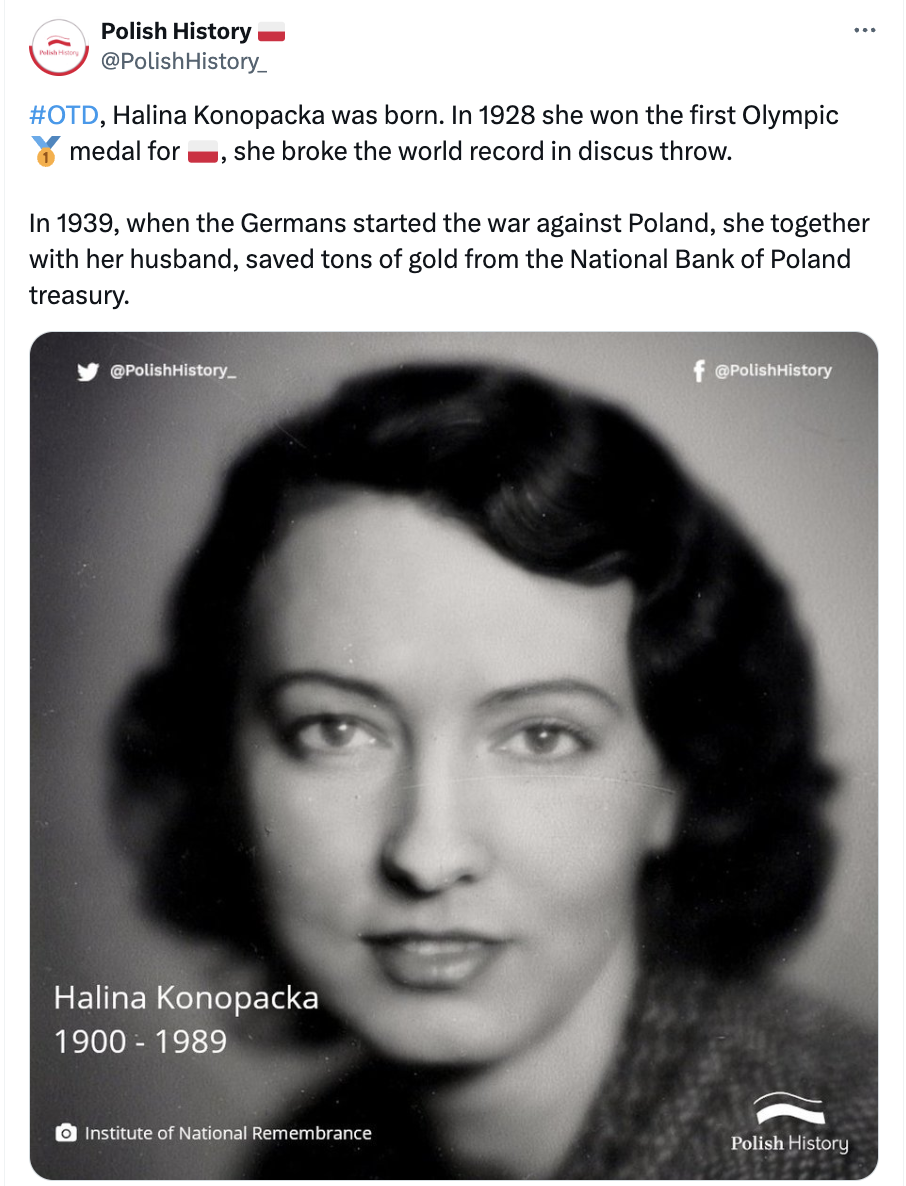
Konopacka visited Poland three times. She died on 28 January 1989 in Daytona Beach, Florida. Her remains were transported to Poland and buried in Warsaw’s Bródno cemetery.
She was posthumously awarded the Order of Polonia Restituta on the occasion of the 100th anniversary of Poland’s independence in November 2018.
Tomasz Modrzejewski
Zdjęcie: IPN