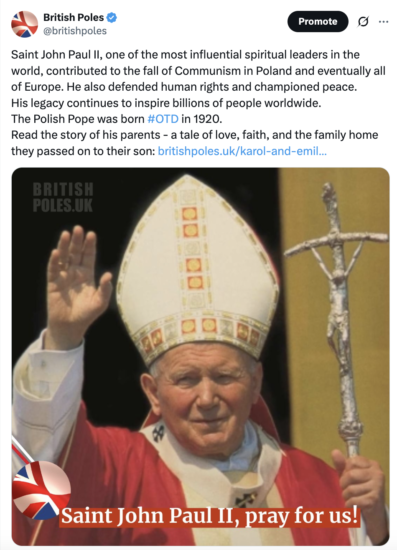
Poland commemorates the late Pope Saint John Paul II not only as a spiritual leader for the country and the first Bishop of Rome of Slavic origin but also as a figure who significantly contributed to the fall of communism in Central Europe and beyond.
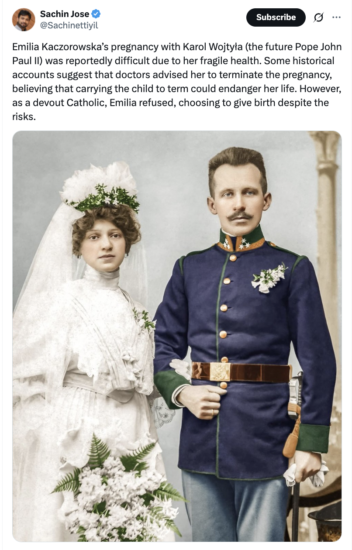
Karol Wojtyła, later known to the world as Pope John Paul II, was born in the small Polish town of Wadowice. His early life was marked by personal tragedy when his mother, Emilia née Kaczorowska, passed away in 1929.
In 1938, having completed his education at the Wadowice Secondary School, Wojtyła moved with his father, also named Karol, to Kraków. There, he embarked on studies in Polish philology at the Faculty of Philology of the Jagiellonian University, one of Poland’s oldest and most prestigious institutions.
However, his academic journey was abruptly interrupted by the outbreak of the Second World War and the Nazi German occupation of Poland, which led to the university’s closure.
In the face of adversity, Wojtyła worked as a manual labourer, first in a quarry in Kraków’s Zakrzówek district and later at a chemical plant in nearby Borek Fałęcki.
This difficult period left a lasting impression on him, later inspiring one of his early poems, Stone and Boundlessness, which he published under the pseudonym Andrzej Jawień.
In 1941, he suffered another profound loss with the death of his father, leaving him without any immediate family.
During the German occupation, Wojtyła found solace and purpose in cultural resistance. He became involved in the underground Rhapsodic Theatre (Teatr Rapsodyczny), a clandestine artistic movement dedicated to preserving Polish culture through literature and performance.
By 1942, his spiritual calling had become undeniable. He secretly entered the Archbishop’s Seminary in Kraków, all while continuing philosophical studies at the covert Faculty of Theology at the Jagiellonian University—both institutions operating underground under Nazi rule.
These formative years laid the foundation for Wojtyła’s later life as a priest, philosopher, and ultimately, one of the most influential figures in modern Catholic history.
Between 1 August 1944 and 18 January 1945, as the Second World War neared its end, Karol Wojtyła found refuge alongside fellow seminarians in the residence of Kraków’s Metropolitan Archbishop, Cardinal Adam Stefan Sapieha. Their sheltering continued until the arrival of the Red Army in the city.
On 1 November 1946, following the completion of his theological studies, Wojtyła was ordained a priest. He soon travelled to Rome, where he pursued further philosophical studies for two years. His time abroad also included pastoral work among Polish émigré communities in France, Belgium, and the Netherlands.
Returning to Poland, he undertook doctoral research at the Faculty of Theology of the Jagiellonian University, defending his thesis in 1948 on The Problems of Faith in the Writings of St John of the Cross. His academic journey continued, and in 1953, he earned his habilitation—the equivalent of a second doctorate—on The Possibility of Constructing a Christian Ethics based on Max Scheler’s System.
By 1953, Wojtyła was teaching moral theology and social ethics at the Kraków Theological Seminary. A year later, he began lecturing at the Catholic University of Lublin, where he was appointed head of the Chair and Department of Ethics within the Faculty of Philosophy.
Wojtyła’s rapid rise through the ranks of the Church hierarchy continued in July 1958, when Pope Pius XII named him auxiliary bishop to Archbishop Eugeniusz Baziak of Kraków. At just 38 years old, he became the youngest bishop in the Polish Episcopate.
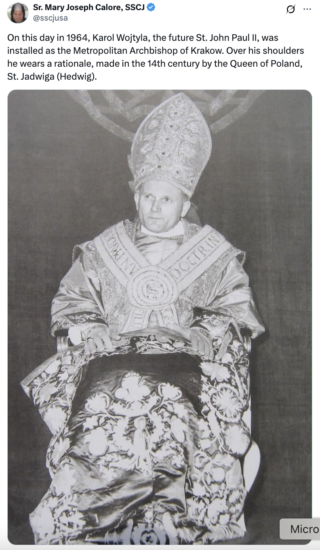
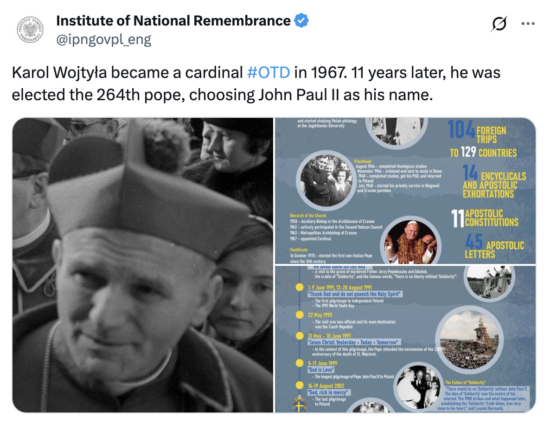
Following Archbishop Baziak’s death in 1962, Wojtyła was elected Vicar Capitular of the Archdiocese of Kraków. His leadership was soon formally recognised when, in December 1963, Pope Paul VI appointed him Archbishop of Kraków. He was elevated to the College of Cardinals in June 1967, marking a significant milestone in a life of faith, intellect, and unwavering commitment to the Church.
Cardinal Karol Wojtyła played a pivotal role in the transformative years of the Catholic Church, actively participating in the Second Vatican Council (1962–1965). He attended all four sessions and was a key contributor to the drafting and final editing of Scheme XIII, the document that would become Gaudium et Spes — the Constitution On the Church in the Modern World. This text marked a fundamental shift in the Church’s engagement with contemporary society.
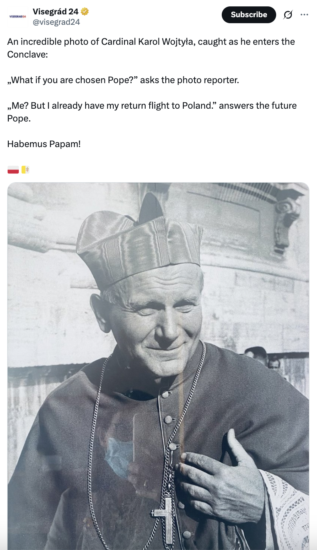
On 16 October 1978, the conclave of cardinals elected the 58-year-old Archbishop of Kraków as the 264th pope. In a symbolic gesture of continuity, he adopted the name John Paul II, honouring his short-lived predecessor, John Paul I, whose pontificate had lasted just 33 days.
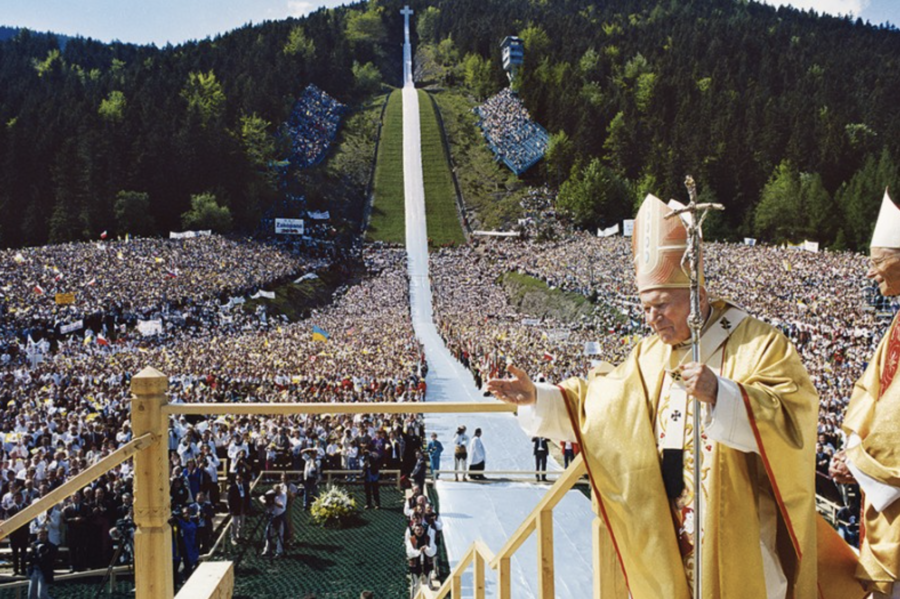
His first papal visit to his native Poland, from 2 to 10 June 1979, proved to be a watershed moment—not only for the Church but for the nation’s path to freedom. His words during the pilgrimage are widely credited with inspiring the birth of the Solidarity movement, which would later play a crucial role in the fall of communism in Eastern Europe. In total, John Paul II returned to Poland on nine occasions.
For more than 26 years as pontiff, John Paul II left a monumental legacy. He issued 14 encyclicals, 14 apostolic exhortations, 11 apostolic constitutions, and 43 apostolic letters. He convened nine consistories and appointed approximately 240 cardinals—including five from Poland—and over 2,500 bishops. He ordained more than 2,000 priests, canonised 482 saints (including 10 Poles), and beatified 1,318 individuals (154 of whom were Polish).
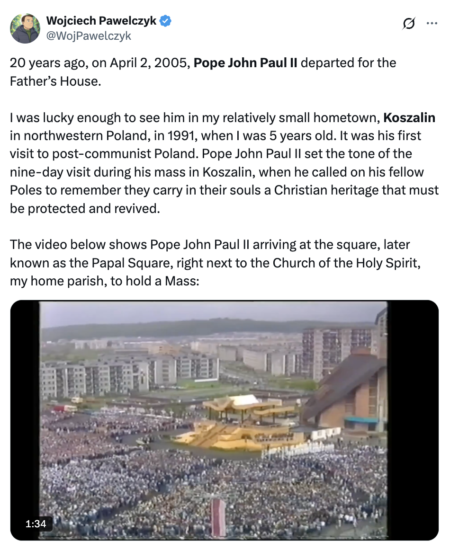
His papacy was also marked by extraordinary global outreach. He undertook 104 apostolic journeys, visiting 132 countries and nearly 900 cities and towns—more than any of his predecessors in the history of the papacy.
A defining moment in Cold War diplomacy came on 1 December 1989, when John Paul II welcomed Soviet leader Mikhail Gorbachev to the Vatican. The encounter symbolised a thaw in East-West relations and affirmed the Pope’s influence on the global stage. His historic pilgrimage to communist Cuba further underscored his commitment to dialogue across ideological divides.
In the 1990s, the Pope strongly criticised armed conflicts that were started in Iraq and the Balkans – he visited Croatia during the war and supported the struggle for independence of that country, even recognising its sovereignty as one of the first entities of international law in January 1992.
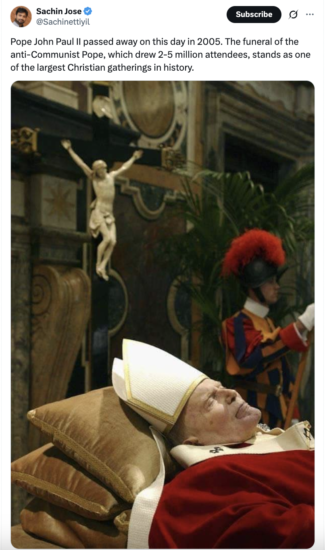
John Paul II died on 2 April 2005. He was beatified by Pope Benedict XVI on 1 May 2011 and canonised by Pope Francis on 27 April 2014. His enduring impact—both spiritual and geopolitical—remains a cornerstone of modern Church history.
Source: Dzieje.pl
Photo: Jolanta Sosnowska
Tomasz Modrzejewski