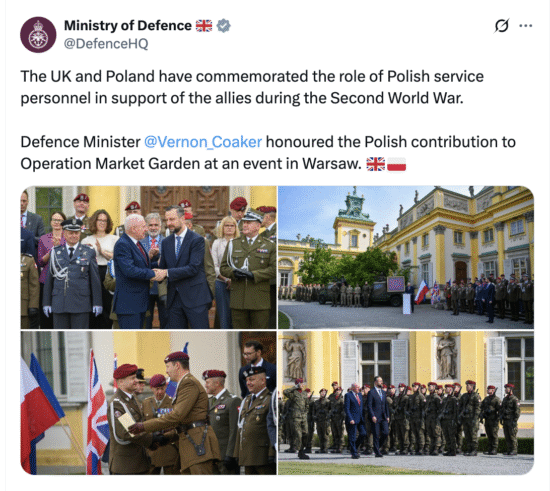
In a symbolic ceremony held in Warsaw, the British government has formally honoured General Stanisław Sosabowski and the 1st Independent Parachute Brigade, decades after the controversial dismissal of the Polish commander following the failed Operation Market Garden. The tribute, announced by UK Defence Minister Vernon Coaker, was presented as a long-overdue act of recognition for Sosabowski’s leadership and the heroism of his troops.
Once scapegoated for the failure of the Arnhem offensive in 1944, Sosabowski was removed from command by his British superior, General Frederick Browning. Historians have since challenged that decision, pointing to flawed Allied planning and suggesting that Browning himself bore the greater responsibility. Despite his removal, Sosabowski was awarded Poland’s Cross of Valour immediately after the operation—a testament to how highly he was regarded by others in the Allied command.
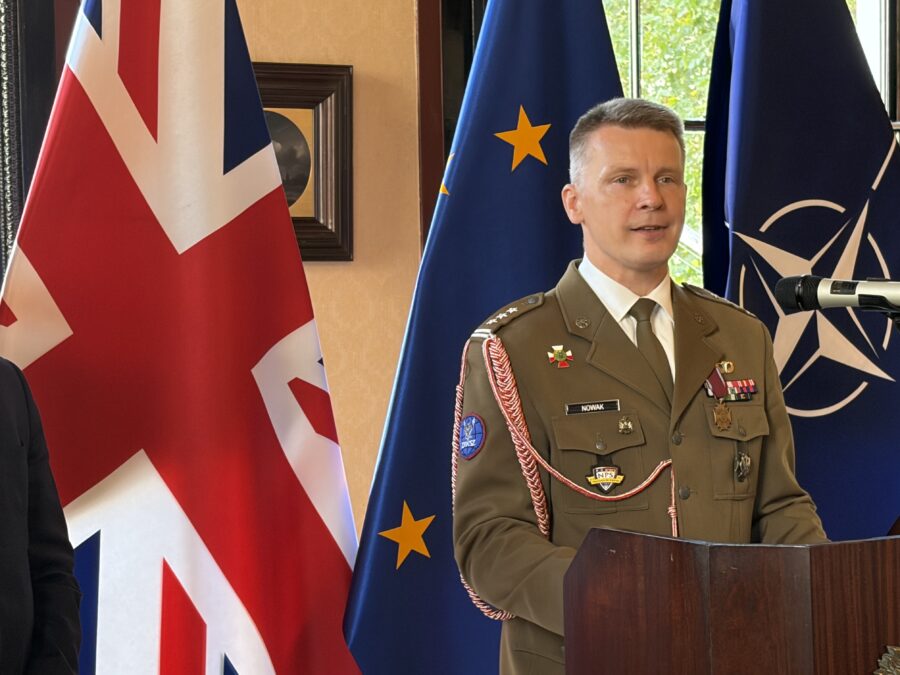
Polish Deputy Prime Minister and Minister of Defence Władysław Kosiniak-Kamysz called the British gesture “a restoration of honour.” Speaking at the ceremony, he emphasised that „a nation that forgets its heroes is unworthy of them—but one that fights to uphold their memory has a great future.” He noted that the decision to rehabilitate Sosabowski came following conversations between the British and Polish prime ministers, marking a joint effort to resolve an open chapter in history.
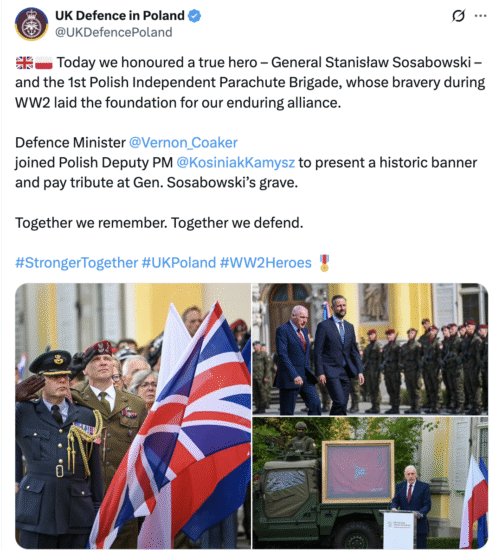
Minister Coaker also acknowledged that the role of Polish forces in Market Garden had been unfairly overlooked for decades. “In these uncertain times,” he said, “their story is a powerful example of perseverance, principle, and commitment. On behalf of the United Kingdom, I wish to express our deep gratitude for the bravery of General Sosabowski and his men. The bonds formed between British and Polish soldiers in Arnhem remain strong to this day.”
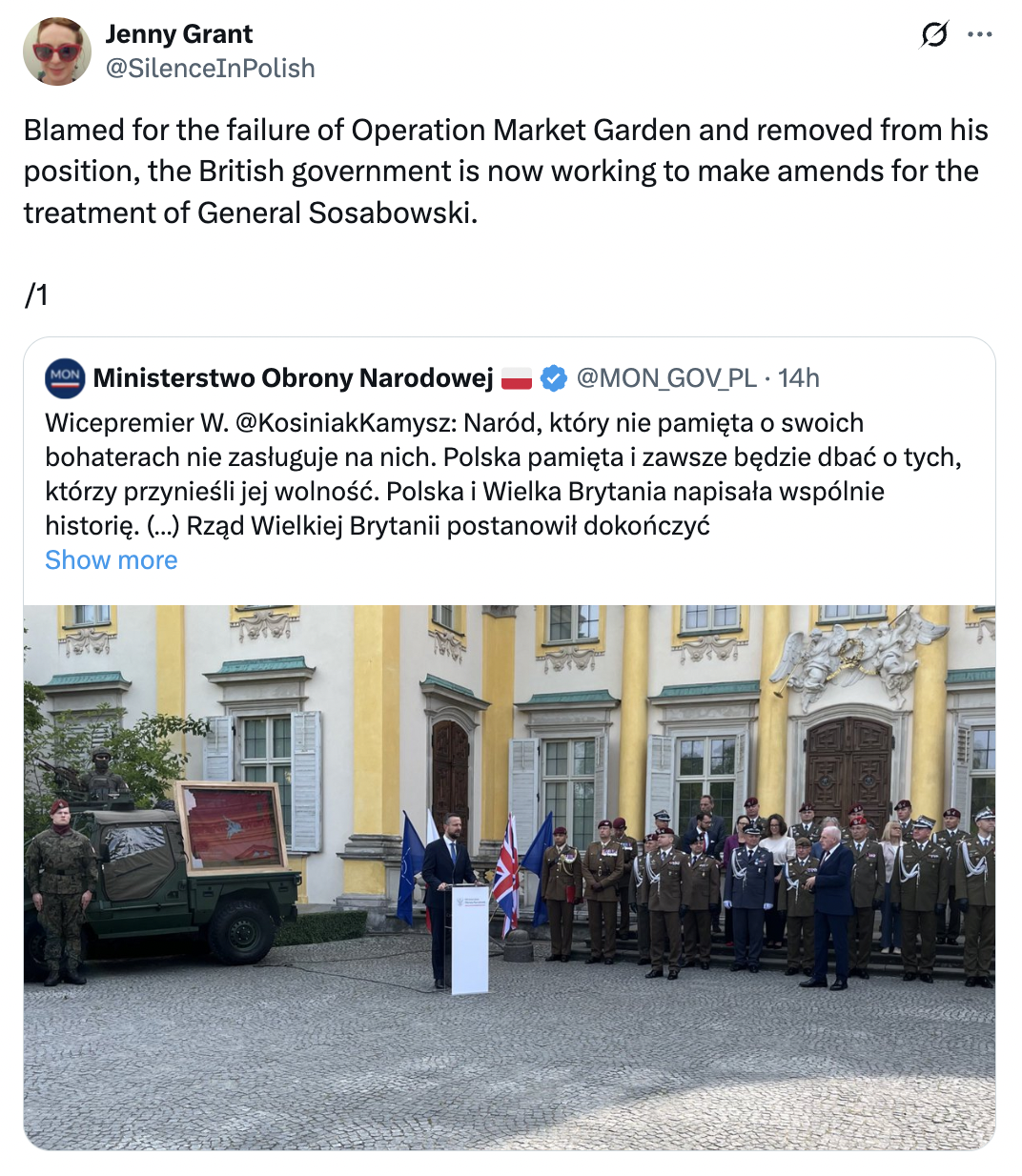
The head of the Polish defence ministry reflected on the enduring alliance between the two nations, from the Battle of Britain to modern missions. He also paid tribute to Britain’s unwavering support during the Cold War and its role in the rebirth of an independent Poland. “Without the help of our British friends,” he stated, “we would not be where we are today.”
Born in 1892 in Stanisławów, Sosabowski began his military career shortly after Poland regained independence in 1918. Although health issues kept him from fighting in the Polish-Bolshevik War, he rose through the ranks in the interwar years, commanding several key infantry regiments. His legacy, once clouded by post-war political dynamics, now stands rehabilitated on both sides of the Channel.
General Stanisław Sosabowski led his brigade into the largest Allied airborne operation of the Second World War—Operation Market Garden. Its objective was bold: to capture a series of key bridges over the Rhine near Arnhem, paving the way for a swift Allied advance into Germany. But when the mission failed, Sosabowski was made the scapegoat. Stripped of his command of the 1st Independent Parachute Brigade, he was reassigned as Inspector of Line-of-Communication and Guard Units—a post that effectively pushed him out of active military service.
Despite this sidelining, Sosabowski remained loyal to his fellow soldiers and continued serving in the Polish Armed Forces in exile until their dissolution in 1947. Following that, he spent two years with the Polish Resettlement Corps—a British initiative created to help demobilised Polish troops who had no intention of returning to a Soviet-dominated homeland. The corps offered training and support for a transition into civilian life.
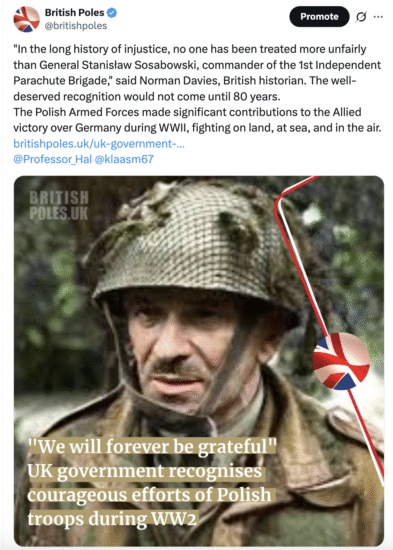
In 1949, the once-celebrated general was offered work as a warehouseman. Throughout his later years, he remained active in Polish veterans’ associations, quietly supporting the community he had once led in battle. Yet, he lived out his days without any formal recognition of his service and sacrifice.

Sosabowski died in 1967, far from the homeland he had fought for. Two years later, his remains were returned to Poland and laid to rest with honour at Warsaw’s Powązki Military Cemetery. Though posthumous tributes have since revived his legacy, he never lived to witness the justice and gratitude that now define his memory.
Source: PAP
Photo: @DefenceHQ
Tomasz Modrzejewski