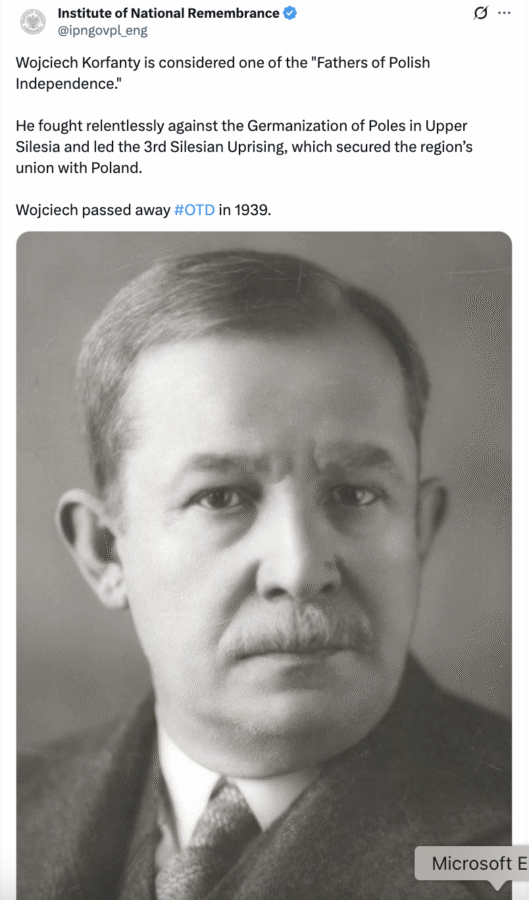
On 17 August 1939, Wojciech Korfanty died in Warsaw after imprisonment in Pawiak. He was an influential politician, a champion of Polish identity in Upper Silesia, the leader of the Third Silesian Uprising, and one of the foremost figures of Christian Democracy in Poland. Although now considered one of the Fathers of Polish independence, Korfanty died after incarceration by the pre-war Polish government, which led a brutal political repression against the top figures of the opposition.
Wojciech Korfanty, born as Adalbert Korfanty, was born on 20 April 1873 in the small settlement of Sadzawka, today part of Siemianowice Śląskie. His family had lived there for generations. Whenever a new child was born, the Korfantys would cross the nearby border over the River Brynica – first the Austrian-Polish frontier, later the Prussian-Polish one – to have the infant baptised in a Polish parish. His father, originally a farmer, eventually joined many of his fellow villagers in working as a miner in the newly opened coal pits.
The boy began his education in Siemianowice in 1879. The local teacher spoke to his Polish pupils only in German. Determined to search for better opportunities for their son, his parents made considerable sacrifices to send him to the Royal Gymnasium in Katowice. There, Korfanty founded a clandestine circle devoted to Polish culture and literature. His connection to Polishness, he later admitted, had been shaped above all by the hostility of his teachers:
“I owe my national awakening to my professors in Katowice, who with their hatred of all things Polish and Catholic drove me to seek out Polish books. From them I wished to learn what this derided and despised nation – the one whose language was spoken in my home – truly was,” he recalled.
During these years, he also forged ties with activists from Greater Poland and attended Polish gatherings where he denounced Chancellor Bismarck. This outspokenness led to his expulsion from the gymnasium before he was admitted to the final exams that allowed him to pursue higher education.
Thanks to the intervention of Józef Kościelski, a Polish deputy to the Reichstag, he was allowed to complete his secondary education externally in Wrocław (then Breslau) in 1895. That same year, he began studies at the Polytechnic in Charlottenburg, near Berlin. The following autumn, he moved to the University of Wrocław, where he studied philosophy for two semesters before finishing his final term in Berlin in 1901.
Between 1901 and 1908, he belonged to the clandestine National League, working closely with another Father of Polish independence, the national democratic leader Roman Dmowski.
His early writings were sharply critical of the German Catholic Centre Party, which he accused of ignoring Polish interests – despite the party’s initial support from the Polish circles in response to the German Kulturkampf policy aimed against Catholics and Poles.
He argued that Poles must build their national movement and warned against the influence of socialism. From the outset, he addressed social questions, drawing inspiration from the emerging Christian Democratic movement, whose programme offered an alternative to the demands of the left.
In 1901, he took over as editor-in-chief of the newspaper Górnoślązak. A year later, for publishing two polemical articles called To the Germans and My Upper Silesian Brothers, he was sentenced to prison in Wronki. His spirited defence in court, in which he argued that he had targeted not all Germans but only chauvinists who oppressed the Poles, won him wide admiration across Prussian-occupied Poland. Upon his release, nationalist activists honoured him with a banquet in Poznań.
Korfanty’s first campaign for the Reichstag came in 1903. His election meetings, held in Silesian taverns, drew crowds of miners and labourers. One newspaper reported that his words were greeted with “thunderous applause.” In the run-off, he won thanks to socialist voters, who preferred a Polish Christian Democrat to a candidate of the German Centre Party. Stanisław Kot, a fellow nationalist, later described the moment as “a hurricane that swept across Silesia, awakening and stirring new forces.”
He remained in the Reichstag until 1912, gaining a reputation as a fiery speaker. He denounced, among other things, the “theft of Polish land” carried out by the Prussian state. From 1903 to 191,8 he also represented the Polish Club in the Prussian Landtag, being the first Silesian to join a body hitherto composed only of deputies from Greater Poland and Pomerania.
The outbreak of the First World War found him sceptical about the prospects of regaining independence. Instead, he concentrated on organising food relief for the starving population of the Kingdom of Poland. In 1918, he re-entered the Reichstag in a by-election, once again pressing for Polish rights within the German Empire.
On 25 October that year, he delivered a landmark speech in which he demanded the incorporation of all Polish territories under Prussian rule into the reborn Polish state.
“Gentlemen, we do not seek an inch of German land. We demand only, by Wilson’s Thirteenth Point, a united Poland from all three partitions, with secure access to the sea. […] We ask for no German districts – only the Polish counties of Upper Silesia, Middle Silesia, Poznań, Polish West Prussia and the Polish lands of East Prussia,” Korfanty said in front of German MPs.
In the same speech, he called for the release of Józef Piłsudski from captivity. Shortly afterwards, Polish deputies symbolically withdrew from the Reichstag altogether.
One of Korfanty’s most important days was 2 May 1921 when a general strike broke out in Upper Silesia, followed that night by the outbreak of the Third Silesian Uprising. Once again, Wojciech Korfanty assumed command.
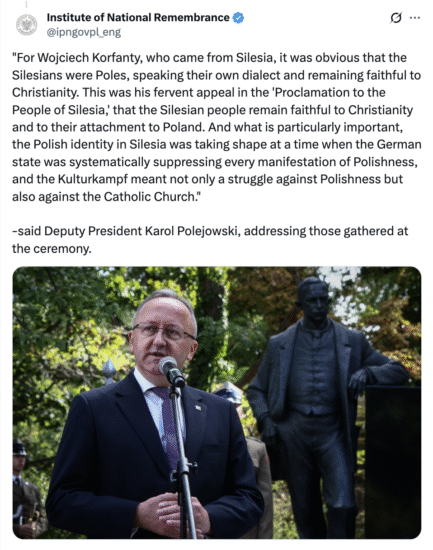
Although he had always opposed military solutions and the policy of fait accompli, he nevertheless agreed to lead the movement. After the first military successes, however, he ordered a halt to further fighting and awaited the verdict of the Inter-Allied Commission.
The rising led to a settlement of a favourable border line to Poland in the south-west. Ultimately, 29 per cent of the plebiscite territory and 46 per cent of its population were incorporated into the Polish Republic.
The decision was also of immense economic benefit, for the newly acquired region contained 53 of 67 coal mines, 22 of 37 blast furnaces, and nine of 14 steelworks.
Between 1922 and 1930, Korfanty sat in the Sejm as a deputy representing Christian Democracy. When Prime Minister-designate Artur Śliwiński failed to form a cabinet, the Sejm’s Main Commission entrusted Korfanty with the task.
Yet his nomination was fiercely opposed by Józef Piłsudski, Head of State, and by the Polish Socialist Party, which threatened to call a general strike. Faced with this hostility, Korfanty abandoned the attempt. The right responded with a motion of no confidence for Piłsudski himself.
From October to December 1923, Korfanty served as Deputy Prime Minister in Wincenty Witos’s government, acting as Christian Democracy’s chief adviser. After 1924, however, his primary activity shifted to journalism.
He became publisher of the influential dailies Rzeczpospolita and Polonia, both of which were sharply critical of Piłsudski’s May Coup. As Dr Węcki notes, “Korfanty condemned the coup as anti-democratic, further deepening his conflict with Piłsudski’s camp.”
In 1930 he was arrested alongside other opposition leaders of the Centrolew and imprisoned in the fortress at Brześć. Upon release he returned to Upper Silesia, where his feud with the local voivode, Michał Grażyński, placed him under threat of renewed arrest. In the spring of 1935 he chose exile, settling in Prague.
Even in 1938, after the death of his son Witold, he was refused safe conduct by the Polish government of Felicjan Sławoj-Składkowski and could not attend the funeral. During these years he became one of the founders of the Morges Front, alongside Ignacy Jan Paderewski, Józef Haller, and Wincenty Witos, and later took the lead in creating the Labour Party, uniting Christian Democrats and the National Workers’ Party.
Following Germany’s annexation of Czechoslovakia in March 1939, Korfanty left Prague for France, travelling through Germany. In April, after Hitler renounced the non-aggression pact with Poland, Korfanty returned to Warsaw.
Within hours of his arrival, he was arrested and placed in the Pawiak prison. Despite protests from across Polish society and the clergy, he remained there for nearly three months.
He was released on 20 July due to a serious illness of the digestive tract; the authorities, it seems, wished to avoid the scandal of his death in custody.
Transferred to St Joseph’s Hospital on Hoża Street, he died on the morning of 17 August 1939.
Only days earlier, he had remarked bitterly to the writer Juliusz Żuławski, correspondent of Polonia: “And so you see, Mr Juliusz, how Poland has repaid me.”
The exact circumstances of his death remain disputed. One theory even claims that he may have been poisoned by arsenic vapours seeping from the walls of his cell.
Korfanty was laid to rest in Katowice, at the cemetery on Francuska Street. His funeral, attended by tens of thousands, became both a patriotic demonstration by the people of Silesia and an expression of support for his lifelong struggle for independence at a time when the threat of German aggression loomed ever larger.
Ignacy Jan Paderewski, writing in Polonia, declared: “Wojciech Korfanty will find his rightful place in the history of reborn Poland, though it was denied him during his lifetime.”
The authorities pointedly abstained from attending; the only official presence visible in photographs is that of the Silesian National Defence Brigade.
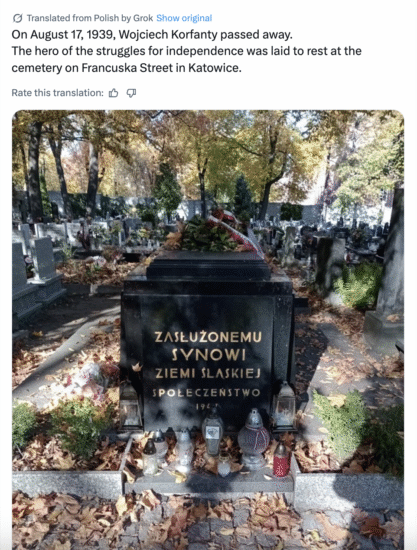
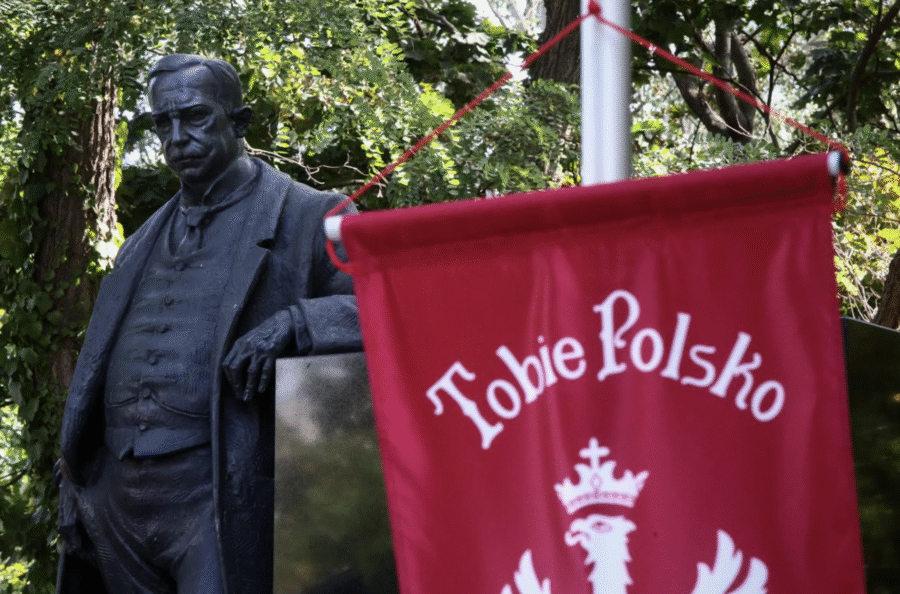
Today, in surveys in Upper Silesia, Korfanty is consistently ranked among the greatest and most deserving figures of the region. His symbolic rehabilitation was marked in 2019 with the unveiling of a monument in Warsaw, standing alongside memorials to the other founding fathers of Polish independence.
Source: PAP
Photo: IPN
Tomasz Modrzejewski