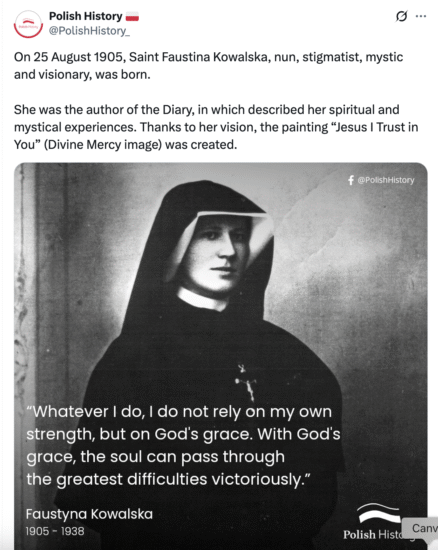
Saint Faustina was born on 25 August 1905 in the small village of Głogowiec, near Turek, the third of ten children of Marianna and Stanisław Kowalski, who made their living as farmers. At her baptism, she was given the name Helena. From an early age, she shared in the hard labour of the household and attended primary school for only three years. At sixteen, she left home to work as a domestic servant in Aleksandrów Łódzki. After entering the convent, she would soon become one of the most important figures in Polish catholicism.
After a year, she returned to her family and announced her desire to enter religious life. Her parents opposed the plan, insisting that they could not afford the dowry required by convents at that time.
Helena therefore resumed employment in Łódź. It was there, during a social event in a city park, that she experienced a vision of the suffering Christ.
Deeply moved, she travelled to Warsaw at the age of nineteen to seek admission to the Congregation of the Sisters of Our Lady of Mercy. She was turned away once more because she lacked the necessary dowry and instead entered service in Ostrówek, near Klembów.
At twenty, she was accepted into the congregation and began her religious life, working in the kitchens, the garden, and the convent gate in various houses of the order, most notably in Kraków, Vilnius, and Płock.
In 1925, Helena Kowalska entered the Congregation of the Sisters of Our Lady of Mercy (Institutum Sororum Matris Misericordiae or ISMM) in Warsaw. Eight years later, on 1 May 1933, she professed her perpetual vows in Kraków. Her religious service took her to several houses of the congregation, though her health was increasingly fragile: she suffered from tuberculosis of the lungs and digestive system. The final two years of her life were spent in the convent at Łagiewniki, Kraków.
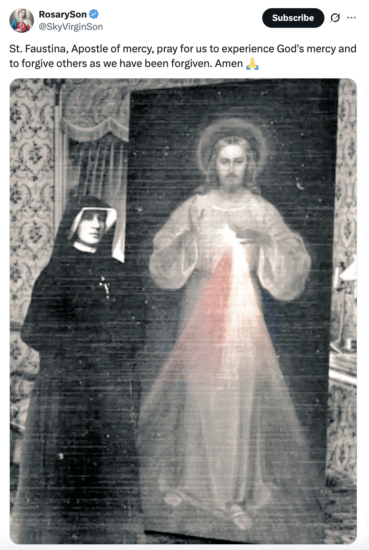
Her mystical experiences had begun earlier. On 22 February 1931, Sister Faustina received her first vision of Christ. As recorded in her Diary, she saw Jesus instructing her to commission a painting of the Divine Mercy with the inscription: “Jesus, I trust in You.”
According to Church accounts, Jesus asked Faustina to promote the Feast of Divine Mercy. This marked the beginning of her mission to spread the message of God’s merciful love, a truth rooted in Scripture and directed towards all humanity.
Although many places connected with her life are associated with visions, three in particular became central to her mission: Płock, Vilnius, and Kraków.
The painting, based on this vision, was completed in Vilnius in 1934 by the artist Eugeniusz Kazimirowski, who worked according to Faustina’s guidance.
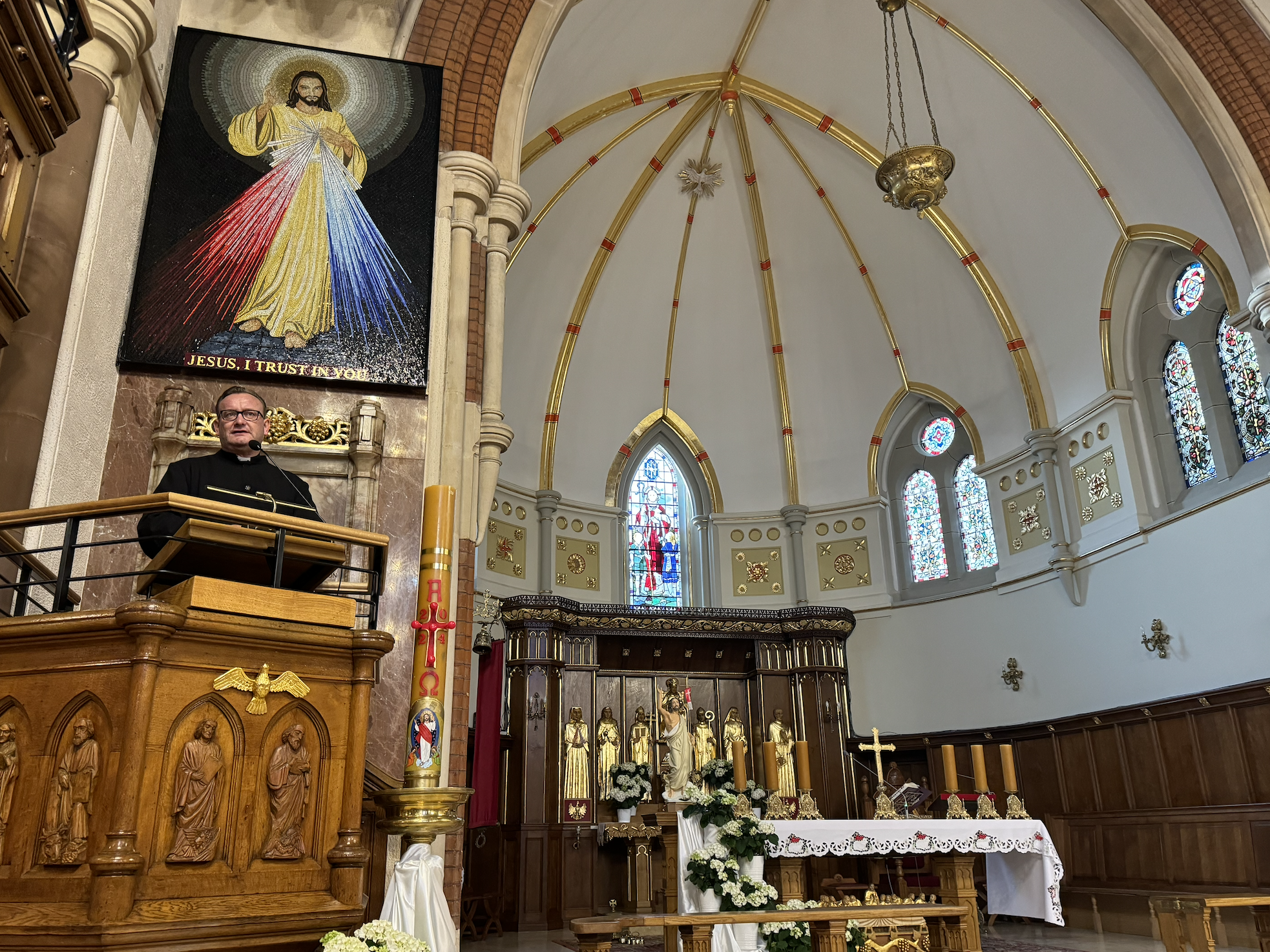
Another significant vision followed in 1935, also in Vilnius, during which Christ taught her the prayer now known as the Chaplet of Divine Mercy. In Kraków, she experienced the revelation linked with the devotion called the Hour of Mercy. Numerous other mystical encounters were recorded in her Diary, a work that later became one of the most widely translated Polish texts worldwide.
Throughout her years in the convent, Sister Faustina suffered from tuberculosis. At the request of her confessors, she recorded her mystical experiences, which were published after the Second World War under the title Diary.
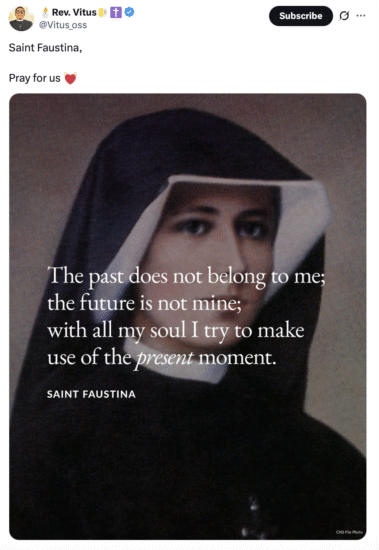
She died on 5 October 1938 in Kraków, and her tomb is now venerated at the Shrine of Divine Mercy in Łagiewniki.
On 30 April 2000, Pope John Paul II canonised Sister Faustina, establishing at the same time the Feast of Divine Mercy, to be celebrated on the first Sunday after Easter. Today, her relics are venerated at the Sanctuary of Divine Mercy in Łagiewniki, Kraków.
Source: Dzieje, Gość Niedzielny
Photo: @JacekWronaCBS
Tomasz Modrzejewski