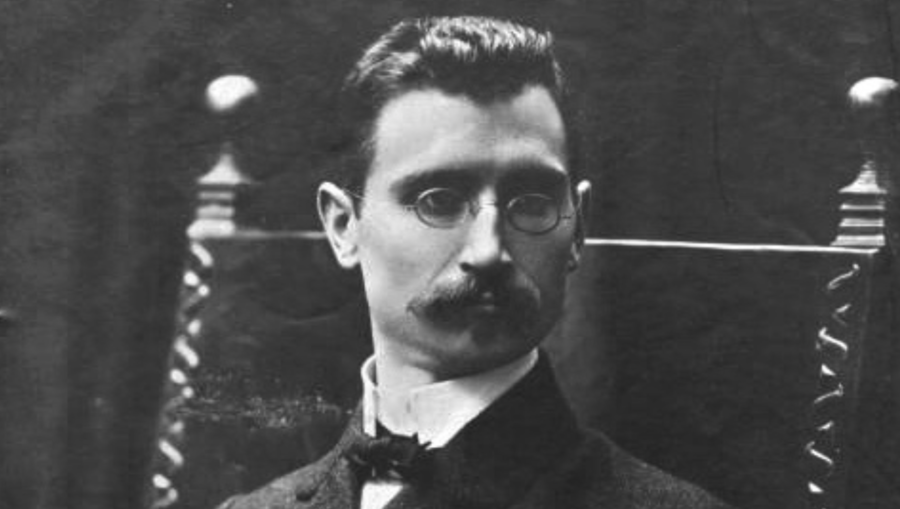
Romuald Traugutt, born on January 16, 1826, in the borderlands of the former Polish–Lithuanian Commonwealth, occupies a very special place in Poland’s historical imagination. A professional officer of the Russian army who ultimately turned against the empire he was forced to serve, Traugutt became the last dictator of the January Uprising, an insurrection doomed militarily, yet victorious in the realm of memory and patriotic spirit.
Raised in Szostakowo, today in Belarus, Traugutt grew up under the moral influence of his grandmother, Justyna Błocka, who shaped his sense of duty and national consciousness. Though academically gifted, he failed to secure admission to an elite engineering institute in St Petersburg.
Instead, he embarked on a military career, one that would sharpen his organisational skills and expose him to the realities of imperial power.
He served in the Imperial Russian Army for years, including during the suppression of the Hungarian revolution of 1848–49 and later in the Crimean War. Decorations, promotions, and a teaching post in St Petersburg followed.
Traugutt married Anna Kościuszkówna, who was the love of his life. She was a very close relative to the greatest Polish hero of the pre-Napoleonic era, General Tadeusz Kościuszko, who was a veteran of fights against the Russians and the American Revolutionary War.
Yet personal tragedy, most notably the death of his wife and children, marked a turning point. Disillusioned and emotionally broken, Traugutt resigned from the army in 1862, retreating briefly into private life.
When the January Uprising erupted in 1863, Traugutt was initially sceptical. Like many moderates, he doubted the wisdom of an ill-prepared armed struggle. But history would soon draw him in. Once committed, he proved relentless. By October 1863, he had assumed full leadership of the insurrection, operating in deep secrecy in Warsaw under a false name.
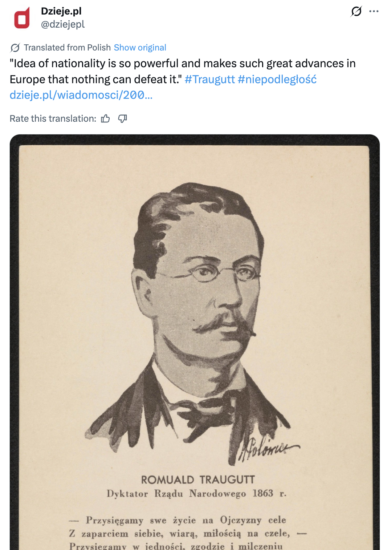
Traugutt attempted what few before him had dared: to impose discipline, hierarchy, and moral clarity on a fragmented resistance movement. He restructured its military command, enforced civil administration, and upheld the promise of peasant emancipation, an act that linked national independence with social justice.
“The sole and true aim of our uprising is the recovery of independence and the establishment in our land of an order founded upon Christian love, respect for the law, and every form of justice,” Traugutt said to describe the aim of the January Uprising.
At the same time, he sought foreign support, believing that Poland’s cause was inseparable from the broader European struggle for national self-determination.
“The idea of nationality is so powerful, and is making such great strides across Europe, that nothing can overcome it,” Traugutt famously wrote during the Uprising, explaining the meaning of creating new nation-states around Europe.
His arrest in April 1864 ended any realistic hope of victory. Interrogated and condemned, Traugutt refused to compromise his comrades.
He faced execution with composure, affirming his belief that nations could not be erased by force alone. His death on the slopes of the Warsaw Citadel transformed him from a failed insurgent leader into a moral authority.
His characteristic glasses were preserved and kept as a relic among Polish patriots who fought other wars and uprisings that led to the recreation of independent Poland in 1918.
In later decades, Traugutt’s legacy grew. To Józef Piłsudski, he embodied the fusion of sacrifice and realism, a man who lost a war but clarified its meaning.
Though the January Uprising collapsed, the values Traugutt represented endured, helping to shape the political imagination of a nation that would one day reclaim its statehood.
The beginning of the 2 World War stopped an initiative to proclaim Traugutt a blessed servant of God within the Catholic Church.
Even today, he remains an important person among Polish intellectuals.
Dr Paweł Milcarek wrote in his text about Traugutt’s legacy:
“How do we look at Traugutt, and what image of him lives in our imagination? In his famous account of the execution of the members of the National Government, Mikołaj Berg wrote in Notes on the Polish Uprising that our patron conducted himself in his final moments with exceptional composure, all the more striking against the background of other, very human reactions. We also read that, placed beneath the gallows, he folded his hands and raised his eyes to heaven at the last moment—and remained frozen in that posture even as he was hanged.”
“This image alone carries a reason for respect and a powerful, instructive message. And yet how easy it would be to turn even this into a flat, cut-out symbol. One must not do that to a man who was, in reality, as profoundly multi-dimensional as Traugutt,” Dr Milcarek wrote.
Another Polish author, Tomasz Łysiak, wrote:
“The English are said to claim that a gentleman takes up only lost causes. Judged by this measure, Romuald Traugutt, who on 17 October 1863 became the last dictator of the January Uprising, was a gentleman a hundredfold. (…) In assuming leadership of a failing insurrection, Traugutt not only breathed new life into it but also left behind a legacy of unbreakable resolve. The Tsarist gallows proved powerless to destroy that spiritual strength. The year 1918, too, stands in part to Traugutt’s credit.”
Photo: X@ckpide
Tomasz Modrzejewski