On 14 December 1945, in a park in Łódź, the body of a young woman was found lying in the winter cold. She was twenty-four years old. Her name was Maria Tyrankiewicz, a stomatology student, a member of a generation that had survived the German occupation only to discover that peace had arrived wearing a different uniform. When her hand was opened, a button from a Soviet military coat lay clenched in her fingers.
Nothing else needed to be said.
Poland was officially “liberated.” The war was over. The slogans had changed. The terror had not.
Maria’s death occurred in a moment of dangerous transition, when the world’s attention had already moved on and Poland’s suffering was expected to fall silent. The Red Army stood triumphant. The new authorities promised order, reconstruction, and justice. In reality, they delivered arrests, disappearances, rape, intimidation, and the systematic dismantling of Polish independence. Those who had survived six years of German occupation were now instructed to accept their fate quietly, to be grateful, to forget.
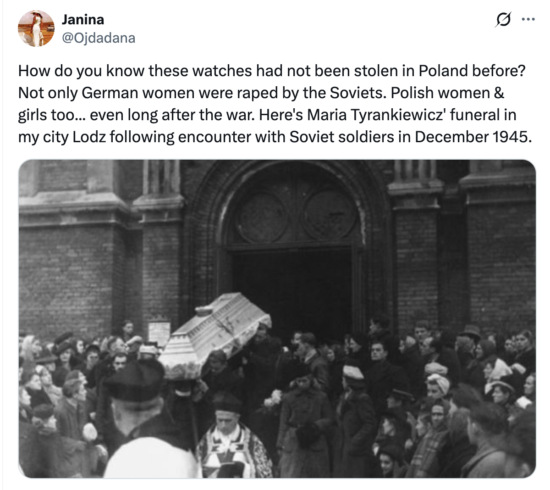
Maria did not forget. Whether in resistance or desperation, whether as evidence or defiance, the button in her hand became a final testimony. It transformed her death from an anonymous crime into an accusation. It named the presence that could not be named publicly. It contradicted the official narrative that no violence existed beyond what the state acknowledged.
Her funeral proved that the lie would not hold.
What should have been a quiet burial became a public reckoning. Mourners did not gather merely to grieve a young woman taken too soon. They gathered because they recognized themselves in her fate. Because they understood that her death was not an aberration, but a warning. The procession turned into a protest not through speeches or slogans, but through sheer presence. Through numbers. Through the courage of standing together in a moment when standing alone meant disappearance.
This was how resistance survived in postwar Poland: not yet organised, not yet armed, but morally awake. Funerals became the last spaces where truth could still gather without permission. Where grief doubled as testimony. Where the dead spoke because the living were not yet allowed to.
Maria Tyrankiewicz did not live to see Poland free. She did not see the lies unravel decades later. She did not hear the names of her killers debated or denied. But she left behind something the occupiers could not erase. A symbol small enough to fit in a clenched hand, yet heavy enough to expose an empire’s hypocrisy.
Her story matters because it reminds us that December 1945 was not peace for Poland. It was a continuation of occupation by other means. It reminds us that Soviet terror was not theoretical, nor limited to prisons and forests, but present in parks, streets, and the lives of young women whose futures were deemed expendable.
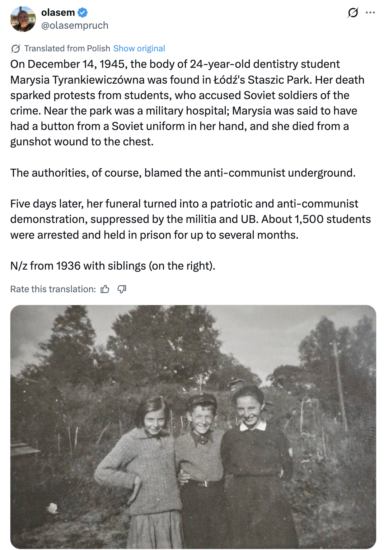
Above all, Maria Tyrankiewicz matters because she was ordinary. A student. A daughter. A
young woman with plans. History is not only shaped by generals and treaties, but by those whose lives are broken in silence and later remembered in defiance.
Her funeral on 19 December was not merely a farewell. It was a refusal. And in postwar Poland, refusal itself was an act of courage.
Edward Reid, an American historian who specialises in WWII
Photo: IPN