Poland is adopting a deliberately cautious stance towards the Peace Council initiative announced by the United States, signalling openness to dialogue while firmly rejecting any immediate legal or political commitments. Officials emphasise that decisions of such magnitude must be grounded in constitutional compliance, detailed legal scrutiny and a clear understanding of the initiative’s long-term implications for Poland’s foreign policy.
Speaking on behalf of the President, Minister Marcin Przydacz stressed that Poland requires additional time, information and in-depth analysis before determining whether participation in the proposed body would be appropriate. He underlined that any international agreement involving Poland must fully respect the Polish Constitution and domestic legislation, and cannot bypass established ratification procedures.
The Peace Council was announced in mid-January by US President Donald Trump and was initially presented as a mechanism to oversee transitional governance arrangements in the Gaza Strip.
Subsequent reports and leaked draft documents, however, suggest that the concept may evolve into a broader international organisation focused on conflict resolution on a global scale. This apparent shift in scope has raised questions among policymakers and analysts, particularly regarding its legal status and relationship with existing international institutions.
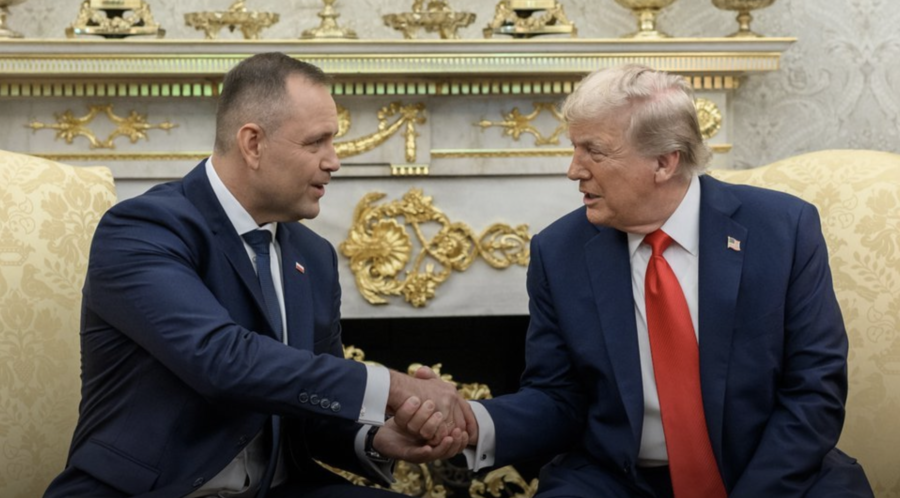
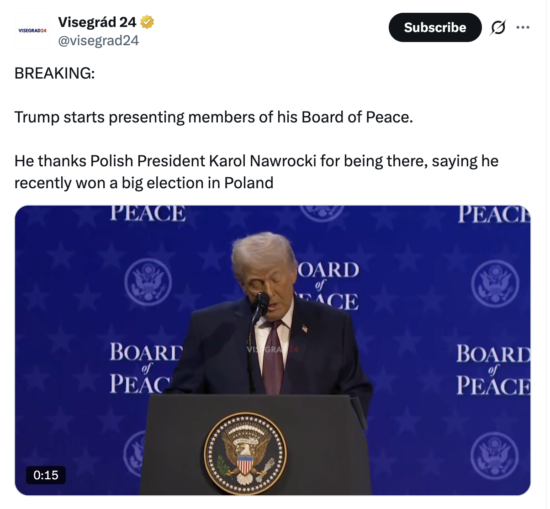
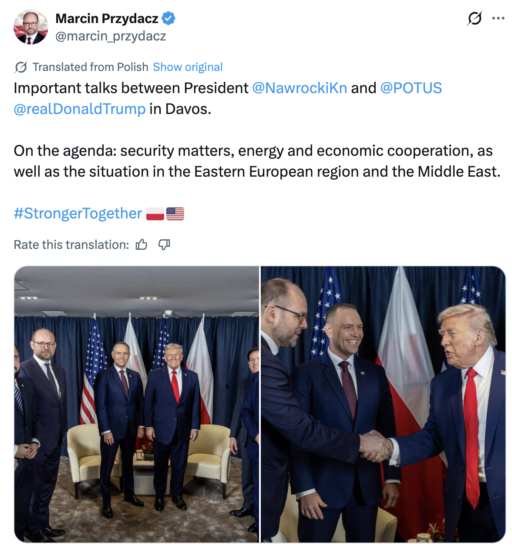
Polish President Karol Nawrocki was among the leaders invited to attend a meeting in Davos related to the Council’s formation. While his presence was confirmed, Polish officials made clear that it would not involve signing any protocol or making binding declarations.
According to the presidential administration, participation in the meeting should be interpreted as an expression of political interest and willingness to engage in discussions with the United States, particularly on issues related to the Middle East.
Przydacz explained that symbolic gestures, such as attendance at an inaugural event, do not equate to the initiation of formal accession procedures. He reiterated that Poland is not entering the Peace Council process at this stage, but remains attentive to the initiative’s development and potential implications.
Legal considerations, he noted, are central to the decision-making process, as any international agreement would require parliamentary approval and subsequent ratification by the President.
He also confirmed that the Presidential Office had received a preliminary assessment from the Ministry of Foreign Affairs. While the ministry reportedly described the initiative as “interesting”, Przydacz criticised the lack of a more substantive position, arguing that foreign policy decisions cannot be based on vague or non-committal evaluations.
He suggested that the government had avoided taking clear responsibility, effectively shifting the burden of analysis onto the presidential administration.
At the same time, Przydacz sought to dispel concerns that Poland’s cautious approach might signal tension in relations with Washington. He described the recent conversation between President Nawrocki and President Trump as constructive and substantive, noting that firm assurances were given regarding Poland’s security.
According to him, there has been no change in US policy towards Poland, including commitments related to defence guarantees and the continued presence of American troops on Polish territory.
The Peace Council proposal has sparked broader international controversy, particularly amid concerns that it could function as an alternative to the United Nations. These concerns were reinforced by remarks from President Trump suggesting that the new body could potentially replace the UN.
Further criticism has focused on the list of invitees, which reportedly includes not only democratically elected leaders but also authoritarian figures, responsible for waging a hybrid warfare against Poland, such as Vladimir Putin and Alaksandr Lukashenka.
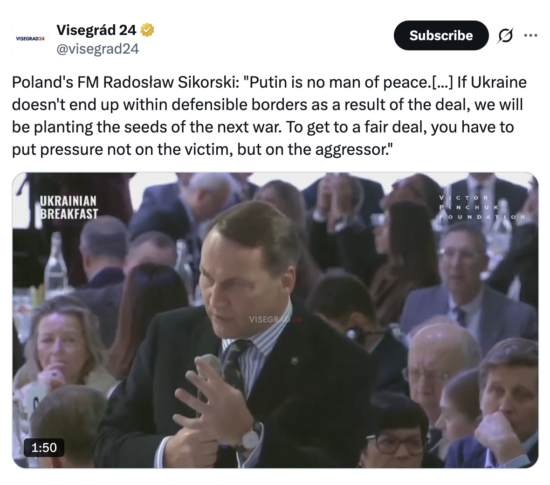
Against this backdrop, Polish officials stress that prudence and procedural integrity must prevail. While Poland values its strategic partnership with the United States and remains open to dialogue on international peace initiatives, it insists that any formal engagement must be preceded by careful evaluation.
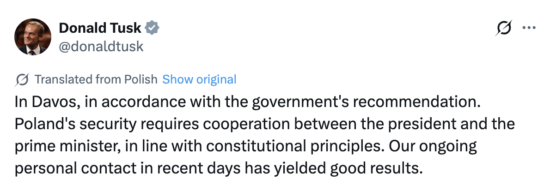
“In Davos, in line with the government’s recommendation,” Prime Minister Donald Tusk commented on platform X. He stressed that Poland’s security requires cooperation between the President and the Prime Minister in accordance with constitutional principles. “Our ongoing personal contact in recent days has produced good results,” the head of government emphasised.
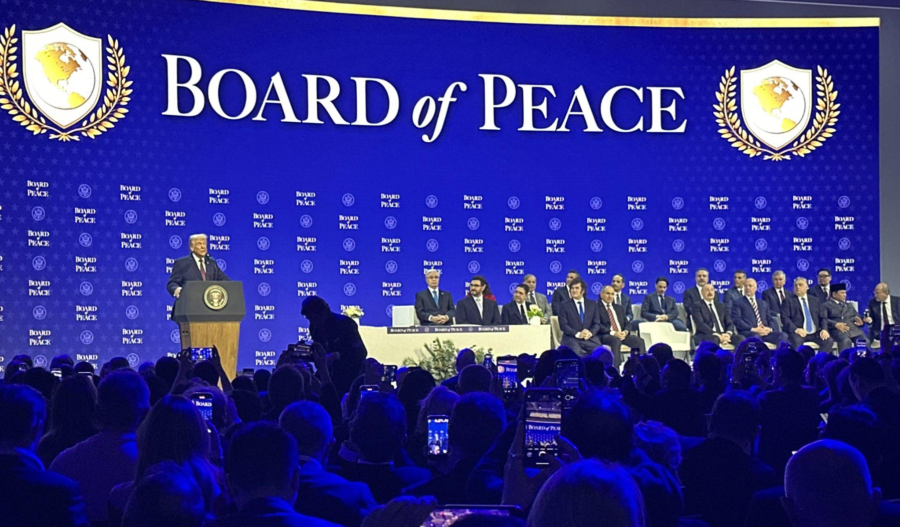
US President Donald Trump inaugurated the Peace Council. Representatives of 19 other countries, including Hungary, Bulgaria and Argentina, took part in the ceremony to sign the founding document. Officials from Russia and most European countries were absent.
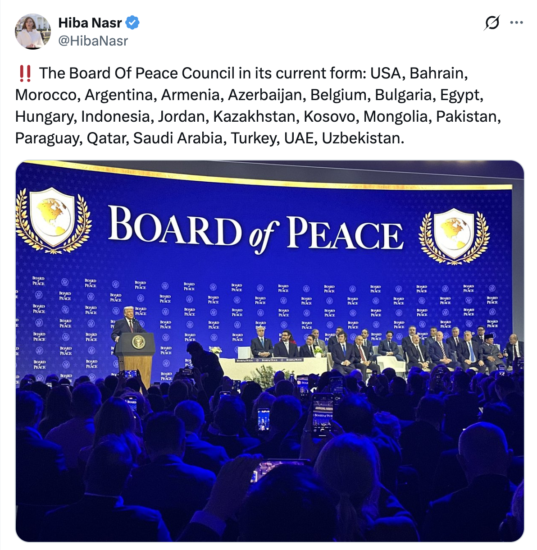
Trump stated that the Council would cooperate with the United Nations in resolving conflicts around the world. He added that the UN has “enormous potential” that has not yet been fully utilised.
Photo: X/@HibaNasr
Tomasz Modrzejewski