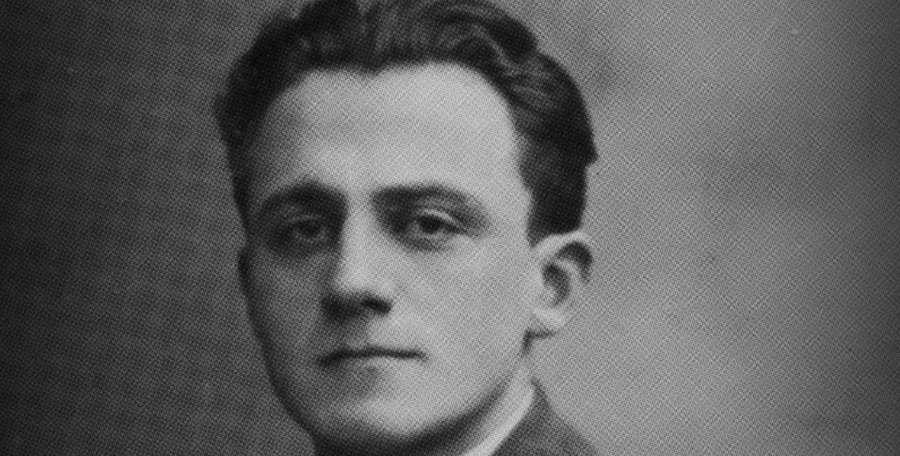
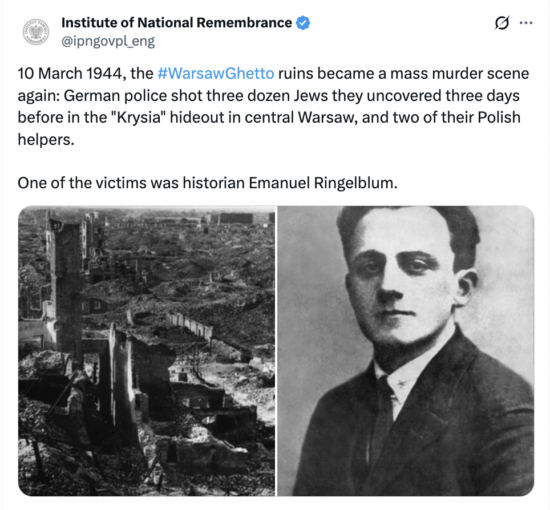
Few historians have shaped our understanding of the Holocaust as profoundly as Emanuel Ringelblum. A scholar, teacher and social activist, he devoted his life not only to studying Jewish history in Poland but also to ensuring that the tragedy unfolding during the Second World War would be documented for future generations.
Ringelblum was born on 21 November 1900 in Buczacz, then part of Eastern Galicia. His early life was marked by the upheavals of the early twentieth century. Following the Russian Revolution, his family fled the advancing Bolsheviks and settled in the southern Polish town of Nowy Sącz. The experience of displacement and political turmoil would later shape his sense of historical responsibility.
In 1922, he began studying history at the University of Warsaw, quickly distinguishing himself as a talented researcher. His doctoral dissertation, completed in 1927, examined the early history of Jewish life in the Polish capital and was titled Jews in Warsaw from the Earliest Times to 1527. After receiving his teaching diploma the following year, Ringelblum worked as a history teacher at the Jehudyjah Gymnasium in Warsaw.
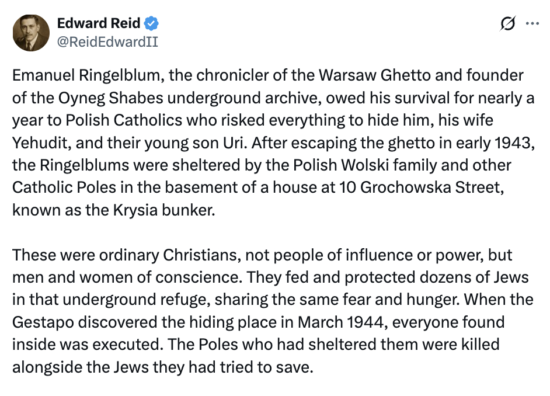
His scholarly interests were closely connected with social engagement. He collaborated with the Central Jewish School Organisation (CISZO), which operated secular Yiddish-language schools, and he was active in the socialist-Zionist movement Poale Zion–Left. In 1929, he helped establish the Warsaw Commission for the History of Jews in Poland, associated with the Jewish Scientific Institute (YIVO) in Vilnius. By the late 1930s, he had already published more than a hundred scholarly articles and studies, including his 1938 book Jews in the Kościuszko Uprising.
That same year, he became involved in humanitarian aid for Polish Jews expelled from Nazi Germany and stranded in the border town of Zbąszyń. This combination of scholarship and social commitment characterised his entire career.
When Germany invaded Poland in September 1939, Ringelblum helped organise civil defence in the Jewish districts of Warsaw. Under occupation, he continued his social work through Jewish relief organisations, including Jewish Social Self-Help, which he co-founded in 1940.
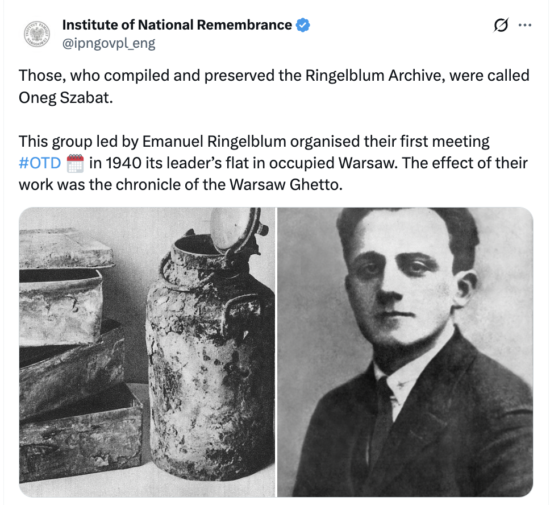
At the same time, he began systematically recording what was happening to the Jewish population. By October 1939, he was already collecting testimonies and documents about the persecution of Jews. Gradually, this effort evolved into a far more ambitious project: the creation of a comprehensive historical record of Jewish life and destruction under German occupation.
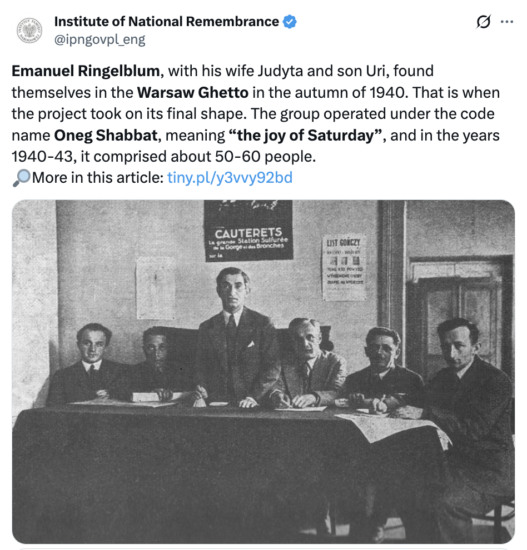
To achieve this goal, Ringelblum organised a secret research group known as Oneg Shabbat (“Joy of the Sabbath”), which met regularly beginning in November 1940 in his apartment on Leszno Street in the newly sealed Warsaw Ghetto. The group gathered a remarkable range of materials: diaries, letters, official decrees, underground newspapers, reports from other ghettos, and testimonies describing deportations and massacres.
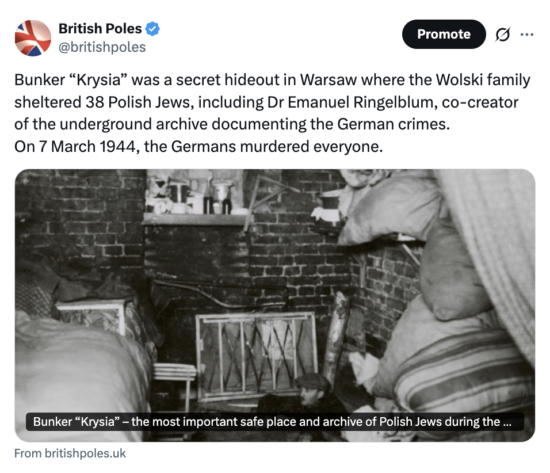
Ringelblum also wrote down his memories of Polish aid to the persecuted Jewish compatriots:
“Taking into account the particular conditions in Poland, we must regard the conduct of that part of the Polish intelligentsia, workers and peasants who hide Jews in their homes as exceptionally noble, consistent with the traditions of tolerance in the history of Poland.”
“Such help was rarely an individual act; usually the entire family knew about it, as did neighbours and sometimes even the whole building. This increased the risk, but also the scale of the phenomenon.”
“Twice during the present war I owe my life to the help of Poles: once in the winter of 1940, when the blessed hand of the Polish Underground saved me from certain death; the second time when that same hand pulled me out of an SS labour camp, where death awaited me from an epidemic or from a Ukrainian or SS bullet.”
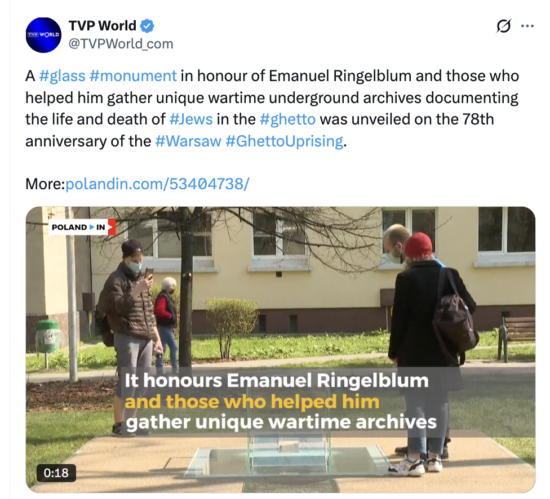
The archive they created, now known as the Ringelblum Archive, became one of the most important documentary sources on the Holocaust.
Ringelblum himself described the spirit of the group in his chronicle of the ghetto:
“Oneg Shabbat is not an association of scholars competing with and fighting one another, but a unified corporation, a brotherly union in which everyone helps one another and strives towards the same goal. For long months, they sat at one table: the devout Rabbi Huberband next to the left-wing Poale Zionist Hersz Wasser and the General Zionist Abraham Lewin…
Every collaborator of Oneg Shabat knew that his toil and torment, his hard labour and suffering, his constant exposure to danger twenty-four hours a day in the hazardous work of moving materials from place to place served a great idea which society, in the day of freedom, would know how to appreciate and reward with the highest distinctions that will exist in a free Europe.”
The members of Oneg Shabbat understood that they might not survive the war. Their work was therefore an act of historical resistance: preserving truth in the face of annihilation. By burying the documents in metal boxes and milk cans, they ensured that the voices of the Warsaw Ghetto would not disappear with its destruction.
Today, the Ringelblum Archive stands as one of the most powerful testimonies to the intellectual courage and moral determination of those who sought to record history even in the darkest of times.
Photo: IPN
Tomasz Modrzejewski