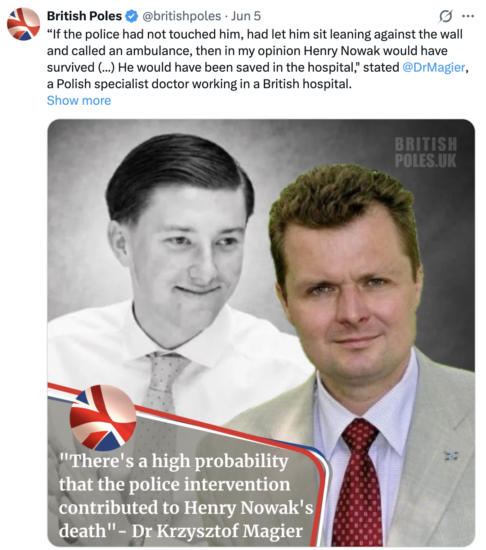
The Daily Telegraph, deeply moved by the killing of Henry Nowak, commissioned an article from Dr Krzysztof Magier, a Polish specialist doctor, who had previously revealed evidence suggesting that the injured man had been treated improperly by the police. Dr Magier argued that, had it not been for the police intervention, Henry Nowak would have had a very strong chance of survival.
We publish the full article below.
At the sentencing hearing the judge’s sentencing remarks quoted the pathologist’s expert report that Henry Nowak’s fatal chest wound, which injured an “important vein behind the collar bone,” was so serious that “he would not have survived, however quickly he received first aid, CPR or expert medical treatment.”
The police body-cam recording of the arrest shows Henry not only conscious but also speaking to the police.
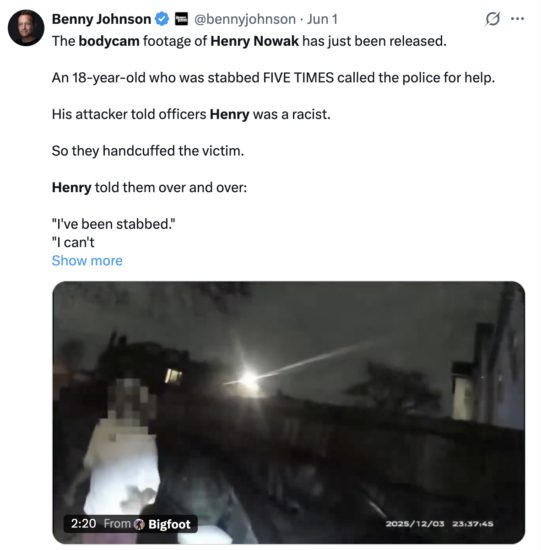
Based on my knowledge of trauma and trauma management, I believe the pathologist’s statement to be incorrect. On Wednesday, 3rd June 2026, I posted this short opinion on X, formerly Twitter and it that attracted considerable attention.
I am not a trauma surgeon and I do not deal with stabbings every day. I am a general paediatrician with a special interest in paediatric critical care. I am the lead for paediatric critical care in my hospital. I have also attended high-quality trauma courses, including an Armed Medical Services training day and a three-day Advanced Paediatric Trauma course. This does not make me an expert in trauma but I consider my knowledge above average.
Let us take a look at trauma management in the UK.
One little-known fact is that the British Army achieved the lowest trauma mortality rates in Afghanistan and Iraq. Their management of battlefield trauma was the best in the world. The experience, skill and procedures were successfully transferred to a civilian setting. After the creation of the Major Trauma Centre network, the mortality rate from trauma in England has decreased considerably.To put things into perspective, the mortality rate of any chest stabbing is under 5%, and one London major trauma centre study of 938 stabbing cases reported a mortality of under 1%.
In cases where the stabbing injures the subclavian vein, the statistics are worse. The mortality rate is closer to 45–50% but still far from 100%. Interestingly, the reported mortality for subclavian vein injuries in patients who reach hospital alive is lower — around 5–30%. Although such injuries are uncommon and statistics are limited, the medical data does not support the view that a serious subclavian injury is inevitably fatal.
The doctor on an air ambulance can provide a much higher level of care than an average paramedic team; it is comparable to initial in-hospital management. If he finds a victim alive, the situation is similar to the victim reaching the hospital alive.
For this reason, I believe that if the police had believed Henry and called for an air ambulance immediately, he would have had a good chance of survival.
The difficulty or delay in repairing the ruptured vein is less critical here. The loss of function of one lung can be survived, too.The most important factors are maintaining circulating blood volume and controlling pressure in the chest cavity. Injury to the lung with bleeding into the pleural space can rapidly increase pressure on one side of the chest, compressing the mediastinum and impairing heart function. This is why paramedics may insert a thick needle between the ribs to decompress the chest and a doctor may insert a chest drain.
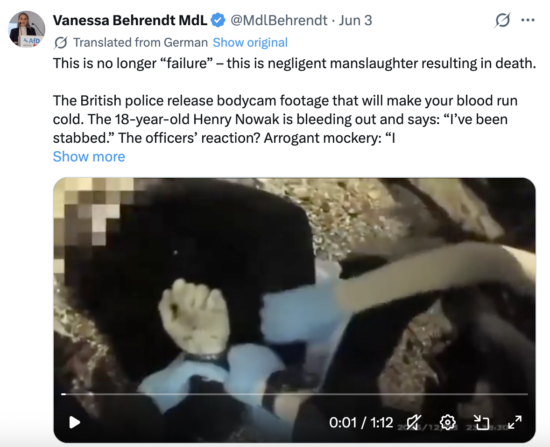
Another important issue is the handling of stab victims or those who suffer internal bleeding.
Bleeding from injured vessels is initially slowed by vessel contraction (in arteries) and the formation of a “primary clot.” In venous bleeding, the lower pressure means the clot can also slow haemorrhage. We avoid rough handling that might dislodge the clot, and we even administer fluids and blood more cautiously than usual to avoid raising blood pressure suddenly and “flushing” the clot away. There is no doubt that pulling one’s arms backwards stretches the collar bone and the vein behind it.
The day after I published my post on X, HM Coroner ordered a full inquest before a jury into the circumstances of Henry’s death. This is an excellent decision. The Coroner’s Court will hear evidence from the best experts in the field on the management of stab wounds and the quality of the treatment that Henry received. The jury will then make an independent decision.
My role, as a modest general paediatrician with an interest in trauma, has now ended.
Dr Krzysztof Magier MD PhD FRCPCH
From the editor: A petition has appeared online: Demand justice for Henry Nowak: charge the officers, publish the findings.” More than 224,000 people have already signed the petition, demanding justice for Henry.