
15 August – in commemoration of the victorious Battle of Warsaw in 1920 – is celebrated as the Armed Forces Day of the Republic of Poland. The triumph of the Polish Army over Soviet Russia was of decisive importance for both Poland and Europe. On this occasion, President Karol Nawrocki, the Commander-in-Chief of the Polish Armed Forces, delivered a speech. We published its full text here.
Below, we present its translation into English.

Dear Heroes of our time, Soldiers of the Polish Armed Forces,
Officers led by the Chief of Staff of the Polish Armed Forces, General Wiesław Kukuła,
Dear People of Poland, Brothers, Fellow Citizens – Ladies and Gentlemen present with us today in Warsaw, eager to pay tribute to our outstanding Servicewomen and men,
Honourable Mr Speaker,
Mr Prime Minister,
Mr Minister, Deputy Prime Minister,
Ministers,
Excellencies, Eminences,
Generals, Officers, Soldiers of foreign corps deployed by our Allies!
The Poles’ grand victory over the Bolsheviks in 1920 left us contemporaries with a beautiful and important lesson, a profound legacy and a testament that we must read and construe. Every year on 15 August, the spirit of the victors and of proud nation ready to fight for the supreme values we cherish, regardless of the odds, is renewed in us.
It is on the 15 of August that the great spirit of freedom and victory is rekindled in us every year. August itself is a very significant month, as in 1920 we managed to overcome the anti–civilisation of the Soviet Bolsheviks. This was a meaningful victory for Poland, Europe and the world. Then, in August 1980, it was here in Poland that we said a loud 'no’ to the communist system, for the sake of Poland, Europe and the world.
The victory over the Bolsheviks in 1920, which came at a great cost in blood, speaks to us, speaks to me as President of the Republic of Poland and to the entire political class. It clearly tells us that independence is a precious commodity, but also that it comes at a great cost, and that nurturing independence is our paramount responsibility today. Regardless of whether we fought for independence before 1918, in 1920 or whether we live in Poland now in peace and ease. We must make every effort and use all available resources to ensure Poland’s safety and enable the Polish Army and Polish Armed Forces to develop and modernise. We must also increase the number of Polish soldiers. We should quickly become not the third, but the strongest army in the North Atlantic Alliance in Europe. This is what I will strive for as President of Poland in the coming years.
The lesson of victory from 105 years ago tells us, My Dear Compatriots, Dear Soldiers, that we won thanks to unity, thanks to community, not only the community of all political parties and groups from 1920, united in the government of national defence, but also thanks to the fact that Polish peasants stood up to fight the Bolsheviks.
Polish peasants stood up alongside Polish students, scouts, and patriots. Professional soldiers, who had fought for independence in 1918 and again in 1920, stood up. Alongside them were volunteers — young people with a love for Poland and freedom in their hearts. This is a lesson we must all learn today.
Indeed, security cannot be a subject of political dispute. Never. And I will not allow this as President of the Republic of Poland, because we must ensure security for everyone, and it is delivered by soldiers, including those with different political views, the ones who make different decisions at the ballot box. Only unity and community give us the strength to build our resilience system, our security system. That is why we must work together with the Government, with the Prime Minister and the Deputy Prime Minister, to examine the strategic, fundamental documents of the National Security Strategy. I firmly believe that the only emotion that will be present in the new National Security Strategy and its implementing documents will be that of the Polish raison d’état. There will be a clear declaration of defence of every centimetre, every scrap of Polish soil, because Poland is one, and the Vistula River is not its border. The National Security Strategy must also consider the social expectations of Polish citizens, who want to feel completely secure in the years and decades to come. It is for their security that Polish soldiers serve.
I will also consistently build unity around the Security Constitution for the Republic of Poland. Yes, I will carry out my plan. I will strive to achieve this – and I encourage the Prime Minister today to act likewise – so that we can sign a commitment between the President and the Prime Minister transcending political lines. I sincerely hope that every future president and every future prime minister will follow the suit.
The Security Constitution for the Republic of Poland will give us an assurance that the development of our defence system is moving in one direction, despite the dynamics of military processes around the world, for years, and perhaps for decades to come. When it comes to our allied tasks, to our firm commitment to expansion of our Armed Forces and the modernisation of the Polish Army, we must all stand together, not just for years, but for decades. The Polish Armed Forces cannot function at intervals marked by parliamentary elections or even presidential elections. It must be the foundation for the development of our Republic.
My Dear Ones!
The victory over the Bolsheviks in 1920 taught us another valuable lesson. The lesson is that neither today’s neoimperial Russia nor Russia in general is invincible since today’s Russia does not differ that much from the Soviet Russia. The heroes of 1920 proved that. I want our officers and soldiers to hear this today.
Russia is not invincible. It lost to Japan in the early 20th century, was beaten by Poland in 1920 and is now bogged down more than three years after its attack on Ukraine. This is thanks to the support of its allies and the solidarity of free nations, including Poland.
Ladies and Gentlemen!
Russia is, of course, a permanent threat, and this may never change. However, I will reiterate that our history, national memory and our modernisation efforts must reaffirm our belief that we can build our potential, feel safe and recognise that our main enemy is not invincible. I say this because our hopes for building a peaceful and secure Poland are placed in us – in me, in the President of Poland, in the Polish Government, in you, Minister, and in the entire political class today. The security of the Polish state is in our hands and in building our potential we cannot afford to waste a single day, week or month. We also realise that if any nation’s government or society does not fund its army, the bill will eventually come due, and foreign armies will have to be funded. We do not want that.
Honourable Prime Minister,
Ladies and Gentlemen!
That is why I will be invariably calling for an end to the discussions and for a decision to be made to allocate 5% of Poland’s GDP to defence. This must happen, and it must happen as soon as possible. Polish security requires it today.
Ladies and Gentlemen!
We must also continue the modernisation of the Polish Armed Forces, which began with flying colours after 2015. That is why I also look with appreciation at Minister Kosiniak–Kamysz today and am glad that Apache helicopters have arrived in Poland. I am glad that we have begun the second stage of the Wisła air defence programme. It is very good that South Korean–made K2 tanks have arrived in Poland. However, we cannot stop here. Yes, we must create an armoured fist and we must have a thousand K2 tanks, which we need today. We must expand and modernise the Polish Armed Forces, regardless of parliamentary elections cycle and discussions in the Polish parliament. We must do what is necessary, what is needed. As President of Poland, I will also monitor the recruitment process and enrolment dynamics within the Polish Armed Forces. I am pleased that my proposal for an army of at least 300,000 Polish soldiers was not rejected, but instead led to a bidding competition. I am, of course, ready to commit to our goal of having an army of half a million if the time is right.
Ladies and Gentlemen!
Yes, we need more Polish soldiers. The litmus test and the technological and mechanical test for this process should be an effort to stabilise six Polish land divisions, including the two under construction and the two planned: the 1st Legion Infantry Division and the 8th Home Army Infantry Division. I will pay particular attention to these two divisions and support the Minister, the Deputy Prime Minister and the Chief of the General Staff of the Polish Army in their efforts to raise the largest army in the North Atlantic Alliance in Europe.
We must also bear in mind the point that the Deputy Prime Minister made: we cannot afford to sleep through the technological revolution. It is happening before our very eyes. Today, right now, all over the world and with our foreign partners, including the United States and the North Atlantic Alliance, this revolution is reaching the Polish Armed Forces, thanks to the Cyberspace Defence Forces. It is an issue to which I intend to devote a lot of time, and the Polish government can count on my support in this area. The Baltic Sea has effectively become an internal sea of the North Atlantic Alliance. We must implement the Orka Programme because the Navy have told me that we need Polish submarines and that they have been waiting for them for years, even decades. This is the direction we must follow, and it is the path I will pursue, My Dear Friends.
Ladies and Gentlemen!
I will also prioritise the establishment of an ammunition factory in Poland. We are currently in the process of building an ammunition factory, and I believe that we are ready to produce one million 155 mm artillery shells and half a million tank shells per year. I will support all legislative and formal efforts. We must have our own Polish–made ammunition. All of this, of course, is to ensure that there is no war.
All this is so that we can feel safe and not think about war, braced by the power of our national memory, history and experience of the past, as well as our modernisation efforts and the actions I intend to take in cooperation with the Polish government. Instead, we can focus on peace and the development of the Republic of Poland.
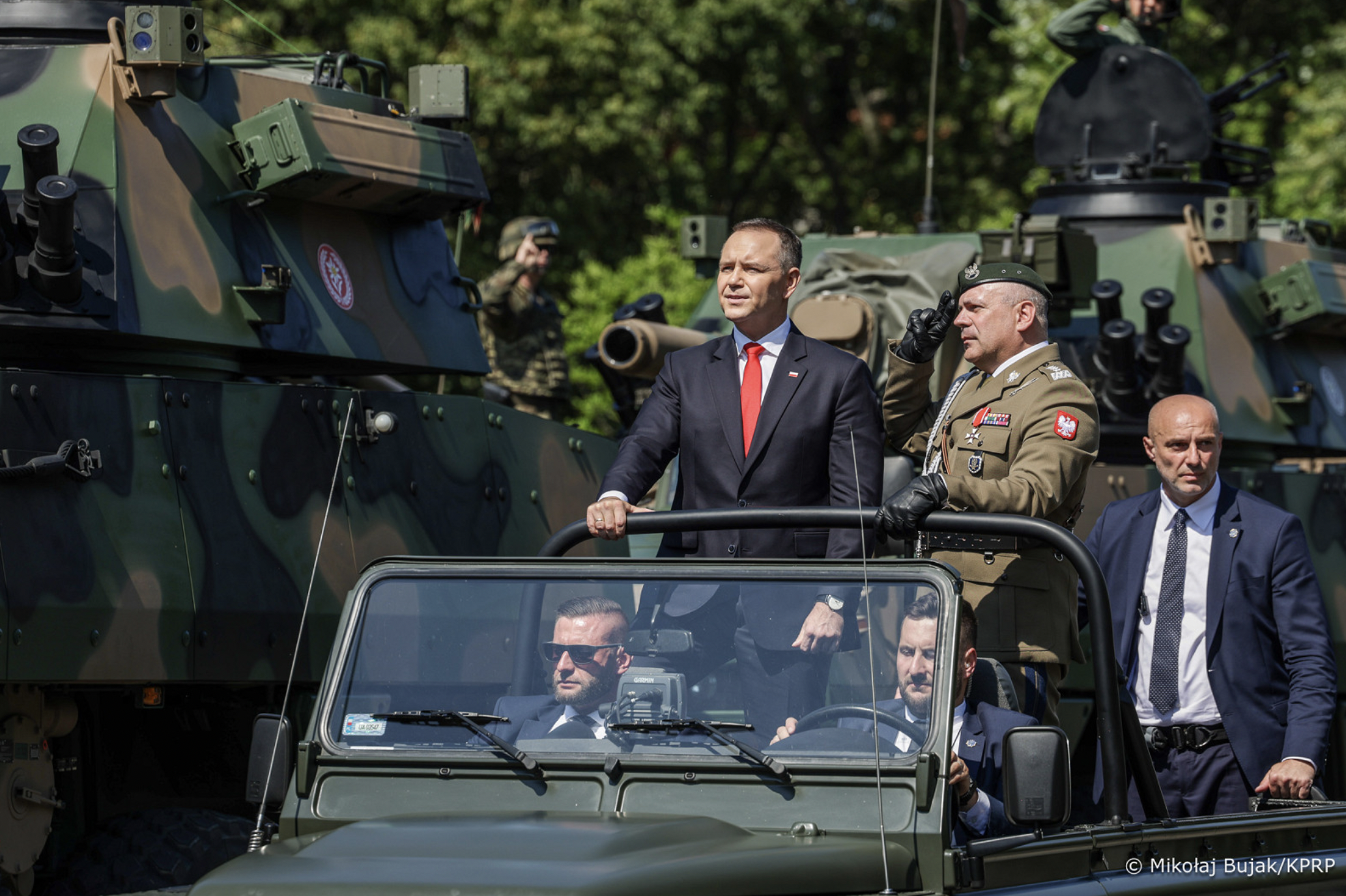
In a moment, the magnificent parade will begin. I would like to thank the Ministry of National Defence staff, officers and soldiers for making it possible. This parade symbolises that all branches of the Armed Forces are ready to serve our wonderful citizens. I am very happy to be here with you today on Polish Armed Forces Day, and I would like to take this opportunity to thank every single Polish soldier who serves the Republic of Poland. I will say it again: joining the Polish Armed Forces is an act of heroism. Yes, you are the heroes of today.
I would like to thank the soldiers, the generals, and those soldiers who cannot be with us today in Warsaw but who serve the Republic of Poland abroad. I remember those who gave their lives for Poland wearing the sacred uniform of the Polish Army.
I would also like to address and to thank the thousands of Polish women and men who are here with us today. It is you who decide on our freedom and security, because without a desire for freedom, sovereignty and independence, defending our borders and the Republic of Poland would be meaningless. You must love Poland in order to defend it and maintain strong borders.
Dear Soldiers, Generals, Prime Minister, Minister!
Honour and glory to the Heroes of 1920!
Honour and glory to the Heroes of today, the Soldiers of the Polish Armed Forces!
Long live the free, independent and sovereign Republic of Poland!
Source: www.president.pl
Photo: Mikołaj Bujak KPRP