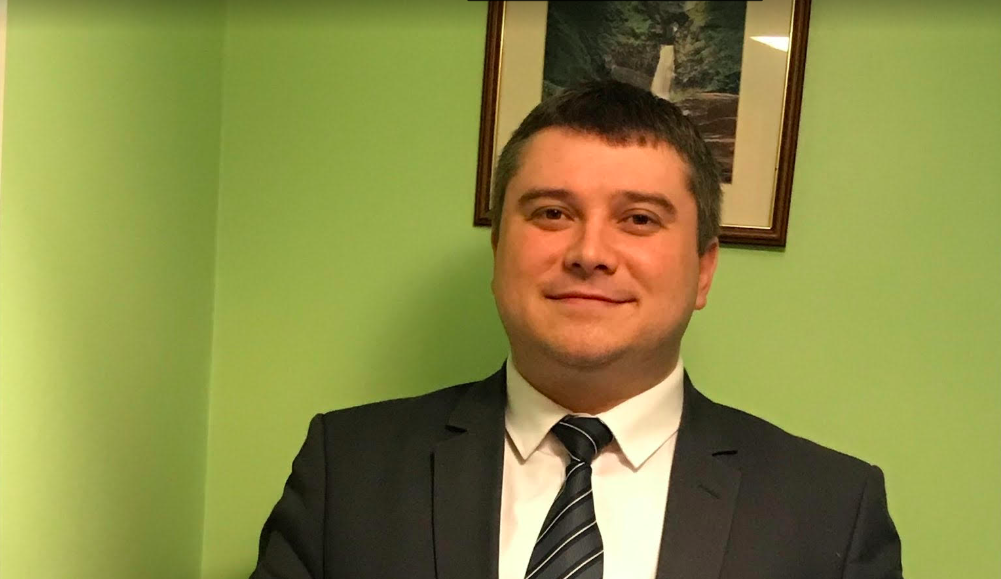
Bogusław Malinowski is an outstanding Polish sworn translator who has been working in England for over 15 years. In 2018, he won a prestigious award in a competition organised by thebigword company, thanks to which he received the de facto status of a master in his profession. Despite having lived away from Poland for so long, Bogusław Malinowski is still attached to his homeland. British Poles contacted him for an interview.
British Poles: It is pretty hard to find any information about you online. Why is it like that?
Bogusław Malinowski: It’s very simple, I don’t have a Facebook account. I only have a Twitter account. Nowadays, when someone does not have a Facebook account or on any other social network, it is not so easy to gather information regarding what that person thinks, how this person perceives the world etc. I do not do it, because I am against such technologies. But it is, I would say, less common nowadays. Therefore, it is not possible to obtain a wide range of information about me with one click. However, I assure everyone that it is possible to live and exist without it.
BP: What is your occupation?
BM: For the last 8 years I have been working continuously for the British Ministry of Justice, carrying out translation assignments in family courts, criminal courts, police stations etc. Sometimes I am called to the Ministry of the Interior. This is what I do on a daily basis and I must say that I find fulfilment in this job that gives me joy. Before English, I learned Russian from which I also translate. You could even say that it is my second language. Contrary to appearances, it is very useful when it comes to working. I also speak German. However, in England, there is no such demand for this language. I also do some private jobs not related to the Ministry of Justice.
BP: Could you give us an example?
BM: A few years ago, I did the official translation of a boxing fight contract between English boxer Tyson Fury and Vladimir Klitschko who is fighting for a German team. Everything was addressed in the document: how many seats, how many tickets will be sold and who will get what and how much, depending on who would win the match of course. Due to the fact that it was Klitschko who called on Fury, this contract was in English and had to be translated to German. That’s what I was doing. I was involved in translating for Volkswagen when they acquired a majority stake in Bentley. Another example of my past experience is doing voice-overs for industrial materials, which is quite popular in England. A lot of Poles work there, but there are also Lithuanians and Latvians. Most of them, especially the older generation, speak excellent Russian.
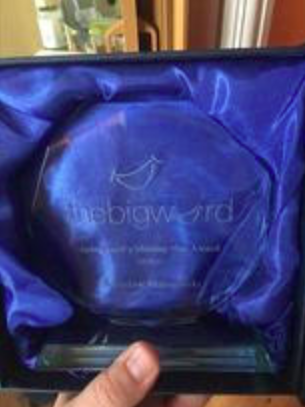
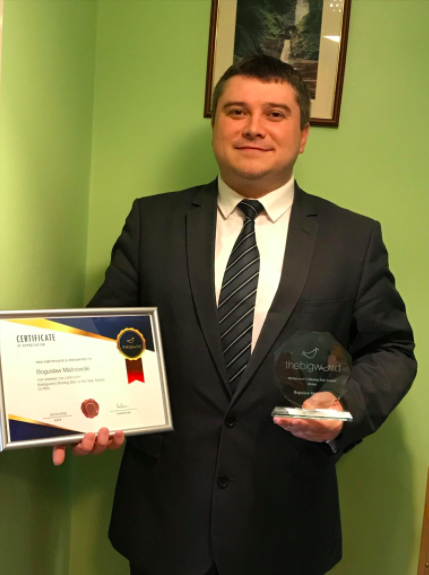
BP: In 2018 you have been awarded a very prestigious prize by thebigword company, which is a world leader in the field of interpretation and translation, cooperating with many governments and companies around the world. Could you tell us a few words about this award?
BM: First of all, I think that I should clarify what the possibility of getting into this entire system as a sworn translator looks like. First of all, you need to pass/receive the so-called DPSI 6 diploma by passing a special exam or having its foreign equivalent. This entitles you to practice. For about 12 years, the British Ministry of Justice has given up direct outsourcing of requests to translators. Instead, they outsourced and selected competition for a company to do it on their behalf. At the turn of these last years, three companies have emerged through such competitions, which are organised approximately every four years. This does not necessarily satisfy the translators, because, to simplify a bit, they earned more when they were still directly subordinate to the ministry, and now things are a little worse from their point of view.
Right now the company that holds this contract is called thebigword. Thebigword has 12 offices around the world, 1,500 employees and over 15,000 linguists. The English tbw office is located in the city of Leeds. Of course, due to the importance of these orders, this company, as well as the previous ones, is controlled and under the constant supervision of the Ministry of Justice. You have to bear in mind that these are contracts worth £ 60 million a year. Thebigword company organised a competition in 2018 to catch gems in this profession. I was actually distinguished by the opinions expressed by judges of the crown courts and magistrates about my work. In other words, I was doing my job, that is, assignments that I agreed to etc. And people who had contact with me from judges, prosecutors and attorneys sent short reports or opinions about my work to thebigword if they deemed it appropriate. There must have been enough of these reports/opinions for me to be nominated. Of course, I was informed about these reports on a regular basis, which was also encouraging.
BP: The contest organised by thebigword was not just for the UK, right?
BM: No. It was a global competition, so I couldn’t imagine that I could compete with the United States or Asia where there are a lot of translators. Individuals in designated geographic regions have been rewarded. However, to my surprise, I was awarded the most prestigious of all of these prizes.
BP: How does it feel to be recognised as “the shining star of the year”?
BM: Quite frankly, it makes me laugh a bit and I certainly didn’t expect it. On the other hand, I’m obviously proud of it, but not to an extent that it makes me crazy. My approach to work is still the same and I always try to carry out all orders at the highest professional level.
BP: Where did your passion for translating come from?
BM: I have been living and working in England since 2006. It is not that I came as a translator from the beginning. I have had various professions and activities. When it comes to my passion, my late father and my mother instilled in me to learn languages. My father came from the Eastern region of the 2nd Republic of Poland as a Pole. Having been born in 1935, he remembered the last years of World War II. Due to repatriation, he landed in Lower Silesia in 1948. His own father was murdered in the forest, most probably by a German militia, which impacted him heavily. He was fluent in Russian and also learned German. He travelled to Germany and worked there; in the 1980s he flew to the USA to earn money. My mother, in turn, was born in Lower Silesia, but it was thanks to her family that my father could travel to the USA as part of my mother’s family left for the pre-war states. All that aside, it was my parents who instilled in me the need to learn languages. Consequently, I was learning these languages, despite the fact that in the beginning, as a young man, I was a little bit reluctant. Today, I must admit with full conviction that it was the right decision.
BP: Facts say more than a thousand words. Would you consider moving back to Poland some day?
BM: „Home is where the heart is”. This quote always comes to mind when I hear such a question. It’s really hard for me to say. One thing is certain: I will never give up on Poland. Whenever there is a Polish national holiday, the white and red flag flutters on my house. Whenever I have the opportunity, I talk to people who are curious about Poland. Together with my wife, we send our children to Saturday’s Polish school as we both consider it right and we try to pass on to our children as many good Polish qualities as possible. I always try to support all initiatives of the Polish diaspora in Great Britain because I believe that united Poles are able to achieve a lot here.
BP: Thank you so much for your time.
BM: Thank you.
Photos: Bogusław Malinowski’s personal archive