This is a comprehensive study of human apathy, helplessness and despair. Poland couldn’t have chosen a better title for the upcoming Oscar nominations.
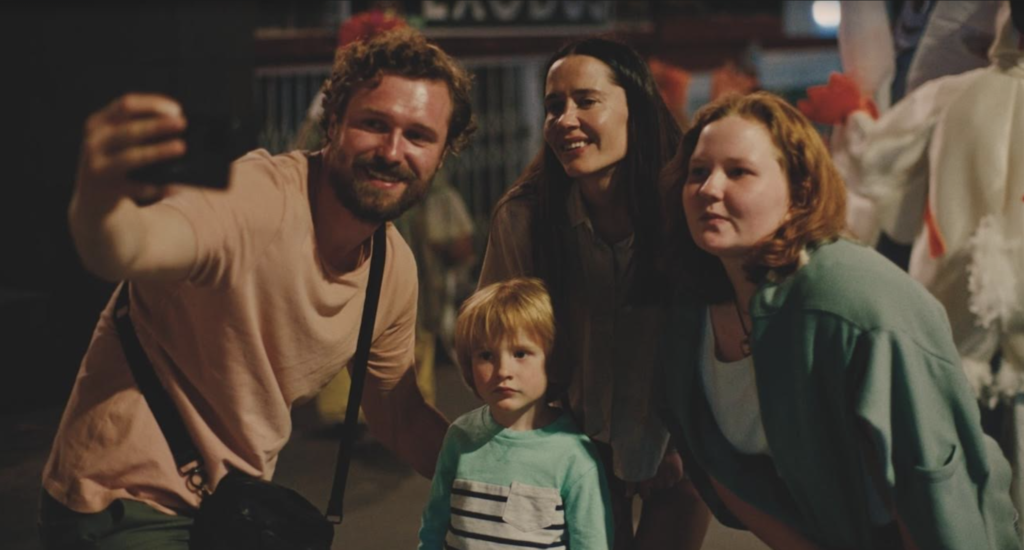
Kocur’s Under the Volcano is a poignant journey towards all our worries, impending anxieties and any other emotions related to the spectre of war that might one day also affect all of us. In the film, we meet a Ukrainian family of four (actors Sofiia Berezovska, Anastasiya Karpenko, Fedir Pugachov and Roman Lutskyi) during their vacation in Tenerife. Everything changes when they learn that they cannot return home due to the Russian invasion of Ukraine.
One might admit that Kocur’s naturalistic close-ups and his eagerness to show his heroes on the verge(s) of their breakdown(s) echo Michael Haneke’s cinema; especially his latest feature film, Happy End (2017), which also tackles – yet, in a much more harrowing way – the modern troubles of immigrants (Kovalenkos become ones as soon as the war commences). Contrarily, Kocur adores his heroes and feels for them.
“How can you even imagine having fun during this difficult time?” the father, Roman, asks his daughter, Sofia, who went to attend a Spanish parade only to ease her younger brother’s fears. If the world falls apart around us, are we even privileged to have fun? Is there any way to make ourselves feel better? While portraying the family’s extended holidays, Kocur tries to understand what exactly happens in the mind of such an absent-minded person. One that is theoretically safe, but still unable to have any sort of agency actually to do something and help their families or friends. It can be compared to the moment when we receive the news of a deadly sickness of a relative. At this moment, everything is fine for us, until it’s not. We can’t stop thinking about this, while the whole powerlessness is killing us from the inside.
When we look at the final credits, the entire unease of Roman’s family still resonates with us. The film ends, but their – and the entire nation’s suffering – sadly continues, with no actual silver linings or hope that the war will soon be finished. Thus, through his alluring cinematography, the Polish director found a plausible way to make us constantly think and feel for the Kovalenko family.
Kocur’s conclusion couldn’t have been different – this is not their war anymore. It is also our war. If we cannot comprehend such tangible suffering, even one that is the quietest and the most unseen, how can we even call ourselves “human”? Those and other painful questions will engulf your mind just after the screening ends.
Watch Under the Volcano during the London Film Festival 2024. In Poland, Kocur’s drama premieres today (on 11.10.2024).
4/5 stars
Author: Jan Tracz